How Much Would It Cost to Build a Treehouse? A Detailed Breakdown
Discover exactly how much it would cost to build a treehouse. We break down lumber, hardware, labor, and design fees for basic to luxury builds.
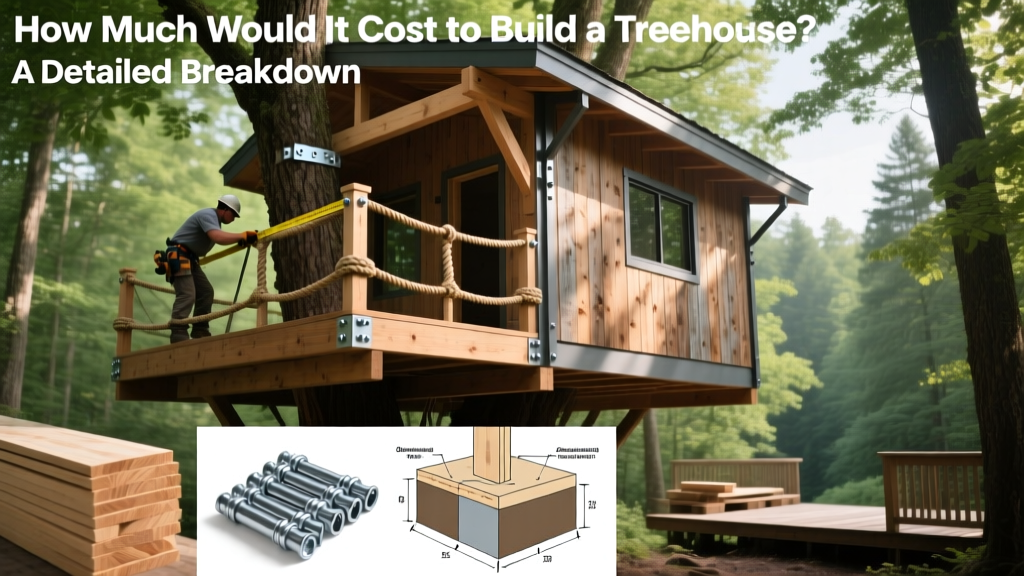
The True Cost Spectrum: From Backyard DIY to Luxury Retreat
When calculating how much it would cost to build a treehouse, the final price hinges on structural engineering, attachment hardware, and material grade. A common misconception is that treehouses are inherently cheaper than ground-level structures. In reality, building in a living, moving canopy requires specialized hardware and dynamic load calculations that drive up material costs.
Quick Cost Ranges (Per Square Foot)
- Basic DIY Platform (10x10 ft): $2,500 – $7,000 ($25 – $70 / sq. ft.)
- Mid-Range Custom Enclosed (15x15 ft): $25,000 – $60,000 ($110 – $265 / sq. ft.)
- Luxury / Glamping Retreat (20x20+ ft): $85,000 – $250,000+ ($350 – $800+ / sq. ft.)
Phase 1: Design, Arborist Consultation, and Permitting
Before purchasing lumber, you must assess the host tree. Trees grow, sway in the wind, and compartmentalize wounds differently than static wooden posts. Hiring an ISA Certified Arborist is a non-negotiable first step for any structure over 100 square feet.
Arborist and Engineering Fees
An arborist will perform a sonic tomography test or visual risk assessment to check for internal decay, root plate stability, and branch union strength. Expect to pay $150 to $300 per hour for this consultation. If your treehouse exceeds local accessory structure thresholds (often 120 to 200 square feet, depending on the municipality), you will need stamped structural plans. Architectural and engineering fees for custom treehouses typically range from $2,500 to $6,000, as engineers must account for dynamic wind loads and tree sway.
Permitting and Zoning
According to the International Code Council (ICC), most residential treehouses fall under accessory structures. However, if you plan to run electricity or plumbing, or if the structure is intended for short-term rental (glamping), commercial building codes and fire egress requirements apply. Permit fees generally range from $200 to $1,200 depending on local jurisdiction and inspection requirements.
Phase 2: Foundation and Treehouse Attachment Bolts (TABs)
The most critical failure point in treehouse construction is the attachment method. Standard galvanized lag screws are entirely inappropriate for primary support; they lack the shear strength for dynamic loads and will eventually girdle the tree, causing rot and structural failure.
Professional builders use Treehouse Attachment Bolts (TABs). A standard 1.5-inch diameter Garnier TAB, available from specialized suppliers like Treehouse Supplies, is forged from high-strength steel and features a thick boss that rests against the tree's heartwood. As the tree grows, it envelops the boss, creating a massive shear collar.
- TAB Hardware Cost: $175 to $320 per bolt.
- Quantity Needed: 4 to 8 TABs for a standard 150 sq. ft. platform.
- Installation Tooling: Requires a heavy-duty 1/2-inch or 3/4-inch drill with an auger bit and a high-torque impact wrench or breaker bar. Tool rental adds roughly $150 to $300 to the budget.
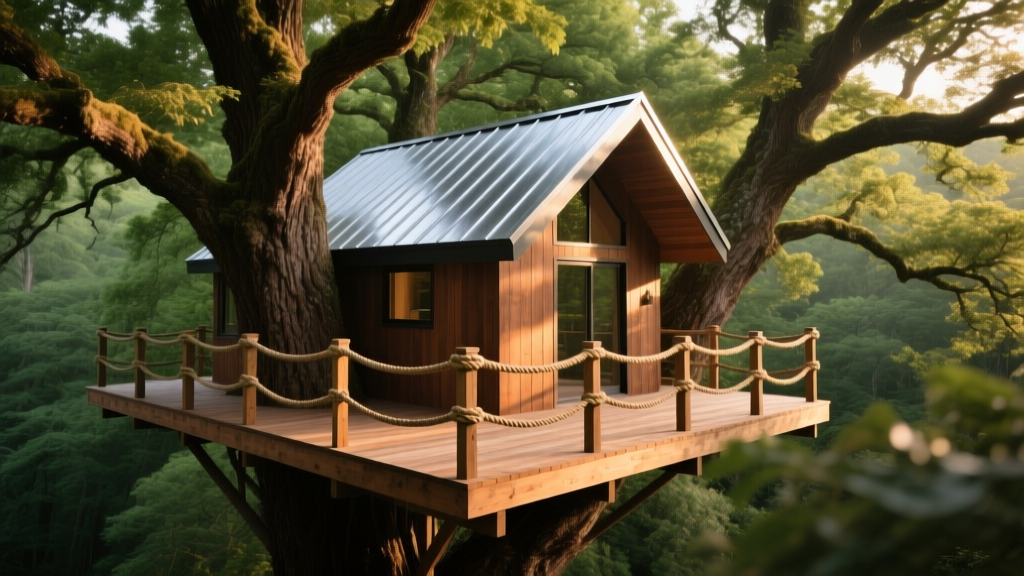
Phase 3: Framing, Decking, and Enclosure Materials
Material selection dictates both the longevity of the structure and the overall weight load placed on the host tree. Lightweight materials like cedar and composite are preferred over heavy pressure-treated pine for the upper decking.
| Component | Basic DIY Build | Mid-Range Custom | Luxury Retreat |
|---|---|---|---|
| Main Beams | 2x10 PT Southern Pine ($45/ea) | Double 2x12 Douglas Fir ($85/ea) | LVL or Glulam Beams ($250+/ea) |
| Joists (16" O.C.) | 2x6 PT Pine ($18/ea) | 2x8 Kiln-Dried Fir ($28/ea) | 2x8 Cedar or Redwood ($45/ea) |
| Decking | PT Pine Boards ($3.50/sq ft) | Tongue & Groove Cedar ($8.00/sq ft) | Trex Composite ($14.00/sq ft) |
| Wall Framing | N/A (Open Platform) | 2x4 Standard Studs ($6/ea) | 2x6 Studs + SIPs Panels ($25/sq ft) |
Phase 4: Roofing, Windows, and Finishing Touches
Roofing a treehouse requires balancing weatherproofing with extreme weight restrictions. Traditional asphalt shingles and heavy clay tiles are generally avoided due to their dead load.
Roofing Material Comparison
- EPDM Rubber Membrane: $3.50 – $5.00 per sq. ft. Extremely lightweight and ideal for flat or low-slope treehouse roofs. Requires a plywood substrate.
- Corrugated Polycarbonate: $2.00 – $4.00 per sq. ft. Very light and allows natural light, but offers poor insulation and can become brittle under heavy snow loads.
- Standing Seam Metal: $9.00 – $14.00 per sq. ft. The premium choice. Lightweight, sheds snow easily, and handles tree sway without cracking or tearing.
For windows, custom-cut acrylic or polycarbonate panes are often used in DIY builds to save weight and prevent shattering from tree movement. However, mid-to-high-end builds utilize standard vinyl double-pane windows, which cost between $250 and $600 each installed. If the treehouse will be used in winter, budget an additional $3,500 to $7,000 for closed-cell spray foam insulation and a mini-split HVAC system.
Labor vs. DIY: Where Your Budget Goes
Labor typically accounts for 40% to 60% of a professional treehouse build. Because working at heights in a confined, irregular canopy is vastly more time-consuming than ground-level framing, labor rates for specialized treehouse builders are premium, often ranging from $85 to $150 per hour.
DIY Approach
- Pros: Saves $15,000+ in labor; complete creative control.
- Cons: High risk of improper load distribution; requires advanced carpentry and rigging skills; high personal injury risk.
Professional Builder
- Pros: Engineered for dynamic tree sway; proper cambium-saving hardware; warranty on structural integrity.
- Cons: High upfront cost; lead times of 6 to 12 months for top-tier builders.
Hidden Costs and Edge Cases to Budget For
When finalizing your budget, ensure you account for these frequently overlooked expenses:
- Tree Pruning and Crown Thinning ($400 – $1,500): The canopy must be pruned to prevent branches from driving through the roof during high winds. This must be done by a professional to avoid introducing disease to the host tree.
- Utility Trenching ($25 – $75 per linear foot): If you are running water, sewer, or electrical lines from the main house to a luxury treehouse, trenching and conduit installation will add significantly to the cost. All electrical lines must be installed in flexible conduit to accommodate tree movement.
- Dynamic Sway Joints ($150 – $400 each): If your treehouse spans multiple trees, you cannot bolt the structure rigidly to both. You must install sliding sway brackets on the secondary trees to allow them to move independently in the wind without tearing the structure apart.
Expert Insight: Always design the treehouse floor plan around the tree's natural trunk taper and branch angles. Cutting large notches into the floor decking to accommodate the trunk is necessary, but you must leave a minimum 3-inch clearance gap around the trunk to allow for radial growth and wind sway. Fill this gap with a flexible rubber treehouse collar rather than rigid wood trim.
Final Budget Allocation Strategy
If you are working with a fixed budget, allocate your funds in this order of priority: 1) Arborist assessment and engineering, 2) TAB hardware and main beams, 3) Roofing and weatherproofing, 4) Interior finishes. Never compromise on the attachment hardware or the main support beams. A treehouse built with premium cedar siding but anchored with cheap lag screws is a severe safety hazard, whereas a structurally sound platform with basic plywood decking can be safely upgraded over time.
Written by
Marcus ChenMarcus Chen is a licensed structural engineer (PE) and building materials analyst with over 12 years of experience across residential, commercial, and industrial construction. He holds a Master of Science in Civil Engineering from UC Berkeley and spent six years at Thornton Tomasetti before transitioning to independent consulting and technical writing. Marcus specializes in material selection for seismic-prone regions, concrete reinforcement strategies, and lifecycle cost analysis. His work has been cited by the American Concrete Institute (ACI) and the Structural Engineers Association of California (SEAOC). When he is not on a job site or at his desk, you will find him hiking the Sierra Nevada or restoring a 1920s craftsman bungalow in Oakland, CA.
More from Marcus Chen
View all
Construction Cost
How Much Did the Eiffel Tower Cost to Build?
How much did the Eiffel Tower cost to build in 1889? We adjust for inflation and compare its budget to modern skyscraper construction.
Aug 4, 2026

Fire Resistance
What Is a Fire Resistant Material? Testing & Certification Guide
Discover what is a fire resistant material through ASTM and UL testing. Learn how fire ratings, certifications, and assemblies work in construction.
Aug 4, 2026

Construction Cost
How Much Did the Burj Khalifa Cost to Build?
How much did the Burj Khalifa cost to build? We break down the $1.5B project and extract 5 money-saving strategies for your next build.
Jul 30, 2026