Average Cost to Build a Treehouse: DIY Kits vs Custom Pro Builds
Compare the cost to build a treehouse across DIY kits, custom pro builds, and luxury estates. Includes material pricing and TAB hardware guides.
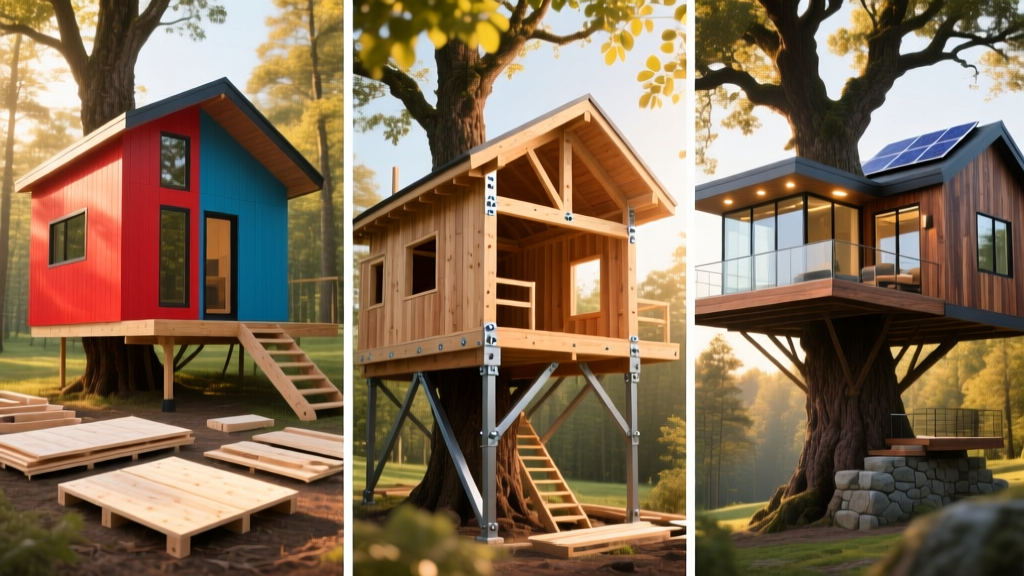
The True Cost Spectrum: From Backyard DIY to Luxury Estates
Estimating the cost to build a treehouse requires moving beyond simplistic averages. While a basic backyard platform might cost a few hundred dollars, architecturally integrated, multi-story estates routinely exceed $250,000. The primary cost drivers are the attachment methodology, lumber grade, and whether you are assembling a prefabricated kit or commissioning a custom architectural build. According to industry data compiled by Bob Vila, the national average for a professionally built, medium-sized treehouse sits between $15,000 and $35,000, but this figure obscures the massive variance between DIY and luxury tiers.
| Build Tier | Description | Average Cost | Cost per Sq. Ft. |
|---|---|---|---|
| Basic DIY Platform | 8x8 pressure-treated pine, basic lag screws, no walls/roof | $400 - $1,200 | $6 - $18 |
| Premium DIY Kit | 10x12 cedar kit, pre-cut lumber, standard hardware, basic roof | $3,500 - $8,500 | $29 - $70 |
| Custom Pro Build | 12x16+ custom design, TABs, insulated walls, composite decking | $25,000 - $65,000 | $130 - $330 |
| Luxury Estate | Multi-level, plumbing, electrical, HVAC, suspension bridges | $90,000 - $300,000+ | $450 - $800+ |
Deconstructing the Build: Where the Money Actually Goes
To accurately budget your project, you must break down the material and labor expenses. A standard 12x12 treehouse (144 square feet) requires roughly 1,800 board feet of lumber for the subfloor, decking, walls, and roof framing.
1. Lumber and Decking Materials
The choice of wood dictates not just the aesthetic, but the structural lifespan and maintenance schedule. Ground-contact pressure-treated (PT) southern yellow pine is the most economical, costing $3.50 to $5.00 per board foot. However, PT lumber is heavy, prone to warping as it dries, and requires annual sealing. Western Red Cedar and Redwood are the industry standards for custom builds, offering natural rot resistance and dimensional stability at $8.00 to $14.00 per board foot. For ultra-premium builds, tropical hardwoods like Ipe or Cumaru push material costs to $18.00 to $25.00 per board foot, but offer a 50+ year lifespan without chemical treatments.
2. The Non-Negotiable: Treehouse Attachment Bolts (TABs)
The most critical structural component of any permanent treehouse is the attachment hardware. Historically, builders used large galvanized lag screws. This is a catastrophic mistake for modern builds. Trees grow outward (secondary growth), which will slowly swallow a lag screw, creating a pocket of rot and compromising the shear strength of the connection.
Standard lag screws lack the shear strength to handle dynamic wind loads on a mature tree. Furthermore, as the tree engulfs the screw, it creates a structural weak point. Professional builders exclusively use Treehouse Attachment Bolts (TABs).
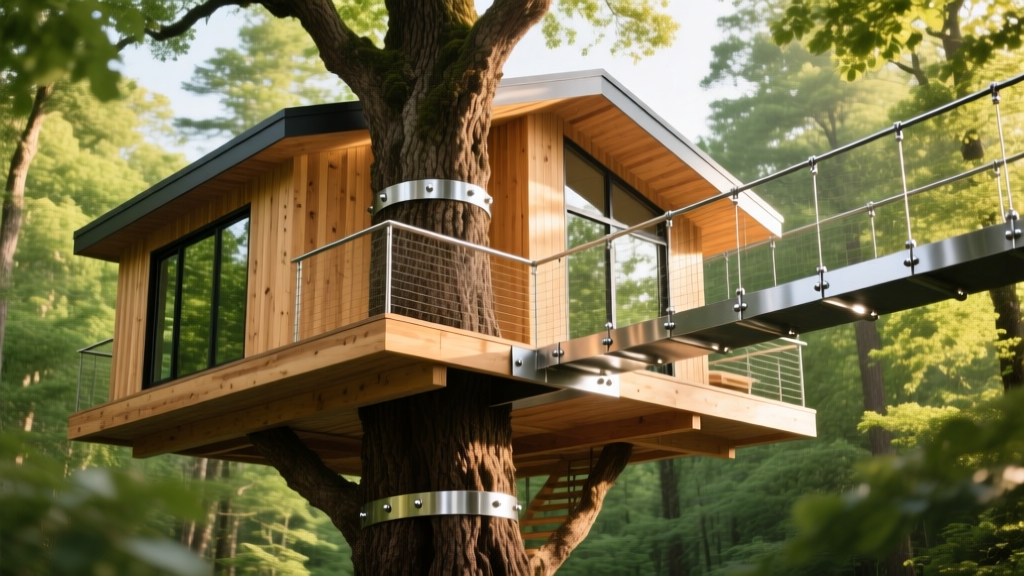
TABs, pioneered by companies like Treehouse Supplies and Tree Top Builders, feature a thick central boss that rests in the cambium layer, allowing the tree to grow over the bolt's collar without compromising the connection. A single heavy-duty TAB (rated for 8,000 to 12,000 lbs of shear force) costs between $275 and $425. A standard 10x12 treehouse requires a minimum of four TABs, meaning your attachment hardware alone will cost $1,100 to $1,700 before factoring in the specialized 2-inch ship auger bits ($80) and heavy-duty torque wrenches required for installation.
3. Roofing and Weatherproofing
Because treehouses experience more dynamic movement than ground-based structures, rigid roofing materials like clay tiles or standard asphalt shingles can crack or tear as the tree sways in high winds. The preferred roofing materials are flexible or interlocking:
- EPDM Rubber Membrane: $1.50 - $2.50 per sq. ft. Highly flexible, excellent for flat or low-slope roofs.
- Standing Seam Metal: $9.00 - $14.00 per sq. ft. The premium choice. Interlocking panels move as a single unit, accommodating tree sway without breaking the water seal.
- Cedar Shakes: $7.00 - $11.00 per sq. ft. Aesthetically pleasing but requires high maintenance and a steep roof pitch (minimum 6:12) to prevent water infiltration.
DIY Kits vs. Professional Builders: A Cost-Benefit Analysis
Choosing between a DIY approach and hiring a specialized treehouse company fundamentally alters the project timeline, cost, and structural longevity.
The DIY Kit Route
Prefabricated kits from manufacturers like Jamaica Cottage Shop or Treehouse Supplies provide pre-cut, pre-drilled lumber and standardized hardware plans. A 10x12 cedar kit typically costs $4,500 to $7,000. The primary advantage is the elimination of architectural design fees and complex material takeoffs. The disadvantage is rigidity: kits are designed for standard, straight-trunk trees. If your host tree has a significant lean, multiple trunks, or irregular branching, a kit's standardized floor joist layout will not work without extensive, unplanned modifications.
The Professional Custom Route
Hiring a specialized treehouse builder shifts the cost structure heavily toward labor and design. Custom builders charge $150 to $250 per hour for on-site skilled labor. A custom 12x16 insulated treehouse with a standing seam roof and composite decking will typically require 250 to 400 man-hours, translating to $37,500 to $100,000 in labor alone. However, professional builders utilize 3D laser scanning to map the tree's canopy and design around irregular growth patterns, ensuring the structure moves harmoniously with the tree.
Soft Costs: Arborists, Permits, and Insurance
Material and labor are only part of the equation. Ignoring soft costs is the most common reason treehouse projects stall or face municipal fines.
Arborist Consultation
Before driving a single TAB into a tree, you must verify the host tree's health and load-bearing capacity. Hiring an ISA-certified arborist (find one via the International Society of Arboriculture) to perform a sonic tomography scan or visual risk assessment typically costs $300 to $600. They will identify internal decay, root plate stability issues, and recommend specific pruning to reduce wind-sail effects on the canopy.
Permitting and Zoning
Municipalities treat treehouses inconsistently. In some jurisdictions, a treehouse under 200 square feet without plumbing is considered a temporary play structure and requires no permit. In others, any habitable structure over 30 inches off the ground requires a full building permit, structural engineering stamps, and zoning variances for setbacks. Budget $500 to $2,500 for permitting, and an additional $1,500 to $3,000 if your local building department requires a licensed structural engineer to stamp your TAB layout and load calculations.
Standard homeowner's insurance policies typically cover treehouses under the "other structures" clause (usually capped at 10% of the dwelling coverage). However, if you add electricity, plumbing, or rent the treehouse out on platforms like Airbnb, you must notify your provider to secure a commercial rider or increased liability umbrella, which may increase your annual premium by 5% to 15%.
Decision Framework: Which Build is Right for You?
Use this matrix to determine the most cost-effective path for your specific scenario.
| Scenario | Recommended Approach | Estimated Budget |
|---|---|---|
| Kids' play space, straight oak/pine tree, basic carpentry skills | Premium DIY Kit | $4,000 - $8,000 |
| Home office/guest room, irregular tree canopy, requires insulation | Custom Professional Build | $35,000 - $60,000 |
| Multi-tree suspension build, high wind zone, complex permitting | Luxury Estate Builder (Specialized Firm) | $85,000+ |
Frequently Asked Questions
Does a treehouse add value to my property?
A professionally built, permitted, and architecturally integrated treehouse can increase property value by 2% to 5%, particularly in markets where outdoor living spaces are highly prized. However, unpermitted DIY structures using lag screws can become a liability during a home inspection, potentially decreasing the appraised value or requiring removal prior to sale.
How long does it take to build a custom treehouse?
While actual on-site construction for a custom 12x16 treehouse typically takes 3 to 6 weeks, the design, engineering, and permitting phase often takes 2 to 4 months. Specialty hardware like custom-forged TABs and specific tropical hardwoods may also carry 6-to-8-week lead times from suppliers.
Can I build a treehouse in a tree with multiple trunks?
Yes, but it requires advanced engineering. Multi-trunk trees (co-dominant stems) move independently in the wind. Builders must use specialized sliding brackets and flexible suspension cables on the secondary trunks to allow for differential movement without tearing the structure apart. This adds approximately 15% to 20% to the overall hardware and engineering costs.
Written by
Elena RodriguezElena Rodriguez is a civil engineer and technical writer specializing in concrete technology, masonry systems, and ASTM/ACI compliance. She earned her B.S. in Civil Engineering from Texas A&M University and spent a decade at a materials testing laboratory, performing over 2,000 concrete compressive strength tests and masonry prism evaluations. Elena is an ACI-certified Field Testing Technician (Grade I) and a member of ASTM Committee C12 on Natural Building Stone. She currently consults on forensic engineering cases involving concrete failures and moisture intrusion. Based in San Antonio, TX, Elena is a proud member of the Society of Women Engineers (SWE) and coaches her daughter's FIRST Robotics team.
More from Elena Rodriguez
View all
Walls & Panels
Cost Analysis: Light Gauge Steel Framing Advantages and Disadvantages
Evaluate light gauge steel framing advantages and disadvantages through a strict cost analysis lens, comparing material, labor, and lifecycle expenses.
Aug 4, 2026

Walls & Panels
Gypsum Board Types: Exact Specifications, Thickness & Dimensions
Compare standard, Type X, and moisture-resistant gypsum board types. Get exact specifications, thicknesses, dimensions, and ASTM standards for your project.
Aug 4, 2026

Fire Resistance
Best Fire-Resistant Outdoor Decking Materials: 2026 Buyer Guide
Discover the best fire-resistant outdoor decking materials for 2026. Compare Class A PVC, aluminum, and hardwood options for WUI compliance and safety.
Aug 4, 2026