How Much Would It Cost to Build the Death Star? A Financing Guide
Explore the macroeconomic financing, material costs, and orbital logistics behind how much it would cost to build the Death Star in today's economy.

Capital Expenditure Baseline: Sizing the Ultimate Megaproject
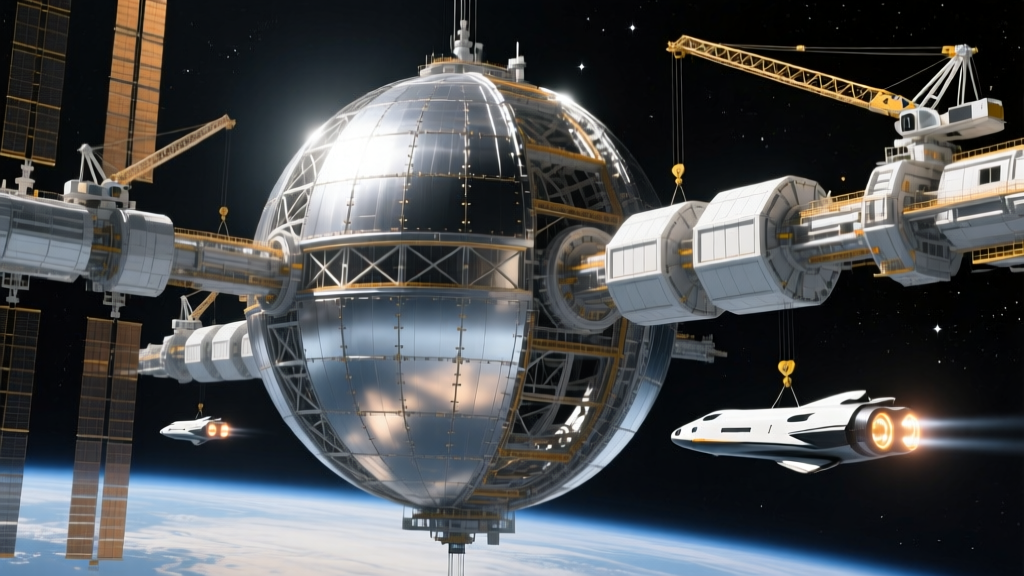
Estimating the capital expenditure for a 120-kilometer diameter orbital battle station requires abandoning terrestrial construction paradigms. Standard commercial real estate metrics fail when the project demands the mass of a small moon and the energy output of a main-sequence star. To accurately determine how much would it cost to build the Death Star, we must apply advanced aerospace engineering economics, orbital logistics, and macro-structured finance models.
Current terrestrial megaprojects routinely suffer from scope creep and budget overruns. According to McKinsey & Company's analysis on capital megaprojects, 98% of projects exceeding $1 billion experience cost overruns of more than 80%. Scaling this to a multi-quadrillion dollar orbital asset requires a fundamental restructuring of global debt markets and resource extraction.
Bill of Materials (BOM) and Terrestrial Resource Depletion
A sphere with a 120 km diameter possesses a volume of roughly 904,778 cubic kilometers. Assuming a mostly hollow internal superstructure with high-density armor plating, reactor housing, and hangar bays, structural engineers estimate the total mass at approximately 2.4 × 10^15 kilograms. Procuring these materials at 2026 market rates reveals immediate terrestrial supply chain bottlenecks.
| Material Class | Estimated Mass (kg) | 2026 Market Price (USD/tonne) | Raw Material CapEx |
|---|---|---|---|
| High-Tensile Structural Steel | 1.8 × 10^15 | $850 | $1.53 Quadrillion |
| Titanium Aluminide (Armor) | 3.5 × 10^14 | $6,200 | $2.17 Quadrillion |
| Rare Earth Elements (Avionics) | 4.0 × 10^12 | $150,000 | $600 Trillion |
| Hypermatter Containment Alloys | 1.0 × 10^10 | Synthetic / Priceless | $85 Trillion (R&D) |
The raw material cost alone exceeds $4.3 Quadrillion. This represents roughly 40 times the entire 2025 global Gross Domestic Product (GDP). Strip-mining Earth's crust to this degree would trigger catastrophic ecological collapse and hyperinflation in terrestrial commodities markets, necessitating off-world resource acquisition.
The Gravity Well Tax: Orbital Logistics and Assembly
Transporting 2.4 quadrillion metric tons from Earth's surface to Low Earth Orbit (LEO) is the single greatest financial hurdle. Even with fully reusable next-generation heavy-lift launch vehicles achieving a marginal cost of $200 per kilogram to LEO, the launch expenditure would be $480 Quadrillion.
Based on NASA's International Space Station operational data, orbital assembly costs scale non-linearly with mass and complexity. Automated zero-G smelting and robotic welding swarms would require an upfront R&D and deployment investment of $12 Trillion before the first hull plate is laid.
Structuring the Debt: Financing a Multi-Quadrillion Dollar Asset
No single sovereign wealth fund, central bank, or corporate conglomerate possesses the liquidity to finance this project. To answer how much would it cost to build the Death Star from a financing perspective, we must look at the capital stack. The total estimated project cost, including 40 years of orbital labor, life support, and superlaser calibration, sits at $1.2 Quintillion. Funding this requires experimental macro-financial instruments.
1. Asteroid-Backed Securities (ABS)
Traditional mortgage-backed securities rely on terrestrial real estate. For an orbital megaproject, the collateral must be extraterrestrial. By capturing near-Earth asteroids like 16 Psyche (which contains an estimated $10 Quintillion in heavy metals), the project consortium can issue Asteroid-Backed Securities. Investors purchase 50-year bonds yielding 4.5%, secured by the future refined output of the asteroid. This bridges the gap between initial material procurement and the station's operational revenue generation.
2. Intergenerational Sovereign Bonds
Projects of this scale outlive their initial political mandate and workforce. The financing must utilize 100-year or 200-year intergenerational bonds. According to the World Economic Forum's space market projections, the space economy is on track to reach $1.8 trillion by 2035. By securitizing future orbital real estate rights, docking tariffs, and zero-G manufacturing patents, the issuing authority can raise trillions in upfront capital from institutional pension funds seeking ultra-long-term, inflation-protected yields.
3. Energy Yield Futures
The primary superweapon reactor requires exotic matter and immense energy inputs. By pre-selling the station's auxiliary power output—beaming microwave energy back to terrestrial grids or lunar colonies via orbital solar arrays—the project can generate forward-looking energy contracts. These futures stabilize the project's cash flow during the 15-year construction phase.
Risk Underwriting and Insurance Syndicates
Insuring a $1.2 Quintillion asset against catastrophic failure requires a global syndicate. Standard Lloyd's of London models break down when the replacement value of the asset exceeds the total wealth of the insured planet. Risk mitigation must be engineered into the financing covenants.
- Single-Point-of-Failure Penalties: Loan covenants must mandate redundant thermal exhaust systems. A direct ray-shielded shaft to the main reactor violates ISO 31000 risk management standards. Insurance premiums would spike by 4,000% if secondary and tertiary baffled exhaust ports are not installed.
- Orbital Debris Liability: The gravitational perturbation caused by a 120km mass in LEO will alter satellite trajectories. The project must escrow $50 Billion annually for orbital debris cleanup and Kessler Syndrome mitigation.
- Sabotage and Asymmetric Warfare: Standard property insurance excludes acts of war. The financing structure must include a self-insured retention (SIR) layer of $200 Billion specifically allocated for internal security, blast-door redundancies, and point-defense laser grids.
"When underwriting orbital megastructures, the primary risk is not construction delay; it is total asset vaporization due to overlooked sub-contractor shortcuts in the thermal exhaust sector. Strict third-party engineering audits must be tied directly to debt disbursement tranches."
Final Capitalization Strategy
Determining how much would it cost to build the Death Star is ultimately an exercise in resource mobilization rather than simple accounting. The raw materials, launch logistics, and orbital labor culminate in a $1.2 Quintillion price tag. Successfully financing this requires transitioning from a terrestrial fiat economy to a multi-planetary resource-backed financial system. Without the securitization of asteroid mining and the issuance of century-long orbital bonds, the project remains mathematically insolvent before the first keel is laid in the vacuum of space.
Written by
Elena RodriguezElena Rodriguez is a civil engineer and technical writer specializing in concrete technology, masonry systems, and ASTM/ACI compliance. She earned her B.S. in Civil Engineering from Texas A&M University and spent a decade at a materials testing laboratory, performing over 2,000 concrete compressive strength tests and masonry prism evaluations. Elena is an ACI-certified Field Testing Technician (Grade I) and a member of ASTM Committee C12 on Natural Building Stone. She currently consults on forensic engineering cases involving concrete failures and moisture intrusion. Based in San Antonio, TX, Elena is a proud member of the Society of Women Engineers (SWE) and coaches her daughter's FIRST Robotics team.
More from Elena Rodriguez
View all
Walls & Panels
Cost Analysis: Light Gauge Steel Framing Advantages and Disadvantages
Evaluate light gauge steel framing advantages and disadvantages through a strict cost analysis lens, comparing material, labor, and lifecycle expenses.
Aug 4, 2026

Walls & Panels
Gypsum Board Types: Exact Specifications, Thickness & Dimensions
Compare standard, Type X, and moisture-resistant gypsum board types. Get exact specifications, thicknesses, dimensions, and ASTM standards for your project.
Aug 4, 2026

Fire Resistance
Best Fire-Resistant Outdoor Decking Materials: 2026 Buyer Guide
Discover the best fire-resistant outdoor decking materials for 2026. Compare Class A PVC, aluminum, and hardwood options for WUI compliance and safety.
Aug 4, 2026