How Much Did It Cost to Build Eiffel Tower? Budget Analysis
Discover how much it cost to build the Eiffel Tower in 1889, adjusted for modern inflation, and the budget planning lessons estimators can learn today.
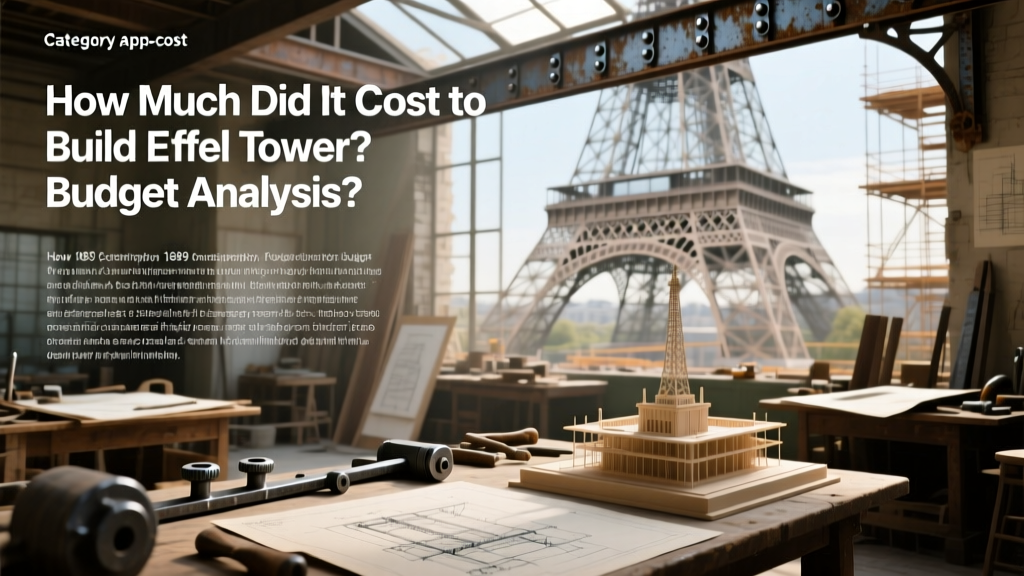
The 1887 Financial Convention: Structuring the Deal
When evaluating the historical budget of the world's most recognizable iron lattice structure, the initial question is always: how much did it cost to build Eiffel Tower? The short answer is 7.8 million gold francs. However, the financial engineering behind that number is far more critical for modern construction estimators than the raw figure itself.
On January 8, 1887, Gustave Eiffel signed a convention with the French government and the City of Paris. The total estimated budget was 6.5 million francs. The state and the city agreed to provide a combined subsidy of 1.5 million francs. Eiffel was required to raise the remaining 5 million francs privately. To secure this capital, Eiffel formed a joint-stock company and leveraged a highly aggressive revenue-offset model: in exchange for fronting the lion's share of the capital, he was granted the exclusive rights to all commercial and ticket revenue from the tower for the first 20 years of its operation.
Ultimately, the project experienced a cost overrun, closing at roughly 7.8 million francs. According to data from the official Eiffel Tower archives, the 20-year concession generated over 10 million francs in ticket sales, allowing Eiffel to recoup his investment and turn a profit well before the 1909 handover.
Material Procurement: The Puddle Iron Supply Chain
A common misconception in structural engineering history is that the tower is made of steel. It is not. The structure relies entirely on puddle iron (fer puddlé), a material chosen specifically for its predictable cost and established supply chain in 1880s France.
The 7,300-Ton Iron Ledger
The metallic framework weighs exactly 7,300 tons, while the total structure, including lifts, shops, and antennae, weighs approximately 10,100 tons. Eiffel sourced the puddle iron from the Pompey forges in Lorraine. By locking in a fixed-price contract with a single regional supplier, Eiffel insulated his budget from the volatile spot prices of imported steel, which was still considered a premium, less standardized material at the time.
The tower consists of 18,038 individual metallic parts. Every single piece was designed, calculated to a tenth of a millimeter, and pre-fabricated at Eiffel's factory in Levallois-Perret, a suburb of Paris. This brings us to the most significant cost-saving measure in the project's ledger.
The Rivet Economy and Off-Site Labor
The assembly required 2.5 million rivets. On-site riveting in the 1880s was incredibly expensive due to the hazardous nature of the work, the need for heating furnaces at extreme heights, and the high wages demanded by specialized 'rivet gangs' (chauffeurs, teneurs de tas, and riveurs). Eiffel's budget strategy was to pre-assemble and rivet as much of the structure as possible at ground level in the Levallois factory. Only the final alignment and connection of the massive trusses required high-altitude on-site riveting. This reduced on-site labor costs by an estimated 40% compared to traditional scaffolding-and-masonry methods of the era.
Inflation-Adjusted: Rebuilding the Tower in 2026
Translating 19th-century gold francs into modern currency requires more than a simple Consumer Price Index (CPI) multiplier. The cost of raw materials has scaled linearly, but the cost of urban logistics, safety compliance, and engineering software has grown exponentially. If a general contractor were to bid on an exact replica of the Eiffel Tower in central Paris today, the budget would look drastically different.
Below is a conceptual 2026 cost estimation matrix based on modern European mega-project metrics, comparing structural equivalents like the Tokyo Skytree and the Shard.
| Cost Category | 1889 Estimate (Francs) | 2026 Estimate (USD) | Modern Cost Drivers |
|---|---|---|---|
| Site Prep & Caisson Foundations | ~1,000,000 | $65,000,000 | Urban vibration limits, Seine water table management |
| Structural Material (Steel/Iron) | ~3,500,000 | $110,000,000 | High-tensile steel tariffs, global supply chain freight |
| Off-Site Prefabrication (DFMA) | ~1,200,000 | $85,000,000 | CNC machining, 3D BIM modeling, automated welding |
| On-Site Assembly & Crane Logistics | ~1,500,000 | $140,000,000 | Unionized crane operators, Paris airspace restrictions |
| Wind Engineering & Safety Systems | Negligible | $45,000,000 | Computational fluid dynamics (CFD), fall arrest systems |
| TOTAL ESTIMATE | 7,800,000 | ~$445,000,000 | Excludes land acquisition and interior fit-outs |
According to structural data archived by Structurae, the tower's aerodynamic lattice design naturally mitigates wind shear, meaning modern engineers would spend millions in CFD software and wind-tunnel testing to prove what Eiffel calculated using empirical slide-rule mathematics. The $445 million 2026 estimate aligns closely with the construction costs of similarly scaled modern observation towers, excluding the astronomical cost of purchasing the land rights on the Champ de Mars.
Budget Planning Frameworks Derived from the Eiffel Tower
Modern cost estimators and project managers can extract three highly actionable budget planning frameworks from Gustave Eiffel's 1889 execution strategy.
1. Design for Manufacture and Assembly (DFMA)
Eiffel's decision to drill every rivet hole and cut every angle iron in the Levallois factory before shipping it to the site is the 19th-century equivalent of modern DFMA. By shifting labor from the unpredictable, weather-dependent construction site to a controlled factory environment, he eliminated the 'hidden costs' of on-site rework. Estimators today should apply a 15-20% labor premium to on-site structural steel assembly versus modular off-site prefabrication.
2. Fixed-Price Risk Transfer via Subcontractors
Eiffel did not self-perform the foundation work. The masonry and caisson foundations were contracted out to specialized firms. When the Seine-side piers required compressed-air caissons to prevent water infiltration—a notoriously expensive and dangerous technique—the financial risk of delays was absorbed by the subcontractor's fixed bid, protecting the master budget.
3. Temporary Works as Permanent Assets
The wooden scaffolding and steam cranes used to build the tower were designed to be dismantled and resold. Eiffel factored the salvage value of his temporary works into his initial capital outlay, effectively lowering the net cost of construction. Modern estimators should always include a 'salvage and resale' line item for heavy temporary works, formwork, and modular site offices in their final cost-to-complete forecasts.
Frequently Asked Questions
Did the Eiffel Tower go over budget?
Yes, but only marginally. The initial contract was set at 6.5 million francs, but the final cost reached approximately 7.8 million francs. This 20% overrun was primarily absorbed by Eiffel's company and offset by the massive commercial success of the 1889 Exposition Universelle, which drew nearly 2 million paying visitors in its first year alone.
How long did the construction take, and did schedule impact the cost?
Construction took exactly two years, two months, and five days (January 28, 1887, to March 31, 1889). Because Eiffel utilized pre-fabricated parts and maintained a relentless schedule with up to 300 workers on site, the project avoided the catastrophic financing costs and loan interest overruns that plague modern multi-year mega-projects.
What was the most expensive single component of the build?
The elevators (lifts) were a massive budget drain. Because the tower's legs curve at a 54-degree angle at the base, standard vertical elevator shafts were impossible. Eiffel had to commission custom hydraulic elevators from the Otis Elevator Company (an American firm, which caused political friction in France) and the French firm Roux, Combaluzier & Lepape. The custom engineering and import tariffs for these lifts consumed a disproportionate amount of the final 7.8 million franc budget.
Written by
David NakamuraDavid Nakamura is a licensed architect (AIA) and construction technology writer focused on sustainable building methods, mass timber engineering, and high-performance building envelopes. He holds a Master of Architecture from the University of Washington and is a certified Passive House Consultant (CPHC). David spent eight years at the Seattle firm Mithun, where he led the design of three LEED Platinum projects, before founding his own practice specializing in net-zero residential design. He serves on the editorial advisory board of GreenBuilder Magazine and has authored peer-reviewed papers on cross-laminated timber (CLT) connections for the Journal of Structural Engineering. In his spare time, David teaches woodworking at Pratt Fine Arts Center and kayaks the Puget Sound.
More from David Nakamura
View all
Construction Cost
Labor Cost to Build a Deck Per Sq Ft: 2026 Installation Guide
Discover the exact labor cost to build a deck per sq ft in 2026. This installation guide breaks down contractor rates, complexity factors, and hidden fees.
Aug 4, 2026

Construction Cost
How Much Does It Cost to Build a 3 Bedroom House? Financing Guide
Learn exactly how much it costs to build a 3 bedroom house and explore 2026 financing options, construction loan types, and budget frameworks for your build.
Aug 4, 2026

Construction Cost
Cost to Build a Tennis Court: 2026 Guide
How much does it cost to build a tennis court in 2026? Breakdowns for asphalt, concrete, and synthetic surfaces plus fencing and lighting.
Jul 30, 2026