How to Finance the Cost to Build Stairs Outside Your Home
Discover how to finance the cost to build stairs outside. Compare loan options, material budgets, and ROI for exterior stairway projects in 2026.
The True Cost to Build Stairs Outside: Establishing Your Baseline
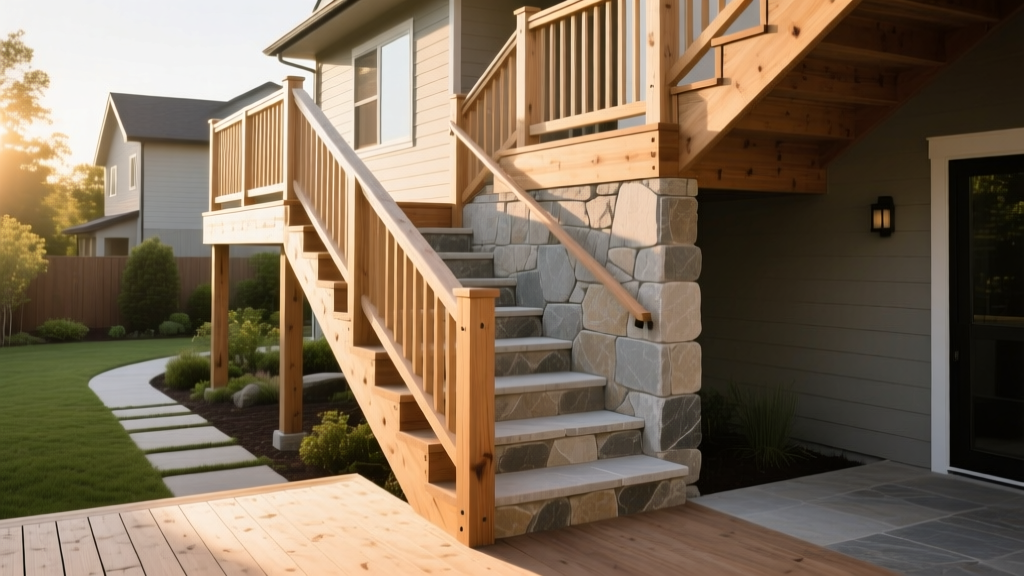
Exterior stairs bridge the gap between your home and the landscape, but they also bridge a gap in your budget. The cost to build stairs outside typically ranges from $1,500 for a basic three-step wooden entryway to over $15,000 for a multi-landing, engineered composite or poured concrete staircase. When the contractor estimate exceeds your liquid cash reserves, strategic financing becomes essential to get the project moving without compromising structural integrity or code compliance.
Before applying for a home improvement loan, you must understand what drives the final invoice. Material selection accounts for 40% to 50% of the total cost, while labor, site preparation, and permitting make up the remainder. In 2026, supply chain stabilization has normalized lumber prices, but composite materials and specialized concrete forms remain premium investments.
| Material Type | Average Cost Per Step | Lifespan & Maintenance | Best Use Case |
|---|---|---|---|
| Pressure-Treated Pine | $100 - $250 | 15-20 years; requires annual sealing | Budget-friendly entryways, rustic decks |
| Composite (e.g., Trex Transcend) | $300 - $600 | 25-50 years; zero staining required | High-traffic patios, low-maintenance homes |
| Precast Concrete Steps | $200 - $400 | 30+ years; prone to surface spalling | Standard basement walkouts, utility entries |
| Poured-in-Place Concrete | $400 - $800 | 50+ years; requires forming and curing | Custom curved stairs, heavy retaining walls |
| Steel Stringers with Wood Treads | $450 - $900 | 30+ years; rust prevention required | Modern architectural designs, commercial |
Code-Driven Cost Multipliers You Must Finance For
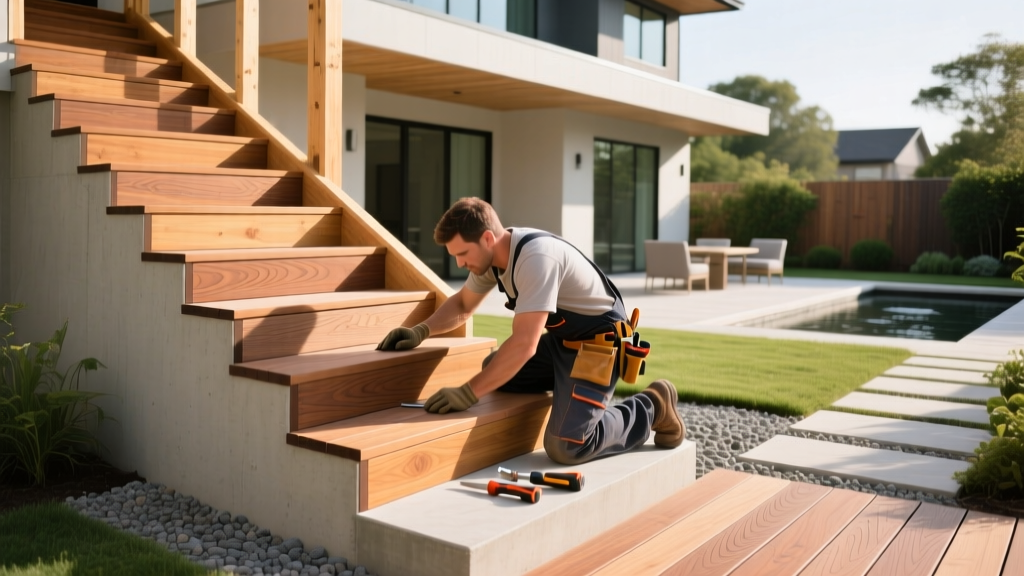
Homeowners frequently underestimate the cost to build stairs outside because they ignore local building codes. The International Residential Code (IRC) Section R311.7 dictates strict parameters for stairway safety. If your existing terrain requires a staircase that violates these parameters, your contractor must engineer expensive workarounds.
Always allocate an additional 15% in your financing request for soil testing, grading, and retaining wall footings. If your stairs attach to a frost-susceptible soil region, helical piers or deep concrete footings (often 36 to 48 inches deep) are mandatory to prevent winter frost heave from destroying the stair stringers.
Matching Your Stair Budget to the Right Financing Vehicle
Not all debt is created equal. The right financing tool depends entirely on the total cost to build stairs outside and your current home equity position. Below is a decision matrix for securing funds in the current 2026 lending environment.
Tier 1: Micro-Projects ($1,000 to $5,000)
For simple three-to-five step entryways or replacing rotting wooden treads with composite overlays, tapping into home equity is often overkill due to closing costs and appraisal fees.
- 0% APR Credit Cards: Many major hardware suppliers and contractors partner with financial institutions offering 12 to 24-month promotional APRs. If you can pay off the balance before the promotional period ends, your effective interest rate is zero.
- Personal Home Improvement Loans: Unsecured personal loans from online lenders or credit unions offer rapid funding (often within 48 hours) with fixed rates. While rates are higher than secured loans, the lack of collateral requirements makes them ideal for small stair repairs.
Tier 2: Mid-Range Structural Projects ($5,000 to $15,000)
Building a multi-level deck staircase with intermediate landings or a custom poured concrete stairwell requires a larger capital injection. According to the Consumer Financial Protection Bureau, leveraging your home's equity remains the most cost-effective route for mid-sized renovations.
- Home Equity Line of Credit (HELOC): A HELOC acts as a revolving credit line secured by your property. It is ideal if your stair project is part of a larger, phased backyard renovation. You only pay interest on the funds drawn to pay the contractor at each milestone.
- Home Equity Loan: A lump-sum second mortgage with a fixed interest rate. This is the superior choice if your contractor requires a 30% to 50% deposit upfront to order custom steel stringers or precast concrete forms.
Tier 3: Major Accessibility & Structural Overhauls ($15,000+)
If the cost to build stairs outside exceeds $15,000—common when integrating ADA-compliant ramps, extensive retaining walls, or multi-story exterior access—you need specialized financing.
- FHA Title I Property Improvement Loan: Backed by the Department of Housing and Urban Development, this program allows homeowners to borrow up to $25,000 for single-family home improvements without requiring a traditional equity appraisal. It is an excellent vehicle for homeowners who have low equity but need major exterior structural work.
- FHA 203(k) Rehabilitation Loan: If you are purchasing a fixer-upper that requires entirely new exterior staircases to meet safety codes, rolling the stair construction costs into your primary mortgage via a 203(k) loan offers the lowest possible interest rate and longest repayment term.
The Accessibility Financing Loophole
If the primary motivation for your exterior stairs is aging-in-place or accommodating a family member with mobility issues, you may not need to finance the project entirely out of pocket. The Americans with Disabilities Act (ADA) does not mandate private home compliance, but local and federal grants heavily subsidize accessible exterior modifications.
Pro-Tip for Aging-in-Place: If your exterior stair project includes integrating a vertical platform lift or an ADA-compliant ramp system alongside traditional stairs, look into your state's Assistive Technology Act program or local Community Development Block Grants (CDBG). These programs frequently offer forgivable loans or direct grants up to $10,000 for accessibility modifications, drastically reducing the amount you need to finance.
ROI and Appraisal Impact: Will the Stairs Pay for Themselves?
When taking on debt to fund exterior improvements, homeowners must evaluate the return on investment. Exterior stairs themselves do not typically generate a 100% direct return at resale. However, they are the critical enabler for the spaces they connect.
If your new stairs provide the only access to a finished walkout basement, a landscaped backyard, or a composite deck, their value is realized in the increased usability and appraisal value of those adjacent spaces. Real estate appraisers evaluate exterior stairs under the 'site improvements' and 'functional utility' categories. A rotting, non-code-compliant staircase will trigger a required repair notice on an FHA or VA appraisal, potentially killing a home sale. Financing a high-quality, code-compliant stair replacement protects your home's marketability and prevents low-ball appraisal valuations.
Step-by-Step: Securing Your Exterior Stair Funding
- Obtain Three Itemized Bids: Do not accept a single lump-sum quote. Require contractors to break down costs by materials, labor, permits, and site prep. Lenders need this granularity to approve draw schedules.
- Verify Code Compliance on Paper: Ensure the bids explicitly state compliance with IRC Section R311.7. Submitting plans that violate rise/run ratios will result in permit rejection, stalling your project and wasting loan interest.
- Calculate Your LTV Ratio: Before applying for a HELOC or Home Equity Loan, calculate your Loan-to-Value ratio. Most lenders in 2026 cap combined LTV at 80% to 85%. Ensure your stair loan doesn't push you over this threshold.
- Lock Your Rate and Close: For fixed-rate personal or home equity loans, lock your interest rate as soon as the contractor signs the final scope of work. Construction delays due to weather should not expose you to interest rate volatility.
- Manage the Draw Schedule: Never pay the full cost upfront. Structure payments around milestones: 20% at signing, 40% upon delivery of materials and completion of footings, 30% upon framing and tread installation, and 10% after the final municipal building inspection is passed.
By aligning the specific material and structural costs of your exterior staircase with the appropriate financial instrument, you ensure the project enhances your property's safety and value without overextending your monthly budget.
Written by
David NakamuraDavid Nakamura is a licensed architect (AIA) and construction technology writer focused on sustainable building methods, mass timber engineering, and high-performance building envelopes. He holds a Master of Architecture from the University of Washington and is a certified Passive House Consultant (CPHC). David spent eight years at the Seattle firm Mithun, where he led the design of three LEED Platinum projects, before founding his own practice specializing in net-zero residential design. He serves on the editorial advisory board of GreenBuilder Magazine and has authored peer-reviewed papers on cross-laminated timber (CLT) connections for the Journal of Structural Engineering. In his spare time, David teaches woodworking at Pratt Fine Arts Center and kayaks the Puget Sound.
More from David Nakamura
View all
Construction Cost
Labor Cost to Build a Deck Per Sq Ft: 2026 Installation Guide
Discover the exact labor cost to build a deck per sq ft in 2026. This installation guide breaks down contractor rates, complexity factors, and hidden fees.
Aug 4, 2026

Construction Cost
How Much Does It Cost to Build a 3 Bedroom House? Financing Guide
Learn exactly how much it costs to build a 3 bedroom house and explore 2026 financing options, construction loan types, and budget frameworks for your build.
Aug 4, 2026

Construction Cost
Cost to Build a Tennis Court: 2026 Guide
How much does it cost to build a tennis court in 2026? Breakdowns for asphalt, concrete, and synthetic surfaces plus fencing and lighting.
Jul 30, 2026