Self Serve Car Wash Cost to Build: 2026 Finance Guide
Discover the exact self serve car wash cost to build in 2026 and learn how to structure SBA, equipment, and CRE loans to fund your bays.
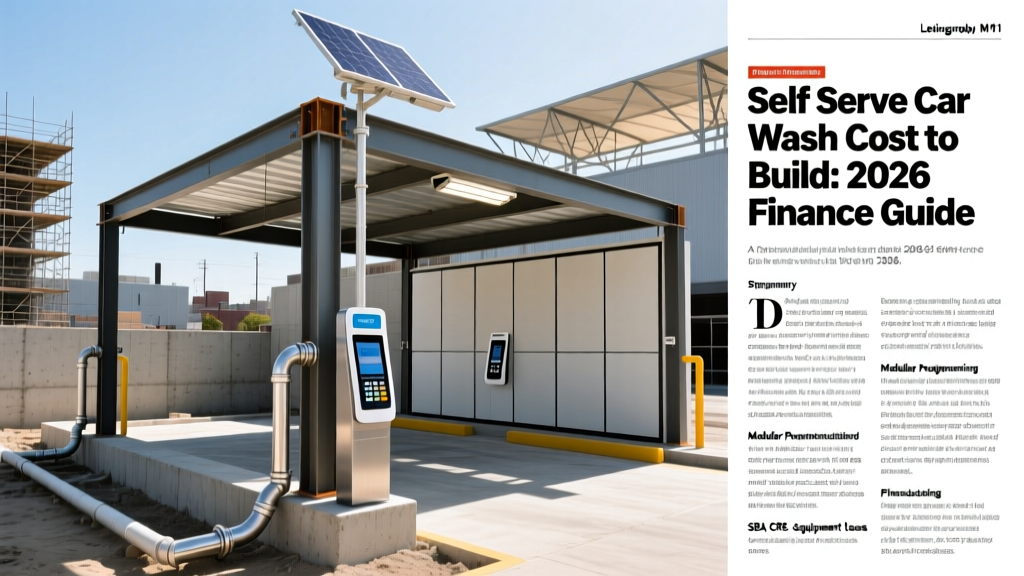
The True Self Serve Car Wash Cost to Build
Securing capital for a self-serve car wash requires more than a generic business plan; lenders demand a granular breakdown of hard costs, soft costs, and asset-specific financing strategies. In 2026, the self serve car wash cost to build typically ranges from $750,000 to $1.2 million for a standard three-bay facility, excluding premium real estate in Tier-1 metro markets. Understanding exactly where these dollars go is the first step in structuring a debt package that lenders will actually underwrite.
2026 Hard Cost Breakdown (3-Bay Facility)
- Land Acquisition: $250,000 – $600,000 (Highly dependent on zoning and traffic counts)
- Site Work & Utilities: $120,000 – $180,000 (Trenching, 3-phase power, oil-water separators)
- Building & Canopy Construction: $150,000 – $250,000 (Steel framing, polycarbonate roofing, concrete pads)
- Wash Equipment: $135,000 – $195,000 ($45k–$65k per bay for brands like Sonny's or PDQ)
- Payment Systems & Tech: $15,000 – $25,000 (DRB or Hamilton Manufacturing coin/card/timer systems)
Because a car wash is a hybrid asset—part specialized real estate, part heavy machinery—attempting to fund the entire project under a single commercial mortgage is a common mistake. Smart developers bifurcate their capital stack to maximize leverage and preserve cash flow.
Asset-Specific Financing Matrix
Matching the right debt instrument to the correct asset class lowers your weighted average cost of capital. The International Carwash Association frequently notes that operators who blend real estate loans with equipment financing achieve faster break-even timelines.
| Capital Need | Optimal Loan Product | Typical LTV | Amortization |
|---|---|---|---|
| Land & Site Prep | SBA 7(a) or CRE Loan | 75% - 80% | 20 - 25 Years |
| Wash Bays & Canopy | SBA 7(a) or Construction Loan | 80% - 85% | 15 - 20 Years |
| Pumps, Booms, Sprayers | Equipment Financing | 90% - 100% | 3 - 7 Years |
| Soft Costs & Working Capital | SBA 7(a) Working Capital Line | N/A | 10 Year Revolving |
Navigating SBA 7(a) Loans for Wash Construction
The SBA 7(a) loan program remains the gold standard for ground-up car wash construction in 2026. Because self-serve washes are classified as special-purpose real estate by most conventional banks, traditional commercial lenders often demand 30% to 40% down. The SBA 7(a) caps the equity injection at 10% to 15% for existing businesses, or 20% for ground-up construction, freeing up vital liquidity for marketing and operational reserves.
When applying, your proforma must demonstrate a Debt Service Coverage Ratio (DSCR) of at least 1.25x. For a $900,000 SBA loan at current 2026 rates, your annual debt service will hover around $85,000. This means your wash must generate a minimum of $106,250 in net operating income (NOI) annually, which translates to roughly $8,850 in monthly profit across three bays.
Leveraging Equipment Financing for PDQ and Sonny's Hardware
While the SBA covers the dirt and the concrete, specialized equipment financing is vastly superior for the actual wash hardware. According to industry financing guides, equipment loans are secured by the machinery itself via a UCC-1 filing, meaning lenders do not need to underwrite the real estate. This results in faster approvals (often under 14 days) and higher LTVs.
If you are purchasing a PDQ LaserWash system or Sonny's high-pressure boom equipment, the manufacturer's dealer network usually has captive financing arms. These programs often offer 90% to 100% financing on the equipment invoice. However, a critical nuance often missed by first-time builders: equipment lenders finance the hardware, not the installation labor, plumbing rough-ins, or electrical drop-downs. You must have cash or SBA proceeds earmarked specifically to pay the general contractor for installing the financed equipment.
Hidden Soft Costs That Derail Wash Funding
The most common reason car wash construction loans stall during the draw phase is the underestimation of municipal soft costs. Lenders will require you to escrow these funds before breaking ground.
- Water and Sewer Tap Fees: Self-serve washes are water-intensive. Municipalities charge heavy impact fees for 2-inch or 3-inch water meter taps, often ranging from $25,000 to $60,000 depending on the county.
- Oil-Water Separators & Reclaim Systems: Environmental regulations mandate commercial-grade oil-water separators (e.g., Highland Tank or Jay R. Smith models) before water hits the municipal sewer. Budget $15,000 to $22,000 per bay for the concrete vaults and separator units.
- Traffic Impact Studies & Driveway Permits: If your site requires a new curb cut on a state highway or arterial road, the Department of Transportation will require a traffic study ($5,000–$12,000) and deceleration lane construction, which can add $40,000+ to site work.
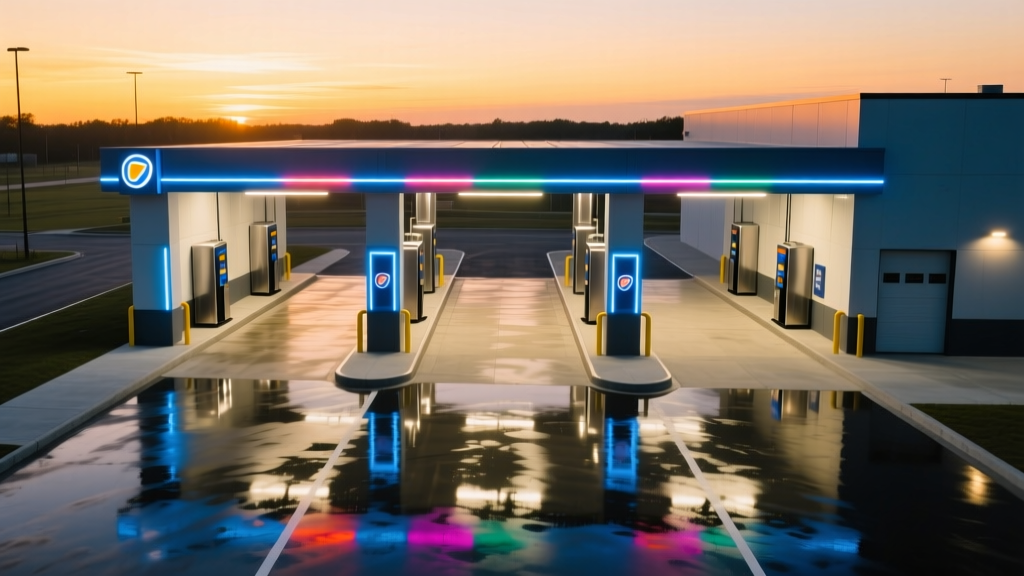
Proving ROI to Lenders: The DSCR Requirement
Lenders do not care about your gross revenue; they underwrite based on Net Operating Income (NOI). To prove your self serve car wash cost to build is justified, you must present a realistic DSCR model.
Sample 3-Bay DSCR Calculation
Gross Monthly Revenue: $18,000 (Assumes 600 washes/month at $30 average ticket across bays and vacuums)
Less Operating Expenses: $6,500 (Water, sewer, electricity, soap, credit card processing, property tax, insurance)
Net Operating Income (NOI): $11,500
Monthly Debt Service (SBA + Equipment): $7,800
DSCR: $11,500 / $7,800 = 1.47x
Result: Fundable. Most SBA lenders require a minimum 1.25x, with 1.35x+ preferred for special-purpose properties.
Step-by-Step Funding Execution Plan
To move from concept to ribbon-cutting without running out of capital, follow this exact sequencing protocol:
- Phase 1: Land Feasibility (Months 1-2): Secure the land under a 90-day feasibility contingency contract. Order the Phase 1 ESA, ALTA survey, and municipal utility capacity letters. Do not apply for an SBA loan until utility capacity is confirmed.
- Phase 2: SBA Packaging (Months 3-4): Engage an SBA Preferred Lender. Submit your 3-year proforma, personal financial statements, and the finalized architectural site plan. Secure the SBA commitment letter.
- Phase 3: Equipment POs (Month 5): Once the SBA loan is in underwriting, issue Purchase Orders to your wash equipment dealer. Apply for the equipment financing line using the SBA commitment letter as proof of the real estate down payment.
- Phase 4: Construction Draws (Months 6-10): The SBA lender will set up a construction draw account. Your GC will bill monthly for site work, concrete, and canopy erection. Equipment is delivered and installed in Month 9.
- Phase 5: Conversion to Permanent Loan (Month 11): Upon receiving the Certificate of Occupancy (CO), the SBA construction facility converts to a fully amortized 20-year permanent mortgage.
By decoupling your real estate costs from your equipment costs and accurately forecasting municipal impact fees, you transform the self serve car wash cost to build from a speculative gamble into a highly leveraged, cash-flowing asset.
Written by
Priya KapoorPriya Kapoor is a real estate market analyst and construction economics researcher with expertise in housing affordability, development feasibility, and infrastructure investment. She holds a Master of Regional Planning from Cornell University and previously worked as a senior analyst at CBRE's Investment Properties group, where she modeled returns for $4B in mixed-use development pipelines. Priya now runs an independent research practice advising developers, municipalities, and REITs on construction cost forecasting and market timing. She publishes the quarterly "BuildMat Market Pulse" report tracking material price indices across 12 commodity categories. Based in Austin, TX, Priya serves on the board of Habitat for Humanity Austin and is a marathon runner.
More from Priya Kapoor
View all
Construction Cost
Cost to Build a 1600 Sq Ft Home in 2026: Full Breakdown
Accurate 2026 cost to build a 1600 sq ft home—material, labor, and regional pricing breakdowns included. Plan your budget with real-time estimates.
Aug 11, 2026

Wood & Lumber
Name the Types of Wood for Pressure Treatment and Preservation
Learn how to name the types of wood best suited for pressure treatment. Compare species treatability, chemical retention levels, and 2026 preservation costs.
Aug 4, 2026

Stone & Masonry
Stone Veneer Suppliers Lindenhurst: 2026 Cost Analysis
Analyze 2026 stone veneer costs in Lindenhurst, NY. Compare local supplier pricing, delivery fees, and Suffolk County installation labor rates.
Aug 4, 2026