How to Finance the Material Cost to Build a 1500 Sq Ft House
Learn how to finance the material cost to build a 1500 sq ft house. Compare construction loans, supplier credit, and HELOCs with 2026 pricing data.
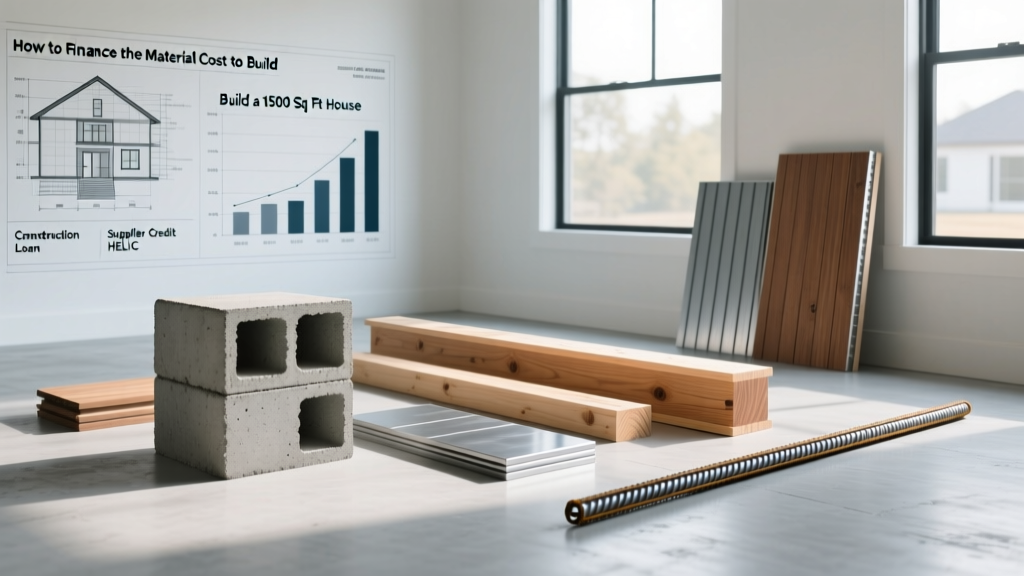
The True Material Cost to Build a 1500 Sq Ft House in 2026
Before securing capital, you must establish an accurate baseline for the material cost to build a 1500 sq ft house. In 2026, the national average for residential construction materials (excluding labor, land, and permits) ranges from $65 to $95 per square foot, depending on finish grades and regional supply chain variables. For a mid-tier 1,500-square-foot build, the total material principal sits at approximately $112,500.
Understanding this figure through the lens of the CSI MasterFormat divisions is critical for lenders, as they disburse funds based on completed phases rather than upfront material purchases.
| CSI Division | Material Category | Estimated Cost (1500 sq ft) | % of Total Materials |
|---|---|---|---|
| Div 03 | Concrete & Foundation | $14,500 - $18,000 | 14% |
| Div 06 | Wood, Plastics & Framing | $24,000 - $32,000 | 25% |
| Div 07 & 08 | Thermal, Moisture & Openings | $22,000 - $28,500 | 22% |
| Div 21-28 | MEP (Mechanical, Electrical, Plumbing) | $23,000 - $29,000 | 23% |
| Div 09 & 12 | Interior Finishes & Furnishings | $18,000 - $26,000 | 16% |
Primary Financing Vehicles for Material Acquisition
Financing the material cost to build a 1500 sq ft house requires a layered approach. Relying solely on a traditional mortgage is impossible since the collateral (the house) does not yet exist. Instead, borrowers utilize a combination of construction loans, supplier credit, and land-equity products.
1. Construction-to-Permanent (C2P) Loans
The C2P loan is the standard vehicle for funding residential builds. According to the Consumer Financial Protection Bureau (CFPB), these loans cover the cost of land (if not already owned), labor, and materials, eventually converting into a standard 30-year mortgage.
In the 2026 rate environment, C2P loans typically require a 20% to 25% down payment on the total project cost. For a $300,000 total build (where materials are $112,500), expect to bring $60,000 to closing. The lender holds the material funds in escrow and releases them via a draw schedule tied to third-party inspections.
2. Commercial Supplier Credit Lines (The Bridge Strategy)
Because C2P lenders reimburse you after materials are installed and inspected, owner-builders and small contractors face a cash-flow gap. The solution is establishing a commercial credit line with major suppliers like Builders FirstSource, 84 Lumber, or SRS Distribution.
- Net 30/60/90 Terms: Approved accounts receive materials upfront with 30 to 90 days to pay. This aligns perfectly with a 45-day lender draw cycle.
- Requirements: Suppliers typically require an LLC, a Dun & Bradstreet (D-U-N-S) number, and a personal guarantee from the builder or owner-builder.
- Cost of Capital: If paid within the Net 30 window, the effective interest rate is 0%. Late payments trigger punitive rates (often 18% to 24% APR).
3. Land-Equity HELOCs
If you own your lot outright, the land serves as immediate collateral. A Home Equity Line of Credit (HELOC) against the unimproved land allows you to purchase the initial material packages (foundation and framing) before the C2P loan's first draw is approved. This is highly effective for securing early-stage materials without paying commercial bridge loan interest rates.

Aligning Supplier Invoices with Lender Draw Schedules
The most common point of failure in financing a 1500 sq ft house build is the misalignment between supplier payment terms and lender draw inspections. To prevent work stoppages, implement the following draw-management framework:
- Pre-Draw Material Staging: Order materials 14 days before the phase begins. Have them delivered to the site and staged.
- The AIA G702/G703 Submission: When the phase is complete, submit the American Institute of Architects (AIA) G702 (Application and Certificate for Payment) and G703 (Continuation Sheet) to your lender. Include all supplier invoices and lien waivers.
- Inspection & Disbursement: The lender sends an inspector within 48 hours. Funds are disbursed to your account within 5 to 7 business days post-inspection.
- Supplier Payment: Use the disbursed funds to pay off the Net 30 supplier invoice before the penalty window opens.
Hedging Against Material Price Volatility
According to the U.S. Census Bureau Construction Price Indexes, material costs can fluctuate wildly due to global supply chain disruptions, tariffs, and seasonal demand. A 10% spike in lumber or concrete between the time your loan is approved and the time you purchase materials can leave you underfunded.
Forward Pricing and Price-Lock Agreements
To protect your financing, negotiate price-lock agreements with your primary suppliers. Most national distributors offer 60-day to 120-day price guarantees for a premium of 2% to 4% of the invoice total. Paying a $4,500 premium to lock in a $112,500 material package is a mathematically sound risk mitigation strategy that lenders view favorably during the underwriting process.
The 10% Contingency Reserve
Never finance a build to the exact dollar. Lenders typically require a 10% contingency reserve on the total hard costs. For a $112,500 material budget, ensure your loan includes an $11,250 contingency line item. This capital is only accessible if approved by the lender via a change order, protecting you from sudden price hikes in MEP rough-in materials or engineered lumber.
Frequently Asked Questions
Can I use a personal loan to buy building materials?
While possible, it is financially inefficient. Personal loans in 2026 carry interest rates between 10% and 24%, and borrowing $100,000+ will severely impact your debt-to-income (DTI) ratio, potentially disqualifying you from the permanent mortgage conversion. Use personal loans only for minor, out-of-pocket finish upgrades not covered by the C2P loan.
Do lenders pay for materials stored off-site?
Generally, no. Most construction lenders will only disburse funds for materials that are physically delivered to and stored on the job site. If you are storing custom windows or cabinetry in a climate-controlled warehouse due to site conditions, you must provide a warehouse receipt, proof of insurance, and a bill of sale to the lender to request an off-site storage draw exception.
How does an owner-builder get approved for material financing?
Owner-builders face stricter scrutiny. To access commercial supplier credit lines, register your build as an LLC, obtain an EIN, and open a dedicated business bank account. Suppliers are significantly more likely to extend Net 60 terms to a registered corporate entity than to an individual acting under their personal Social Security Number.
Written by
Sarah WhitfieldSarah Whitfield is a chartered quantity surveyor (MRICS) and construction cost analyst with 15 years of experience in material pricing, procurement strategy, and project budgeting. She earned her degree in Construction Management from the University of Reading (UK) and has worked on projects ranging from $2M custom homes to $180M mixed-use developments across North America and Europe. Sarah currently leads cost estimating for BuildMat Insight, maintaining a proprietary database of 4,000+ material price points updated quarterly. She is a frequent contributor to RSMeans cost data panels and has presented at the International Cost Engineering Council (ICEC) congress. Based in Denver, CO, Sarah is an avid trail runner and volunteer mentor for Women in Construction.
More from Sarah Whitfield
View all
Wood & Lumber
What Are the Different Types of Wood? A Builder's Guide
Compare structural softwoods, finish hardwoods, and engineered lumber. Analyze Janka ratings, MOE values, and 2026 pricing for construction.
Aug 4, 2026

Walls & Panels
Steel Framing vs Wood Framing: Corrosion and Moisture Defense
Compare steel framing vs wood framing for moisture resistance. Learn about galvanized coatings, condensation risks, and corrosion protection strategies.
Jul 21, 2026

Stone & Masonry
How to Cut Stone Veneer: Wet Saw vs Grinder Comparison
Compare the best tools for cutting stone veneer. We review wet saws, angle grinders, and chop saws to help you achieve clean, chip-free cuts.
Jul 21, 2026