2026 Cost to Build a Swimming Pool in Florida: Size & Scope Guide
Calculate the 2026 cost to build a swimming pool in Florida. Break down pricing by size, soil conditions, screen enclosures, and high water table prep.
The Florida Pool Cost Matrix: Base Sizes & Scope
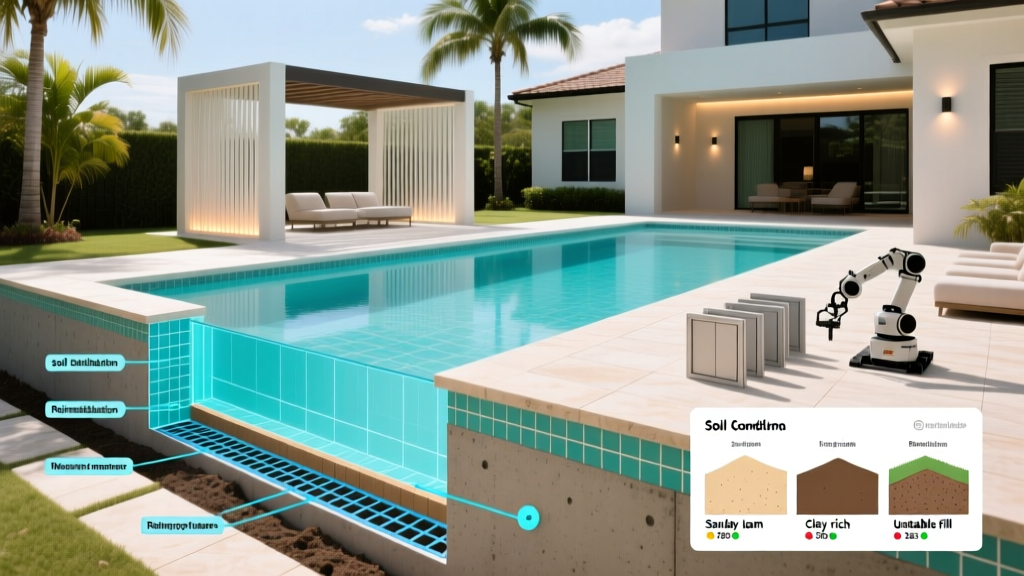
Estimating the cost to build a swimming pool in Florida requires moving beyond national averages. The state's unique subsurface conditions, strict wind-load engineering, and mandatory enclosure requirements create a distinct pricing matrix. When using a size and scope calculator, the base gunite shell is only the starting point. The figures below represent 2026 baseline costs for a standard rectangular gunite pool with a basic white marcite finish, standard coping, and a basic single-speed pump setup, excluding site-specific remediation.
| Pool Dimensions | Surface Area (Sq Ft) | Perimeter (Linear Ft) | Base Gunite Cost Range | Cost Per Sq Ft (Shell Only) |
|---|---|---|---|---|
| 12' x 24' | 288 | 72 | $52,000 - $61,000 | $180 - $211 |
| 14' x 28' | 392 | 84 | $64,000 - $76,000 | $163 - $193 |
| 16' x 32' | 512 | 96 | $78,000 - $94,000 | $152 - $183 |
| 18' x 36' | 648 | 108 | $95,000 - $115,000 | $146 - $177 |
| 20' x 40' (Lap) | 800 | 120 | $112,000 - $135,000 | $140 - $168 |
Notice the economies of scale: as the pool size increases, the cost per square foot of the shell decreases. However, the perimeter dictates the cost of coping, decking, and fencing, which scale linearly. A 16x32 pool is the most common scope in Florida, balancing swim space with the spatial constraints of standard subdivision lots and screen enclosure dimensions.
Calculating the 'Florida Tax': Subsurface & Site Conditions
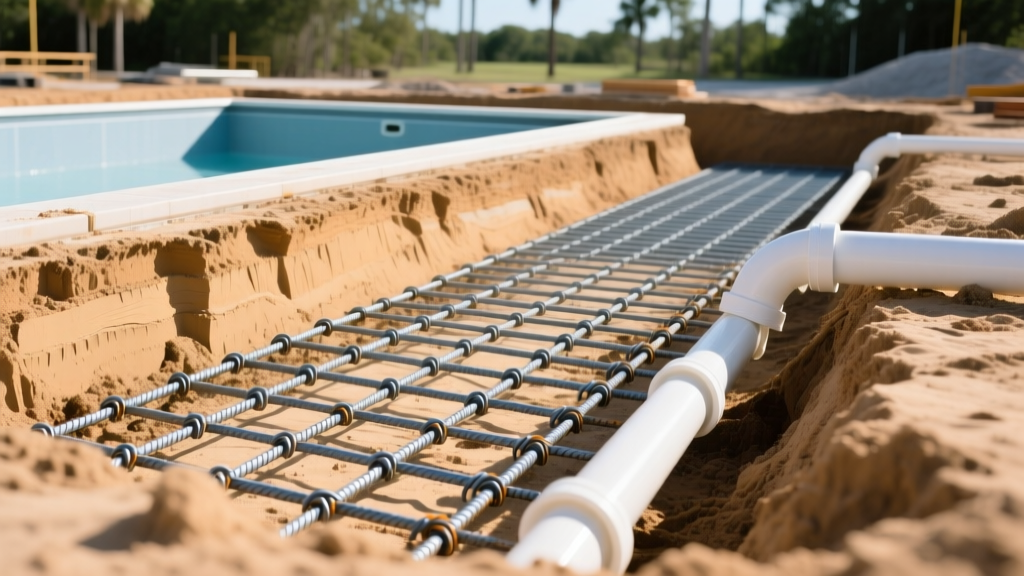
The most volatile variable in any Florida pool cost calculator is the soil. Unlike the clay-heavy soils of the Midwest, Florida's geology is dominated by sugar sand, muck, and a notoriously high water table tied to the Floridan Aquifer. These conditions mandate specific engineering and construction techniques that immediately inflate the base scope.
High Water Table & Dewatering Systems
In coastal counties (Brevard, Volusia, Pinellas) and low-lying inland areas, excavators frequently hit water at just 3 to 5 feet below grade. A standard pool requires a 6-foot deep hopper. To prevent the hole from collapsing or the empty gunite shell from 'floating' out of the ground like a boat before the deck is poured, contractors must install a well-point dewatering system.
- Standard Dewatering (3-5 days): Adds $2,500 - $4,000 to the scope.
- Extended Dewatering (Muck/Artesian springs): Adds $5,000 - $8,500, requiring continuous pumping over 2-3 weeks and potentially a permanent hydrostatic relief valve network.
Soil Stabilization & Limerock Bases
Sugar sand lacks the cohesive strength to support the hydraulic load of a filled pool without shifting. If soil borings reveal loose sand or organic muck, the scope must include over-excavation and backfilling with compacted limerock or flowable fill. Expect to add $3,500 to $7,000 to your calculator for soil stabilization on a 16x32 footprint. Skipping this step risks catastrophic structural cracking within the first three years of the pool's lifecycle.
Scope Multipliers: Enclosures, Equipment, and Finishes
Once the shell and site conditions are calculated, the functional scope dictates the final price. Florida's climate and insect population make certain upgrades practically mandatory, shifting them from 'optional' to 'baseline' in a realistic cost calculator.
Screen Enclosures (Lanais)
Over 80% of residential pools in Central and South Florida are built inside a screen enclosure to block debris, mosquitoes, and UV radiation. Enclosures are priced by cubic volume and wind-load rating.
- Standard Screen (110 mph wind load): $18 - $24 per sq ft of footprint.
- HVHZ Coastal Screen (150+ mph wind load): $28 - $38 per sq ft, requiring heavier extruded aluminum beams and concrete tie-down footings.
- Typical 16x32 Enclosure Cost: $22,000 - $35,000 depending on roof style (mansard vs. gable) and height.
Sanitation & Circulation Equipment
Florida's intense UV index degrades liquid chlorine rapidly, making Saltwater Chlorine Generators (SWCG) the industry standard. Furthermore, utility companies like FPL mandate or heavily incentivize variable-speed pumps.
- SWCG System (e.g., Pentair IntelliChlor IC40 or Hayward AquaRite): $1,800 - $2,600 installed. Note: Salt systems require a sacrificial zinc anode ($150) to prevent corrosion of copper heat exchangers in gas heaters.
- Variable Speed Pump (e.g., Pentair IntelliFlo VSF): $2,200 - $2,800. According to the U.S. Department of Energy, variable speed pumps reduce pool circulation energy costs by up to 70% compared to single-speed models, a critical factor given Florida's year-round swim season.
Interior Finishes
Standard white marcite is rarely used in modern Florida builds due to its susceptibility to algae staining and chemical etching in high-heat water. The scope calculator should default to exposed aggregate finishes.
- Standard Marcite: $5 - $7 per sq ft (Base)
- Exposed Aggregate (e.g., PebbleTec or Diamond Brite): $9 - $14 per sq ft. Adds $4,000 - $7,000 to a 16x32 pool but extends the resurfacing lifecycle from 7 years to 15+ years.
Step-by-Step Size & Scope Cost Buildup
To demonstrate how the calculator synthesizes these variables, consider a realistic scope for a 14x28 gunite pool in Orlando (Orange County), featuring a high water table, a screen enclosure, and upgraded equipment.
- Base Shell (14x28): $68,000
- Site Prep (Dewatering & Limerock): $5,500
- Interior Finish (PebbleTec upgrade): +$4,500
- Equipment (VS Pump + SWCG + Automation): $6,200
- Decking (600 sq ft brushed concrete): $5,400 ($9/sq ft)
- Screen Enclosure (Standard Mansard): $24,000
- Permitting, Engineering & Surveys: $3,200
Total Estimated Scope Cost: $116,800. This reflects the true turnkey reality of building a mid-sized pool in Florida, far exceeding the $50,000 national averages often cited in generic online estimators.
Permitting & Code Requirements
Florida enforces some of the strictest pool barrier laws in the country to prevent child drownings. Under the Residential Swimming Pool Barrier Act, your scope must include compliant safety features. The Florida Department of Health mandates that all residential pools have a barrier at least 4 feet high with no gaps exceeding 4 inches. Furthermore, doors providing direct access from the home to the pool must be equipped with approved alarms, or the pool must feature a certified safety cover. Budget $800 - $1,500 for code-compliant fencing, self-closing/self-latching gate hardware, and door alarms if your screen enclosure does not serve as the primary barrier.
Frequently Asked Scope Questions
Does adding a spa significantly increase the scope?
Yes. Integrating a raised spillway spa adds $12,000 - $18,000 to the base cost. This includes the structural tie-in, a dedicated booster pump, an air blower for the spa jets, and the complex plumbing required to manage the hydraulic head difference between the spa and the main pool.
How do I calculate the cost of a saltwater system vs. traditional chlorine?
While a saltwater system adds roughly $2,000 to the initial construction scope, it reduces annual chemical expenditures by $400 - $600. In Florida's 10-month swim season, the ROI on a salt system is typically realized within 3.5 years, making it a mathematically sound inclusion in any long-term scope calculator.
What is the cost impact of a tanning ledge?
A Baja shelf or tanning ledge (typically 8-12 inches deep) adds $3,500 - $5,500. It requires additional forming, specialized plumbing returns to ensure shallow water circulation, and often a secondary umbrella sleeve core-drilled into the shelf concrete.
Written by
Elena RodriguezElena Rodriguez is a civil engineer and technical writer specializing in concrete technology, masonry systems, and ASTM/ACI compliance. She earned her B.S. in Civil Engineering from Texas A&M University and spent a decade at a materials testing laboratory, performing over 2,000 concrete compressive strength tests and masonry prism evaluations. Elena is an ACI-certified Field Testing Technician (Grade I) and a member of ASTM Committee C12 on Natural Building Stone. She currently consults on forensic engineering cases involving concrete failures and moisture intrusion. Based in San Antonio, TX, Elena is a proud member of the Society of Women Engineers (SWE) and coaches her daughter's FIRST Robotics team.
More from Elena Rodriguez
View all
Walls & Panels
Cost Analysis: Light Gauge Steel Framing Advantages and Disadvantages
Evaluate light gauge steel framing advantages and disadvantages through a strict cost analysis lens, comparing material, labor, and lifecycle expenses.
Aug 4, 2026

Walls & Panels
Gypsum Board Types: Exact Specifications, Thickness & Dimensions
Compare standard, Type X, and moisture-resistant gypsum board types. Get exact specifications, thicknesses, dimensions, and ASTM standards for your project.
Aug 4, 2026

Fire Resistance
Best Fire-Resistant Outdoor Decking Materials: 2026 Buyer Guide
Discover the best fire-resistant outdoor decking materials for 2026. Compare Class A PVC, aluminum, and hardwood options for WUI compliance and safety.
Aug 4, 2026