How Much Does It Cost GM to Build a Truck? 2026 Breakdown
Discover exactly how much it costs GM to build a truck in 2026. We break down the Bill of Materials, UAW labor rates, R&D, and profit margins.
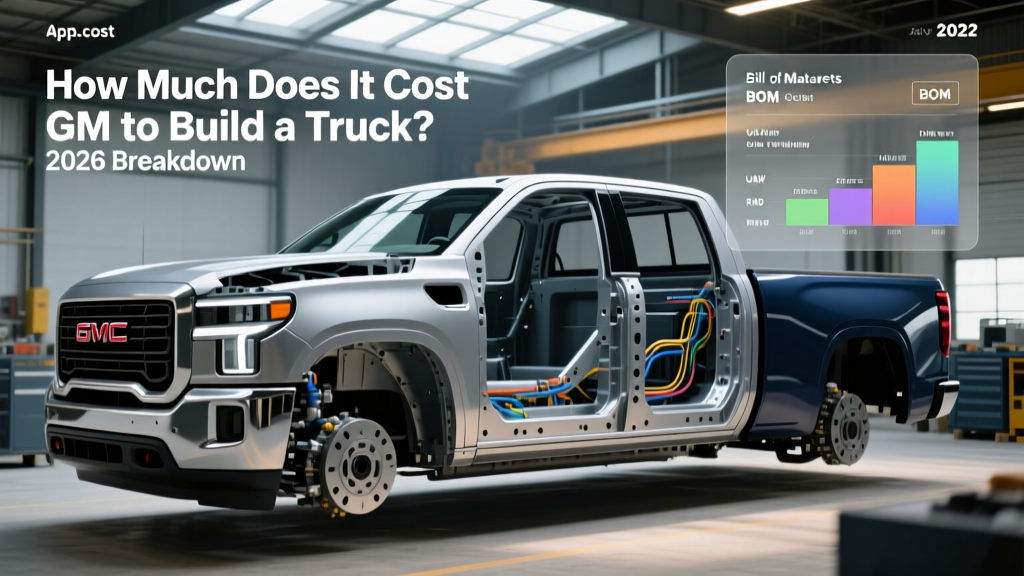
The Anatomy of the GM Truck Price Tag
When a consumer purchases a mid-tier Chevrolet Silverado 1500 or GMC Sierra for $55,000, the sticker price reflects a complex web of global supply chains, union labor agreements, and corporate amortization. For construction fleet managers, automotive investors, and procurement analysts, understanding the actual manufacturing cost of a full-size pickup is critical for forecasting commercial vehicle pricing and evaluating OEM profitability. General Motors (GM) produces some of the most profitable vehicles in the automotive sector, but the margin is not simply the difference between raw steel and the showroom floor.
This complete cost guide dissects the factory-gate economics of building a GM full-size truck in 2026. We analyze the Bill of Materials (BOM), the financial impact of the latest United Auto Workers (UAW) collective bargaining agreements, plant overhead, and the hidden costs of R&D amortization. Data synthesis is drawn from GM Investor Relations Annual Reports, teardown analyses by automotive engineering firms, and UAW-GM Collective Bargaining Agreement Highlights.
2026 GM Truck Production Quick Stats
- Average Wholesale Revenue (per unit): $49,500
- Total Estimated Factory Cost: $35,200 - $38,800
- Average Gross Margin per Truck: $10,700 - $14,300
- Primary Assembly Hubs: Fort Wayne (IN), Flint (MI), Silao (Mexico)
Bill of Materials (BOM): The Raw Hardware Costs
The Bill of Materials represents the direct cost of the physical components required to assemble the vehicle. For a modern GM T1-platform truck (Silverado/Sierra 1500), the BOM is heavily influenced by commodity fluctuations in aluminum, high-strength boron steel, and semiconductor pricing. Based on industry teardown benchmarks, the BOM for a moderately equipped 4WD crew cab accounts for roughly 50% to 55% of the total manufacturing cost.
| Component Category | Estimated Cost (Mid-Tier 1500) | Key Materials & Suppliers |
|---|---|---|
| Body, Frame & Bed | $5,400 | High-strength steel, aluminum alloys (Nucor, Alcoa) |
| Powertrain (ICE V8/TurboMax) | $7,200 | Cast iron blocks, forged internals, 10-speed trans |
| Interior, Infotainment & Glass | $4,100 | Leather, acoustic glass, Snapdragon automotive chips |
| Suspension, Axles & Drivetrain | $2,800 | Dana axles, Multimatic dampers, transfer cases |
| Electrical Architecture & Wiring | $1,900 | Copper harnesses, ADAS sensors, domain controllers |
| Wheels, Tires & Brakes | $1,450 | Michelin/Goodyear rubber, Brembo calipers |
| Paint, Coatings & Fluids | $950 | E-coat primers, polyurethane clear coats, synthetics |
| Total Estimated BOM | $23,800 | Varies by trim (Denali/High Country adds ~$6,000) |
The EV Shift: Silverado EV BOM Variance
As GM scales production of the Silverado EV at Factory ZERO in Detroit-Hamtramck, the BOM structure shifts dramatically. The internal combustion engine (ICE) and multi-speed transmission are eliminated, saving roughly $5,500 in machining and assembly complexity. However, this is offset by the Ultium battery pack. A 200-kWh battery pack, at current industry estimates of $110 per kWh, adds approximately $22,000 to the BOM. Consequently, the raw hardware cost of a long-range Silverado EV is roughly $12,000 to $15,000 higher than its ICE counterpart, necessitating higher MSRP pricing to maintain margin parity.

UAW Labor and Assembly Costs
Direct and indirect labor constitutes the second largest variable in GM truck production. The financial landscape of assembly labor was fundamentally altered by the 2023 UAW strike and subsequent collective bargaining agreement, which instituted immediate wage hikes and a compressed timeline to top-tier pay, fully realized by 2026.
Building a full-size truck requires approximately 18 to 24 hours of direct touch-labor per unit, depending on the complexity of the trim (e.g., installing a Denali interior with massaging seats takes longer than a base Work Truck). At a fully loaded rate of $75/hour, direct assembly labor costs roughly $1,650 per vehicle.
However, direct labor is only part of the equation. Indirect labor—which includes plant maintenance crews, quality control inspectors, material handlers, and line supervisors—adds an additional $1,400 per unit. Therefore, the total plant labor cost embedded in a GM truck sits between $3,050 and $3,200.
Overhead, R&D, and Logistics
The factory gate cost extends far beyond parts and payroll. GM must allocate massive capital expenditures (CapEx) and operational expenditures (OpEx) across its production volume.
- Plant Overhead & Energy ($2,800 per unit): Running a massive stamping and assembly facility requires immense electrical power, natural gas for paint ovens, and water for treatment facilities. Furthermore, the depreciation of robotic welding arms, stamping presses, and automated guided vehicles (AGVs) is amortized into the cost of each truck.
- Warranty Reserves ($1,200 per unit): GM legally and financially must set aside capital to cover future powertrain and bumper-to-bumper warranty claims. For full-size trucks, which endure heavy commercial and towing use, this reserve is strictly calculated based on historical claim data.
- R&D Amortization ($3,500 per unit): Developing the T1 platform, engineering the TurboMax engine, and validating ADAS (Advanced Driver Assistance Systems) like Super Cruise costs billions. These engineering costs are divided by the projected lifecycle volume of the truck (typically 4-6 million units over a 7-year generation).
- Logistics & Freight ($950 per unit): Moving a finished 5,500-pound truck from an assembly plant in Mexico or Indiana to a dealership in California or New York via rail and car-hauler trailers is a major expense. GM absorbs a portion of this freight cost before invoicing the dealer.
Manufacturing Cost vs. MSRP: Where Does the Margin Go?
A common misconception is that the difference between the BOM and the MSRP is pure profit for the automaker. In reality, the margin is distributed across corporate operations, marketing, and the dealer network.
"The full-size pickup truck is the financial engine of the Detroit Three. While a compact crossover might yield a 4% to 6% operating margin, a well-equipped Silverado or Sierra can generate operating margins exceeding 15%, effectively subsidizing the development of next-generation electric and autonomous platforms."
— Automotive Industry Margin Analysis, Center for Automotive Research
Let us map the financial journey of a 2026 GMC Sierra SLT with an MSRP of $62,000:
- MSRP: $62,000
- Dealer Holdback & Incentives: -$3,500 (Funds kept by or returned to the dealer)
- GM Wholesale Invoice Revenue: $58,500
- Total Factory Cost (BOM + Labor + Overhead + R&D): -$36,500
- Gross Manufacturing Margin: $22,000
- SG&A (Marketing, Corporate Salaries, IT): -$7,500
- Net Operating Profit per Truck: ~$14,500
This $14,500 net operating profit per unit is what GM ultimately uses to pay dividends to shareholders, service corporate debt, and fund the capital-intensive transition to electric vehicle battery plants (Ultium Cells).
FAQ: GM Truck Production Economics
Does it cost GM more to build a heavy-duty (2500/3500) truck than a 1500?
Yes. Heavy-duty trucks require significantly more raw material, including fully boxed high-strength steel frames, larger Dana axles, and heavy-duty cooling systems. The BOM for a Silverado 2500HD is typically $3,500 to $5,000 higher than a 1500. However, because HD trucks command a much higher MSRP and are frequently ordered with expensive diesel powertrains (the Duramax V8), the absolute dollar margin on an HD truck is often higher despite the increased build cost.
How do Mexican assembly plants affect GM truck costs?
GM produces a substantial portion of its light-duty and regular cab trucks at its Silao Assembly complex in Guanajuato, Mexico. While the BOM remains largely identical, the labor cost differential is stark. Fully loaded manufacturing labor in Mexico can be 60% to 70% lower than UAW-represented plants in the US, allowing GM to protect margins on lower-trim, high-volume fleet trucks where pricing pressure from competitors like Ford and Ram is most aggressive.
What happens to GM truck margins during a steel tariff or commodity spike?
Commodity volatility directly impacts the BOM. A 10% spike in global steel or aluminum prices can add $300 to $500 to the cost of a single truck. Rather than absorbing this entirely, GM typically utilizes a mix of supplier cost-down mandates, reducing hidden dealer incentives, and introducing mid-year package price adjustments to pass a portion of the commodity inflation to the end consumer.
Written by
David NakamuraDavid Nakamura is a licensed architect (AIA) and construction technology writer focused on sustainable building methods, mass timber engineering, and high-performance building envelopes. He holds a Master of Architecture from the University of Washington and is a certified Passive House Consultant (CPHC). David spent eight years at the Seattle firm Mithun, where he led the design of three LEED Platinum projects, before founding his own practice specializing in net-zero residential design. He serves on the editorial advisory board of GreenBuilder Magazine and has authored peer-reviewed papers on cross-laminated timber (CLT) connections for the Journal of Structural Engineering. In his spare time, David teaches woodworking at Pratt Fine Arts Center and kayaks the Puget Sound.
More from David Nakamura
View all
Construction Cost
Labor Cost to Build a Deck Per Sq Ft: 2026 Installation Guide
Discover the exact labor cost to build a deck per sq ft in 2026. This installation guide breaks down contractor rates, complexity factors, and hidden fees.
Aug 4, 2026

Construction Cost
How Much Does It Cost to Build a 3 Bedroom House? Financing Guide
Learn exactly how much it costs to build a 3 bedroom house and explore 2026 financing options, construction loan types, and budget frameworks for your build.
Aug 4, 2026

Construction Cost
Cost to Build a Tennis Court: 2026 Guide
How much does it cost to build a tennis court in 2026? Breakdowns for asphalt, concrete, and synthetic surfaces plus fencing and lighting.
Jul 30, 2026