How Much Does It Cost to Build a House in Houston in 2026?
Discover exactly how much it costs to build a house in Houston in 2026. Get real per-square-foot pricing, soil prep costs, and climate-specific budgets.
The True Baseline: Houston Construction Costs Per Square Foot
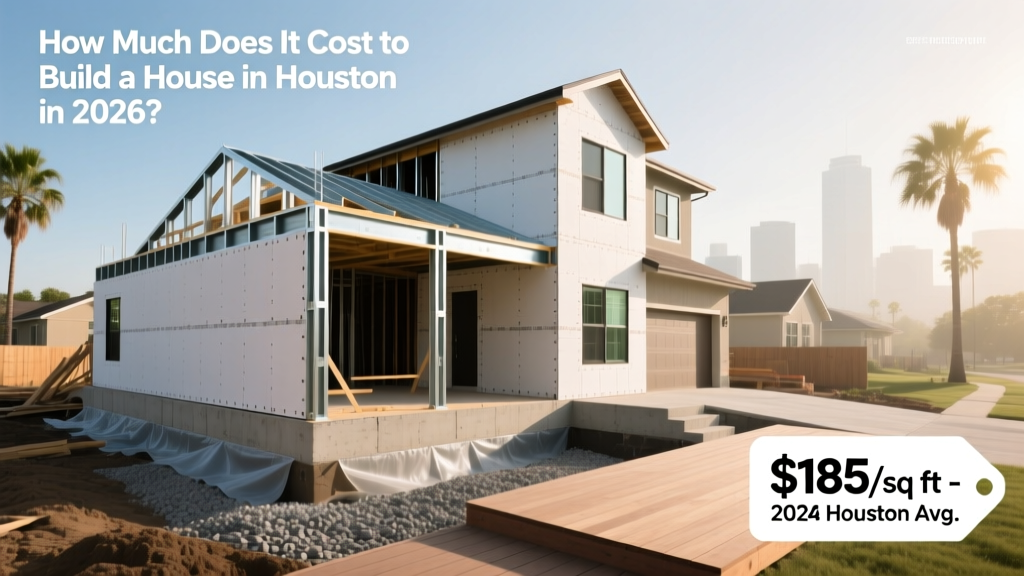
Estimating construction costs in the Greater Houston area requires a localized approach. National averages fail to account for the region's unique geological and meteorological challenges. As of 2026, the cost to build a single-family home in Houston ranges significantly based on the level of customization, lot preparation, and specific municipal codes in areas like Katy, The Woodlands, or Sugar Land.
According to recent data from the National Association of Home Builders (NAHB), regional labor and material fluctuations have stabilized compared to the early 2020s, but specialized engineering requirements keep Houston's baseline costs distinct.
| Build Tier | Cost Per Sq. Ft. (2026) | Total Est. (2,500 Sq. Ft.) | Typical Specifications |
|---|---|---|---|
| Production / Tract | $135 - $165 | $337,500 - $412,500 | Standard rebar slab, asphalt shingles, 16 SEER2 HVAC, vinyl plank flooring. |
| Semi-Custom | $170 - $225 | $425,000 - $562,500 | Post-tension slab, engineered hardwood, spray foam insulation, quartz counters. |
| Luxury Custom | $250 - $375+ | $625,000 - $937,500+ | Drilled pier foundation, standing seam metal roof, smart home integration, outdoor kitchen. |
Houston-Specific Cost Drivers (The 'Hidden' Expenses)
Building in Southeast Texas introduces environmental variables that directly impact your budget. Ignoring these during the estimating phase is the primary reason local builds run over budget.
1. Expansive Clay Soil & Foundation Engineering
Houston sits atop the Beaumont Formation, notorious for its 'black gumbo' clay. This soil expands dramatically when wet and shrinks during droughts, exerting thousands of pounds of upward pressure on concrete. A standard rebar-reinforced slab-on-grade will almost certainly crack and compromise the structural integrity of the home.
- Post-Tensioned (PT) Slabs: The standard for Houston production and semi-custom homes. Steel cables are tensioned after the concrete cures, compressing the slab and resisting soil movement. Cost: $7.50 - $9.50 per sq. ft.
- Drilled Bell Piers: Required for luxury builds or lots with extreme soil plasticity. Concrete is poured 15 to 25 feet deep into the ground, bypassing the active clay layer to anchor the home in stable bedrock or deep sand. Cost: $12.00 - $18.00 per linear foot (adds $15,000 - $30,000 to the foundation budget).
2. Windstorm & Flood Zone Compliance
Proximity to the Gulf Coast means Houston builders must adhere to strict windstorm and floodplain regulations. The Harris County Flood Control District enforces rigorous drainage and elevation standards, especially in the 100-year and 500-year floodplains.
- FEMA Base Flood Elevation (BFE): If your lot is in a flood zone, the finished floor must be elevated above the BFE. This requires importing compacted fill dirt. In 2026, engineered fill dirt costs $35 - $55 per cubic yard, delivered and compacted. Elevating a 2,500 sq. ft. pad by two feet can add $12,000 - $18,000 to site prep.
- IBHS FORTIFIED Roofing: To secure affordable windstorm insurance, many Houston builders now adopt the Insurance Institute for Business & Home Safety (IBHS) FORTIFIED standard. This requires a sealed roof deck (peel-and-stick underlayment) and 6-inch ring-shank roofing nails. Cost Premium: $2,500 - $4,500 over standard roofing.
3. High-Performance HVAC & Insulation
Houston's climate features 95°F+ summer days coupled with 80% ambient humidity. Standard HVAC systems cool the air but fail to remove latent moisture, leading to mold and warped wood floors.
- SEER2 Ratings: Current 2026 energy codes and practical comfort demands require a minimum 16 SEER2 rating. Variable-speed compressors (like the Trane XV20i or Carrier Infinity series) are highly recommended to run continuously at low speeds, maximizing dehumidification. Cost: $8,500 - $14,000 for a dual-zone system.
- Insulation: Open-cell spray foam (R-13 to R-15 in walls) and closed-cell spray foam (R-38+ in rooflines) create a conditioned attic space, preventing HVAC ductwork from sweating in the humid Houston summer. Cost: $4,500 - $7,000 for a full spray foam envelope.
Material Matrix: Optimized for the Houston Climate
Choosing materials based purely on aesthetics leads to premature degradation in Southeast Texas. Use this matrix to select materials that withstand high UV index, torrential downpours, and high humidity.
| Component | Poor Choice (Avoid) | Optimal Houston Choice | Why It Works |
|---|---|---|---|
| Exterior Siding | Traditional Wood Clapboard | Fiber Cement (e.g., James Hardie) | Impervious to termites, rot, and high humidity; holds paint 2x longer. |
| Roofing | Standard 3-Tab Asphalt | Architectural Shingles (IKO Dynasty) | Heavier mat, higher wind uplift rating (130 mph), algae-resistant granules. |
| Subfloor | Standard OSB | Advantech Engineered Panels | Resists swelling and delamination if exposed to rain during the framing stage. |
| Interior Paint | Flat / Matte Latex | Eggshell / Satin Acrylic-Enamel | Withstands frequent wiping; resists mildew in high-humidity rooms. |
Step-by-Step Budget Allocation for a 2,500 Sq. Ft. Semi-Custom Home
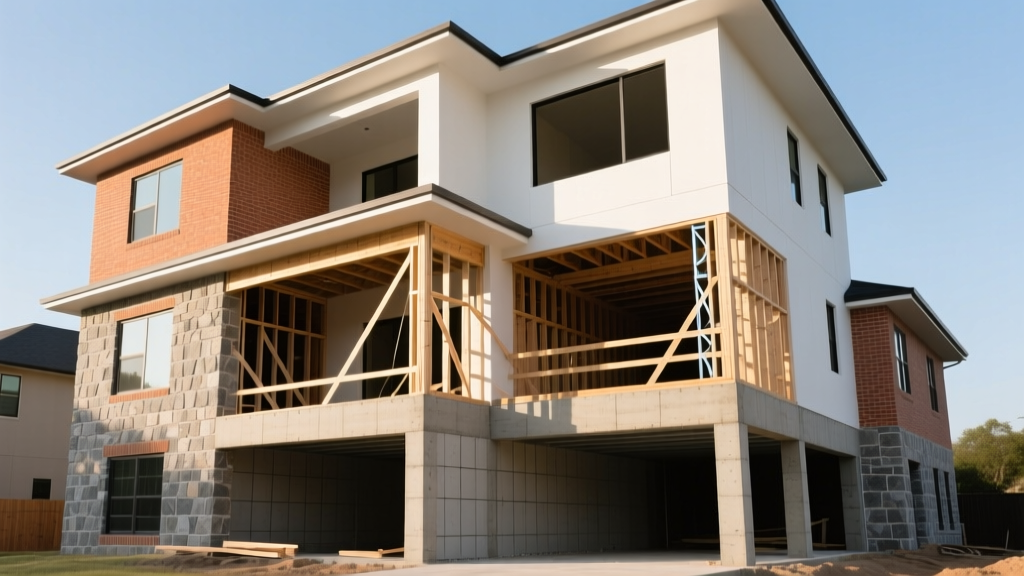
To understand where your money goes, here is a realistic percentage breakdown for a $500,000 semi-custom build in a master-planned community like Bridgeland or Sienna.
- Site Work & Foundation (12% | $60,000): Clearing, grading, fill dirt, and post-tensioned slab engineering.
- Framing & Exterior Shell (22% | $110,000): Lumber packages, engineered trusses, fiber cement siding, and architectural roofing.
- Major Systems (16% | $80,000): High-SEER2 HVAC, PEX plumbing, and 200-amp electrical with smart panel integration.
- Interior Finishes (28% | $140,000): Drywall, spray foam insulation, engineered hardwood, custom cabinetry, and quartz countertops.
- Landscaping & Hardscaping (8% | $40,000): Bermuda sod, concrete driveway, sprinkler system, and patio slab.
- Permits, Fees & Soft Costs (7% | $35,000): Municipal permits, impact fees, architectural plans, and soil testing.
- Builder Overhead & Profit (7% | $35,000): Standard margin for custom and semi-custom general contractors.
Pro-Tip for Houston Builders: Always allocate a 10% contingency fund specifically for 'weather days' and soil remediation. Houston's spring and early summer can bring weeks of torrential rain, delaying concrete pours and framing, which extends equipment rental and labor holding costs.
Frequently Asked Questions
FAQ: How much does it cost to build a house houston vs. Dallas?
Generally, building in Houston is 5% to 8% cheaper per square foot than in Dallas-Fort Worth. Dallas features rockier soil (requiring expensive rock excavation for foundations) and stricter winterization codes. However, Houston's costs for flood mitigation, fill dirt, and advanced HVAC dehumidification can narrow this gap depending on the exact lot location.
Are solar panels worth the investment for new Houston builds?
Yes, but with caveats. Houston receives abundant sun, but the primary ROI comes from offsetting the massive summer cooling loads. A 10kW solar array with a battery backup (like the Tesla Powerwall) costs roughly $35,000 - $45,000 before the 30% federal tax credit. It is highly recommended for homes in areas prone to grid instability during hurricane season or summer heat domes.
How long does it take to build a house in Houston?
A production home in a tract neighborhood takes 5 to 7 months. A semi-custom or fully custom home typically takes 9 to 14 months. Delays are most frequently caused by municipal permitting backlogs in rapidly expanding counties (like Montgomery or Fort Bend) and seasonal rain events halting foundation and framing work.
Written by
Marcus ChenMarcus Chen is a licensed structural engineer (PE) and building materials analyst with over 12 years of experience across residential, commercial, and industrial construction. He holds a Master of Science in Civil Engineering from UC Berkeley and spent six years at Thornton Tomasetti before transitioning to independent consulting and technical writing. Marcus specializes in material selection for seismic-prone regions, concrete reinforcement strategies, and lifecycle cost analysis. His work has been cited by the American Concrete Institute (ACI) and the Structural Engineers Association of California (SEAOC). When he is not on a job site or at his desk, you will find him hiking the Sierra Nevada or restoring a 1920s craftsman bungalow in Oakland, CA.
More from Marcus Chen
View all
Construction Cost
How Much Did the Eiffel Tower Cost to Build?
How much did the Eiffel Tower cost to build in 1889? We adjust for inflation and compare its budget to modern skyscraper construction.
Aug 4, 2026

Fire Resistance
What Is a Fire Resistant Material? Testing & Certification Guide
Discover what is a fire resistant material through ASTM and UL testing. Learn how fire ratings, certifications, and assemblies work in construction.
Aug 4, 2026

Construction Cost
How Much Did the Burj Khalifa Cost to Build?
How much did the Burj Khalifa cost to build? We break down the $1.5B project and extract 5 money-saving strategies for your next build.
Jul 30, 2026