How Much Does It Cost to Build an Indoor Pool? Size & Scope Guide
Calculate exactly how much it costs to build an indoor pool. Break down size, HVAC dehumidification, vapor barriers, and scope modifiers with 2026 pricing.
The Baseline: Understanding Indoor Pool Economics
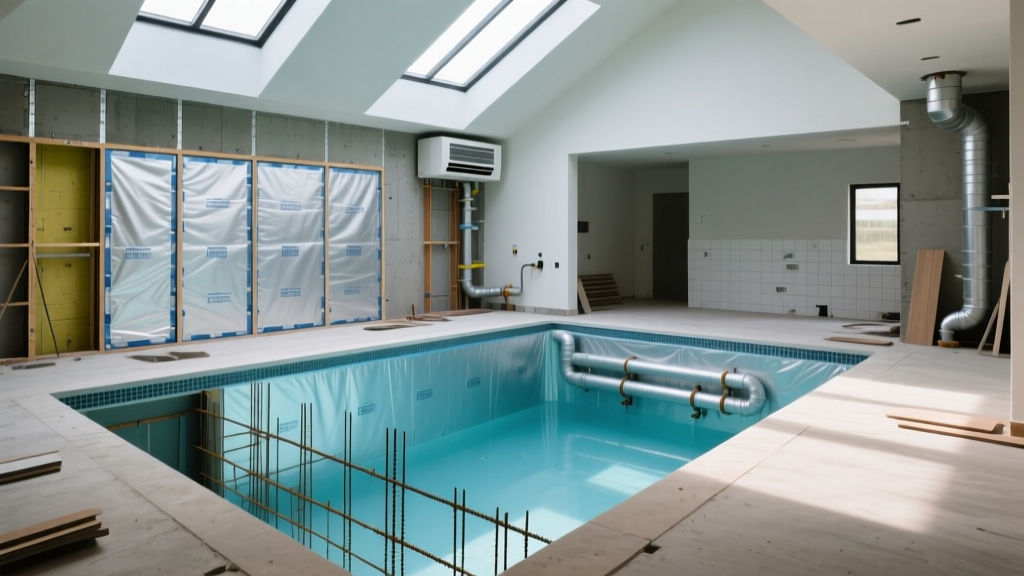
When evaluating how much does it cost to build an indoor pool, the project must be approached as a commercial-grade mechanical engineering challenge rather than a standard residential landscaping upgrade. An indoor pool requires managing massive latent heat loads, aggressive vapor drive, and corrosive off-gassing. In 2026, the total cost to build a fully enclosed, climate-controlled indoor pool ranges from $180,000 to $450,000+. The final price is dictated by the physical dimensions of the water vessel, the cubic volume of the enclosing structure, and the complexity of the dehumidification systems required to prevent structural rot.
Size-to-Cost Matrix: The Water Vessel
The pool shell itself typically accounts for 30% to 40% of the total project budget. Shotcrete (pneumatically applied concrete) remains the industry standard for indoor pools due to its structural integrity and ability to form custom shapes without the crane-access limitations of precast fiberglass shells. Below is a scope calculator breaking down base construction costs by standard indoor pool sizes.
| Pool Classification | Dimensions | Surface Area | Approx. Volume | Base Shell & Plumbing Cost |
|---|---|---|---|---|
| Plunge / Therapy | 10' x 20' | 200 sq ft | 8,000 gal | $65,000 - $85,000 |
| Standard Lap Pool | 10' x 40' | 400 sq ft | 16,000 gal | $110,000 - $145,000 |
| Family Recreation | 18' x 36' | 648 sq ft | 28,000 gal | $160,000 - $210,000 |
| Estate / Commercial | 20' x 50' | 1,000 sq ft | 45,000 gal | $240,000 - $310,000 |
Note: Base costs include excavation, structural shotcrete, standard white plaster finish, and basic plumbing. They do not include the enclosing structure or HVAC systems.
The Enclosure and HVAC Scope (The True Cost Driver)
The most critical variable in your scope calculator is the mechanical dehumidification system. An indoor pool continuously evaporates water; a standard 400-square-foot pool surface can evaporate up to 15 gallons of water per day into the ambient air. If left unchecked, this moisture will condense on cold surfaces, leading to catastrophic structural failure, mold proliferation, and rusted steel trusses.
Sizing the Dehumidifier
Dehumidifier sizing is calculated based on the pool surface area, the wet deck area, and the desired room temperature. The industry standard requires the ambient air temperature to be maintained exactly 2°F above the water temperature to minimize evaporation. For a 400-square-foot pool, expect to pay between $45,000 and $75,000 for a properly sized commercial dehumidification unit (typically 8 to 12 tons of cooling capacity), including the specialized ductwork required to sweep dry air across all exterior glass and wall surfaces to prevent condensation.
Vapor Drive and Structural Protection Scope
Water vapor moves from areas of high pressure (the warm, humid pool room) to areas of low pressure (the cold exterior walls). This phenomenon, known as vapor drive, requires specialized enclosure scoping.
- Closed-Cell Spray Foam Insulation: Standard fiberglass batt insulation will absorb moisture and fail. The enclosure must be insulated with closed-cell spray foam, which provides an R-value of approximately R-7 per inch while acting as a Class II vapor retarder. Budget $2.50 to $3.50 per board foot.
- Vapor Barriers: A continuous 6-mil polyethylene vapor barrier must be installed on the warm-in-winter side of the wall assembly, or a specialized vapor-retarding primer (such as Sherwin-Williams Waterbased Alkyd) must be applied to all drywall surfaces.
- Corrosion-Resistant Materials: Standard steel fasteners, HVAC registers, and light fixtures will corrode within months. The scope must specify 316-grade stainless steel or heavy-duty polymer alternatives for all exposed hardware.
Sanitization Scope for Indoor Environments
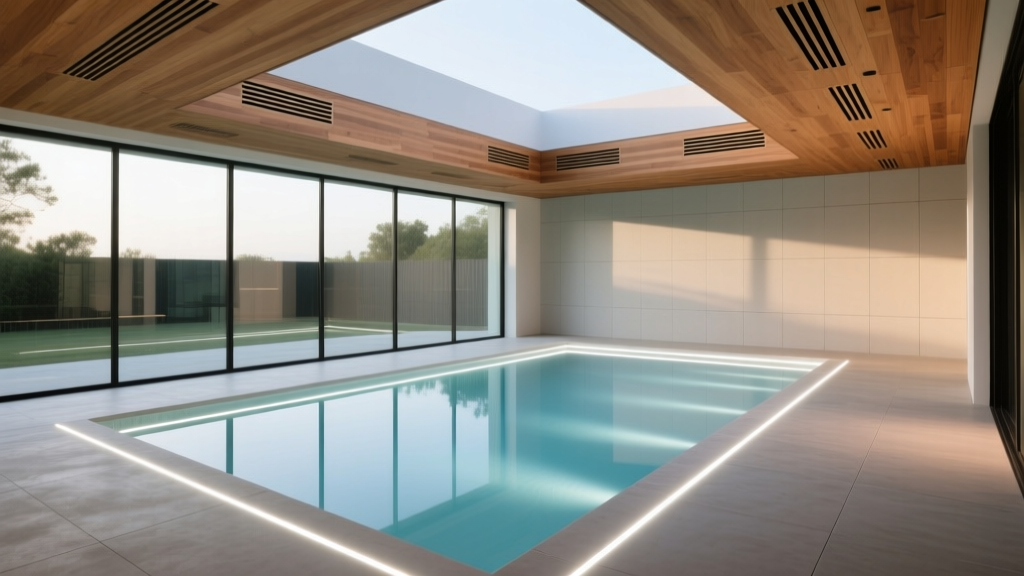
Outdoor pools rely on ultraviolet (UV) sunlight to break down combined chlorine (chloramines). Indoor pools lack this natural UV exposure, allowing chloramines to accumulate and off-gas into the air. This causes the strong 'pool smell' and creates a highly corrosive acidic environment that destroys structural steel and mechanical components.
To mitigate this, your scope must include secondary sanitization systems. Installing a UV-C sanitization system (such as those manufactured by ClearComfort or Pentair) or a corona discharge ozone generator reduces chlorine dependency by up to 70% and eliminates airborne chloramines. Budget an additional $4,500 to $8,500 for commercial-grade UV-C integration, which aligns with CDC guidelines for healthy indoor aquatic environments regarding air quality management.
Scope Modifiers and Feature Adders
Custom features drastically alter the mechanical and structural scope of the project. Use this checklist to calculate your specific adders:
| Feature Modifier | Cost Adder | Scope Impact |
|---|---|---|
| Automated Safety Cover (e.g., Coverstar) | $12,000 - $18,000 | Reduces evaporation by 90%, allowing for a smaller, cheaper dehumidifier. |
| Infinity Edge / Vanishing Edge | $35,000 - $60,000 | Requires a secondary catch basin, surge tank, and complex hydraulic balancing. |
| Swim Jet System (e.g., Badujet) | $8,000 - $14,000 | Requires dedicated high-flow plumbing lines and a separate booster pump. |
| Condensation-Resistant Glazing | $120 - $180 / sq ft | Triple-pane, argon-filled, thermally broken aluminum frames are mandatory to prevent window weeping. |
Operational Cost Projections
The financial scope extends beyond construction. Maintaining an 84°F water temperature and an 86°F ambient room temperature year-round requires significant energy. According to the U.S. Department of Energy, pool heating and continuous dehumidification represent the bulk of ongoing aquatic facility costs.
For a standard 10' x 40' indoor pool, expect monthly utility costs (electricity for pumps and dehumidifiers, plus gas for water heating) to range from $450 to $800 during peak winter months, dropping to $200 to $350 in the summer when ambient exterior temperatures assist with thermal management.
Final Scope Calculation
To accurately determine your final budget, sum the base shell cost corresponding to your desired dimensions, add the enclosure construction costs (typically $150 to $250 per square foot of floor space), integrate the $45,000+ mechanical dehumidification baseline, and layer on your chosen feature modifiers. Precision in the scoping phase—particularly regarding vapor management and air handling—is the only way to ensure the longevity of the structure and the health of the indoor environment.
Written by
Priya KapoorPriya Kapoor is a real estate market analyst and construction economics researcher with expertise in housing affordability, development feasibility, and infrastructure investment. She holds a Master of Regional Planning from Cornell University and previously worked as a senior analyst at CBRE's Investment Properties group, where she modeled returns for $4B in mixed-use development pipelines. Priya now runs an independent research practice advising developers, municipalities, and REITs on construction cost forecasting and market timing. She publishes the quarterly "BuildMat Market Pulse" report tracking material price indices across 12 commodity categories. Based in Austin, TX, Priya serves on the board of Habitat for Humanity Austin and is a marathon runner.
More from Priya Kapoor
View all
Construction Cost
Cost to Build a 1600 Sq Ft Home in 2026: Full Breakdown
Accurate 2026 cost to build a 1600 sq ft home—material, labor, and regional pricing breakdowns included. Plan your budget with real-time estimates.
Aug 11, 2026

Wood & Lumber
Name the Types of Wood for Pressure Treatment and Preservation
Learn how to name the types of wood best suited for pressure treatment. Compare species treatability, chemical retention levels, and 2026 preservation costs.
Aug 4, 2026

Stone & Masonry
Stone Veneer Suppliers Lindenhurst: 2026 Cost Analysis
Analyze 2026 stone veneer costs in Lindenhurst, NY. Compare local supplier pricing, delivery fees, and Suffolk County installation labor rates.
Aug 4, 2026