Regional Cost Per Square Foot to Build a Luxury Home in 2026
Discover the 2026 regional cost per square foot to build a luxury home. Compare pricing across US markets, from coastal California to the Mountain West.
The Geography of High-End Construction: Why Location Dictates Price
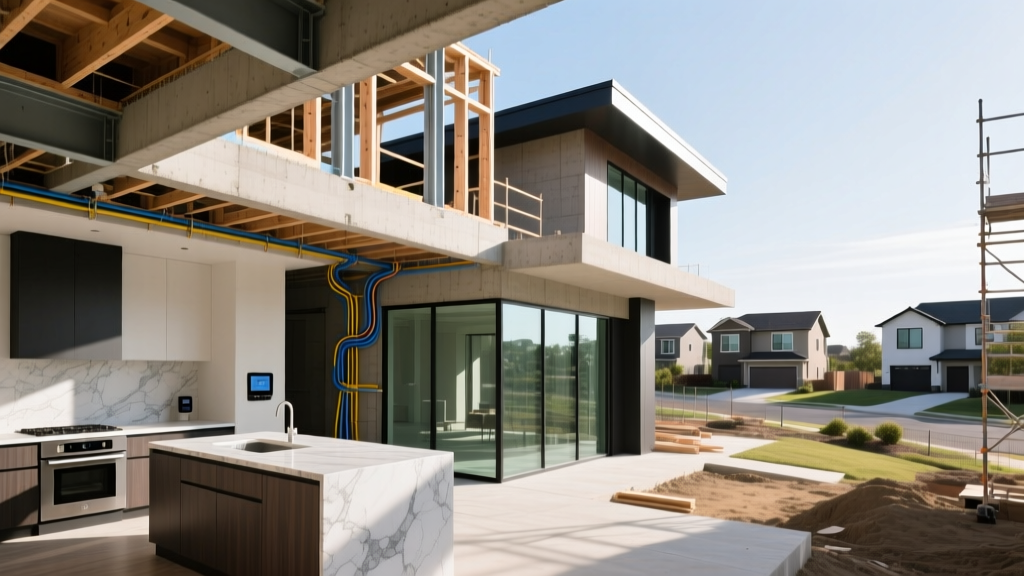
Estimating the cost per square foot to build a luxury home requires moving beyond national averages. In 2026, the delta between building a custom estate in Greenwich, Connecticut, and a similarly appointed residence in Austin, Texas, can exceed $450 per square foot. This disparity is not merely a reflection of land values; it is driven by localized labor markets, stringent regional building codes, topographical challenges, and supply chain logistics for premium materials.
According to the National Association of Home Builders (NAHB), custom luxury builds (defined as the top 10% of the market by finish quality and mechanical complexity) operate on an entirely different cost matrix than production housing. When analyzing data from RSMeans construction cost databases, we see that high-end residential construction is heavily influenced by micro-economic factors that national indices often obscure.
2026 Regional Cost Matrix: Cost Per Square Foot to Build a Luxury Home
The following matrix breaks down the hard construction costs (excluding land acquisition, architectural fees, and soft costs) for a 6,000-square-foot custom luxury residence across major U.S. geographies. These figures assume premium fenestration, structural envelope upgrades, and Level 4 interior finishes.
| Region | Cost Range (Per Sq Ft) | Primary Cost Drivers & Code Mandates |
|---|---|---|
| West Coast (CA, WA, OR) | $750 - $1,400+ | Title 24 energy compliance, Wildland-Urban Interface (WUI) fire ratings, seismic structural steel, high union labor rates. |
| Northeast (NY, CT, MA) | $650 - $1,150 | Stretch energy codes, deep frost-line foundations, coastal flood elevation, prevailing wage requirements in certain municipalities. |
| Mountain West (CO, WY, MT) | $600 - $1,100 | Extreme snow load engineering, high-altitude material transport logistics, geothermal heating mandates, short building seasons. |
| South (TX, FL, SC) | $450 - $850 | Hurricane impact glazing (Miami-Dade NOA), expansive clay soil stabilization, lower regional labor costs, favorable supply chains. |
| Midwest (IL, OH, MN) | $400 - $750 | Frost-depth foundations, accessible topography, lower land and labor costs, standard energy codes compared to coastal regions. |
Deconstructing the Premium: Where the Money Actually Goes
Understanding the cost per square foot to build a luxury home requires isolating the specific assemblies that separate a custom estate from a high-end production home. In 2026, luxury buyers are prioritizing resilience, acoustic isolation, and invisible technology over sheer square footage.
Structural & Envelope Upgrades
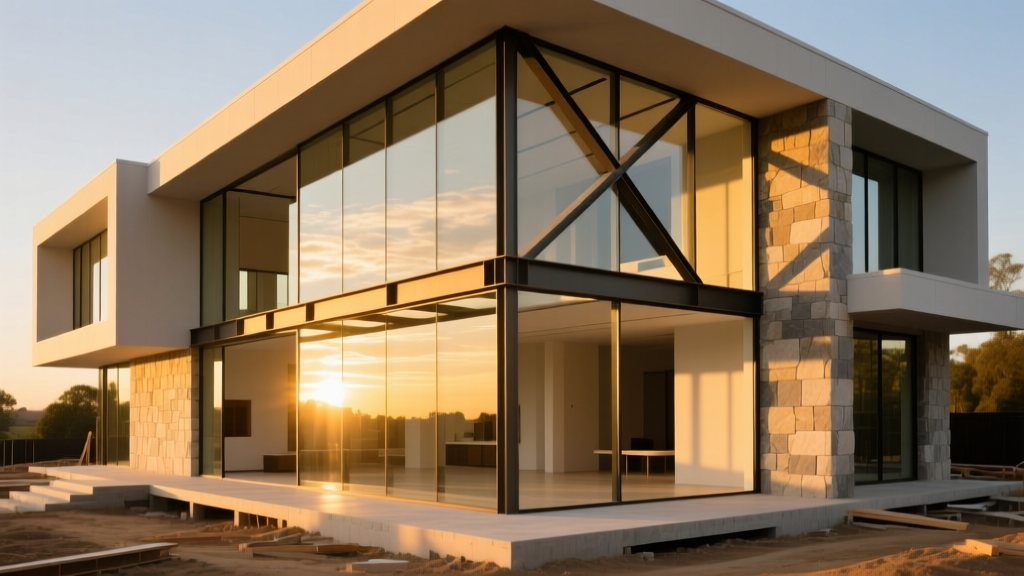
The building envelope represents the most significant divergence in luxury construction costs. Standard vinyl or aluminum-clad wood windows are replaced by thermally broken, triple-pane structural glazing.
- Fenestration: Brands like Zola Windows or Intus offer triple-pane, argon-filled units with U-values of 0.14 or lower. Installed costs range from $140 to $220 per square foot of window area, compared to $65 for standard dual-pane production windows.
- Roofing Systems: Architectural asphalt shingles ($8/sq ft) are swapped for standing seam zinc (e.g., VMZINC) or slate. Zinc roofing installed costs between $55 and $75 per square foot and offers a 100-year lifecycle with zero maintenance.
- Acoustic & Thermal Isolation: Luxury builds utilize staggered-stud framing, double-layer 5/8" Type X drywall with Green Glue damping compound, and closed-cell spray foam. This envelope upgrade adds approximately $18 to $25 per square foot to the total build area but achieves STC (Sound Transmission Class) ratings above 60.
Mechanicals and Smart Infrastructure
A true luxury home in 2026 operates as a micro-grid. The integration of enterprise-grade technology and advanced HVAC systems drastically alters the mechanical budget.
"The mechanical room of a modern luxury estate resembles a commercial server facility. We are routinely specifying WaterFurnace 7000 series geothermal loops paired with ERV (Energy Recovery Ventilation) systems that cost upwards of $120,000 for a 7,000-square-foot footprint, but guarantee hospital-grade air filtration and net-zero heating capabilities." — Senior MEP Engineer, Custom Residential Sector
- Lighting & Automation: A fully integrated Lutron HomeWorks QSX system, including motorized shading, architectural dimming, and centralized processors, averages $60,000 to $110,000 for a large estate.
- Climate Control: Radiant floor heating (e.g., Uponor PEX-a tubing embedded in gypcrete) combined with a high-velocity Unico SDHV system eliminates bulky ductwork and provides silent, draft-free conditioning, adding $35 to $50 per square foot to the mechanical budget.
Topography and Site Work: The Hidden Regional Multipliers
The Knight Frank Wealth Report frequently highlights that ultra-high-net-worth individuals are gravitating toward topographically complex lots—cliffsides, alpine ridges, and coastal bluffs—for privacy and views. These sites destroy standard cost-per-square-foot estimates.
In the Mountain West, blasting granite bedrock for a walk-out lower level and installing helical piers to anchor the foundation can easily consume $250,000 to $400,000 before a single wood stud is framed. Conversely, in the coastal South, soil liquefaction risks and expansive clays require deep-driven timber piles or post-tensioned concrete slabs, adding $40,000 to $85,000 to the foundation phase. When evaluating regional costs, a flat, easily accessible lot in Ohio will inherently yield a lower per-square-foot metric than a 15-degree sloped lot in Aspen, purely due to earthwork and structural retaining walls.
Labor Market Disparities and the Master Artisan Premium
Material costs are relatively standardized nationally due to freight networks; labor is strictly hyper-local. The cost per square foot to build a luxury home is heavily skewed by the availability of master artisans required for Level 4 and Level 5 finishes.
In markets like New York City, the Hamptons, or San Francisco, unionized trades and a scarcity of specialized plasterers, stonemasons, and custom millworkers create intense bidding wars. Applying a true Venetian plaster finish (such as Marmorino) requires specialized craftsmen who charge $30 to $55 per square foot of wall space. In the Midwest or South, where the labor pool for these niche finishes is smaller but less union-constrained, the same finish might be executed for $22 to $35 per square foot, provided the artisan can be sourced.
Developers often attempt to fly in specialized trades (e.g., custom staircase fabricators or high-end tile setters) from major hubs to rural luxury markets to save on local premium rates. However, factoring in per diems, travel time, luxury lodging, and freight for specialized tooling frequently negates the savings while introducing severe schedule delays due to local code inspection bottlenecks.
Strategic Framework: Optimizing the Luxury Build Budget
To accurately forecast the cost per square foot to build a luxury home in your specific region, apply this decision framework during the schematic design phase:
- Allocate by Volume, Not Just Area: Luxury homes feature soaring ceilings. A 6,000 sq ft home with 20-foot great room ceilings contains vastly more drywall, HVAC volume, and lighting infrastructure than a 6,000 sq ft home with 9-foot ceilings. Price your estimates on cubic volume, not just floor plan area.
- Front-Load the Envelope: Value-engineer the interior millwork if necessary, but never compromise on the building envelope (insulation, glazing, and roofing). A $1.2M envelope ensures the $3M interior finishes are protected from moisture and thermal degradation.
- Factor in 2026 Code Compliance: Ensure your estimator has accounted for the latest local iterations of the IECC (International Energy Conservation Code). In states like Massachusetts and California, the mandatory integration of solar PV, battery storage (e.g., Tesla Powerwall 3), and heat pump water heaters can add $60,000 to the baseline cost of a new custom build.
Ultimately, the cost per square foot to build a luxury home is a localized metric dictated by the intersection of geological reality, municipal code, and artisan availability. Accurate estimation requires abandoning national averages in favor of hyper-local, assembly-based cost modeling.
Written by
Marcus ChenMarcus Chen is a licensed structural engineer (PE) and building materials analyst with over 12 years of experience across residential, commercial, and industrial construction. He holds a Master of Science in Civil Engineering from UC Berkeley and spent six years at Thornton Tomasetti before transitioning to independent consulting and technical writing. Marcus specializes in material selection for seismic-prone regions, concrete reinforcement strategies, and lifecycle cost analysis. His work has been cited by the American Concrete Institute (ACI) and the Structural Engineers Association of California (SEAOC). When he is not on a job site or at his desk, you will find him hiking the Sierra Nevada or restoring a 1920s craftsman bungalow in Oakland, CA.
More from Marcus Chen
View all
Construction Cost
How Much Did the Eiffel Tower Cost to Build?
How much did the Eiffel Tower cost to build in 1889? We adjust for inflation and compare its budget to modern skyscraper construction.
Aug 4, 2026

Fire Resistance
What Is a Fire Resistant Material? Testing & Certification Guide
Discover what is a fire resistant material through ASTM and UL testing. Learn how fire ratings, certifications, and assemblies work in construction.
Aug 4, 2026

Construction Cost
How Much Did the Burj Khalifa Cost to Build?
How much did the Burj Khalifa cost to build? We break down the $1.5B project and extract 5 money-saving strategies for your next build.
Jul 30, 2026