The True Cost to Build a House in Michigan: 2026 Financing Guide
Discover the true cost to build a house in Michigan in 2026. Explore regional pricing, construction loan options, and financing strategies for your build.
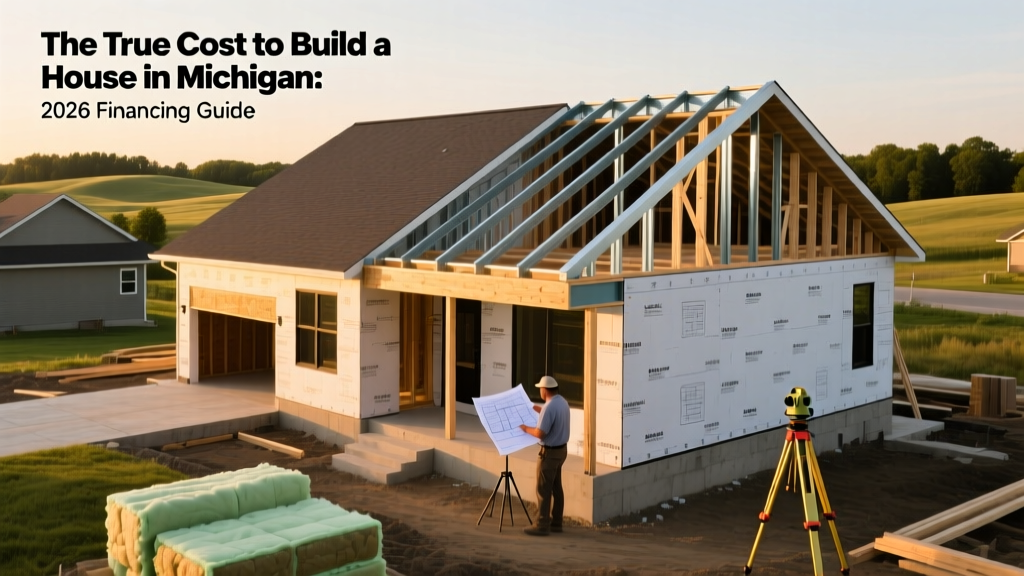
The Real Cost to Build a House in Michigan
Understanding the true cost to build a house in Michigan requires navigating a unique intersection of climate-driven construction requirements, volatile material supply chains, and specialized lending products. As of 2026, the baseline cost to build a house in Michigan ranges from $165 to $245 per square foot for a standard stick-built, single-family residence. For a 2,000-square-foot home, expect total hard construction costs between $330,000 and $490,000, excluding land acquisition, site preparation, and soft costs like architectural fees.
Unlike southern states, Michigan’s harsh winters dictate strict building codes that inherently drive up foundation and roofing costs. Furthermore, securing financing for a custom build involves complex construction-to-permanent (C2P) loan structures that differ significantly from traditional mortgages. This guide breaks down the exact costs, regional variations, and financing frameworks you need to execute your build successfully.
- Hard Construction Costs: $330,000 – $490,000
- Land Acquisition (Average): $45,000 – $120,000
- Site Prep & Utilities: $18,000 – $35,000
- Soft Costs (Plans, Permits): $12,000 – $22,000
- Total Estimated Project Cost: $405,000 – $667,000
Regional Price Variations Across Michigan
Michigan’s diverse geography heavily influences labor availability and material logistics. Building in the Detroit metro area offers high contractor competition and lower material transport costs, whereas building in the Upper Peninsula (UP) or Northern resort towns introduces significant logistical premiums.
| Region | Cost Per Sq. Ft. (2026) | Primary Cost Drivers |
|---|---|---|
| Detroit Metro / Ann Arbor | $175 – $225 | High land costs, strict municipal zoning, premium labor rates in Ann Arbor. |
| Grand Rapids / West MI | $165 – $205 | Balanced labor market, moderate material transport costs, sandy soil reduces excavation costs. |
| Traverse City / Northern | $210 – $265 | High demand for custom vacation homes, seasonal labor shortages, strict environmental shoreline permits. |
| Marquette / Upper Peninsula | $190 – $245 | Extreme weather building requirements, high freight costs for materials, limited specialized subcontractors. |
Michigan-Specific Construction Gotchas
When calculating the cost to build a house in Michigan, out-of-state builders or first-time owner-builders often miss climate-specific code requirements that drastically alter the budget.
1. The 42-to-48-Inch Frost Line
Michigan building codes require foundation footings to be placed below the frost line to prevent structural heaving during freeze-thaw cycles. In southern counties (like Wayne or Oakland), this requires a minimum 42-inch depth. In northern counties (like Houghton or Marquette), footings must be 48 inches deep or more. This requires deeper excavation, more concrete, and extensive frost-wall insulation, adding $8,500 to $16,000 to your foundation budget compared to a slab-on-grade foundation in a southern state.
2. Ice and Water Shield Expansion
While the Michigan Residential Code mandates ice and water protective membrane on the first 24 inches past the interior wall line, experienced roofers in heavy snow-load areas (Traverse City, Cadillac, the UP) strongly recommend extending this to 36 or 48 inches to prevent ice damming leaks. Budget an additional $1,200 to $2,500 for premium ice shield materials on a standard 2,000 sq. ft. roof.
3. Rural Well, Septic, and Bedrock
If you are building in rural areas (e.g., Clare, Roscommon, or Marquette counties), municipal water and sewer are rarely available. Drilling a private well in Michigan averages $6,500 to $15,000, but costs can spike to $25,000+ if drillers hit deep bedrock or require extensive casing. Similarly, a conventional septic system costs $10,000 to $18,000, but if your site has high seasonal water tables or clay-heavy soil, you may need an engineered mound system costing upwards of $25,000.
Financing Your Michigan Build: Loan Types Compared
Traditional mortgages do not fund construction. You must utilize specialized construction financing that converts to a permanent mortgage upon completion. According to the National Association of Home Builders (NAHB), navigating these loan products requires a high credit score and significant liquidity.
| Loan Type | Down Payment | Best For | 2026 Rate Estimate |
|---|---|---|---|
| Construction-to-Permanent (C2P) | 20% - 25% | Borrowers building high-end custom homes with strong credit (720+). | 6.75% - 7.50% |
| FHA One-Time Close | 3.5% - 5% | First-time builders with moderate credit (620+) and modest budgets. | 6.25% - 6.80% |
| Land Loan + Construction | 30% - 50% (Land) | Buyers purchasing raw acreage years before building. | 8.00% - 9.50% (Land) |
Construction loans require an upfront appraisal based on your blueprints. If you are building a $550,000 custom home in a neighborhood where comparable sales (comps) max out at $400,000, the bank will only lend based on the $400,000 appraisal. You must cover the $150,000 "appraisal gap" entirely in cash. Always run a localized comp analysis with your appraiser before finalizing your blueprints.
Step-by-Step Construction Loan Workflow
Securing financing is not a single event; it is a phased process tied directly to your builder's draw schedule.
- Pre-Approval and Land Acquisition: Secure a pre-approval letter from a lender experienced in Michigan construction loans (local credit unions like Consumers Credit Union or U of M Credit Union often have specialized departments). If buying land, use a land loan or cash, as C2P lenders prefer you to own the lot outright or use it as equity.
- Finalize Blueprints and Specs: Lenders require a comprehensive "spec sheet" detailing every material, from the R-value of your insulation (aim for R-21 walls and R-49 attics in MI) to the brand of your HVAC system.
- The Builder’s Draw Schedule: Your bank will not hand your builder a lump sum. Funds are disbursed in 5 to 7 "draws" (e.g., Foundation, Framing, Dry-In, Mechanicals, Finishes). The bank sends an inspector after each phase to verify completion before releasing the next payment.
- Rate Lock Strategy: Construction takes 8 to 14 months. Lock your permanent mortgage rate 60 to 90 days before the expected completion date to protect against market fluctuations.
- Certificate of Occupancy (CO) & Conversion: Once your local Michigan municipality issues the CO, the construction loan automatically modifies into your permanent 30-year mortgage.
Leveraging State Programs and Energy Rebates
While the Michigan State Housing Development Authority (MSHDA) MI Home Loan program is primarily designed for purchasing existing homes, state and federal energy incentives can significantly offset the cost of high-efficiency systems in your new build.
Under the Inflation Reduction Act (IRA), extending into 2026, Michigan builders can leverage federal tax credits for installing qualifying energy-efficient systems. Specifying a cold-climate air source heat pump (ccASHP) rated to perform at -15°F can yield up to $2,000 in federal tax credits, while upgrading to high-efficiency triple-pane windows and advanced insulation can yield up to $1,200 annually. Factoring these rebates into your initial budget allows you to finance premium materials upfront while recouping the cost during your first tax return.
Final Budgeting Advice
Always maintain a minimum 15% contingency fund in cash, separate from your loan amount. Michigan’s spring thaws can delay site prep, and winter builds require temporary heating enclosures (adding $2,000 to $4,000 in fuel and tarp costs). By understanding the precise cost to build a house in Michigan and aligning it with the correct draw-based financing structure, you can prevent budget overruns and secure a structurally sound, climate-resilient home.
Written by
Marcus ChenMarcus Chen is a licensed structural engineer (PE) and building materials analyst with over 12 years of experience across residential, commercial, and industrial construction. He holds a Master of Science in Civil Engineering from UC Berkeley and spent six years at Thornton Tomasetti before transitioning to independent consulting and technical writing. Marcus specializes in material selection for seismic-prone regions, concrete reinforcement strategies, and lifecycle cost analysis. His work has been cited by the American Concrete Institute (ACI) and the Structural Engineers Association of California (SEAOC). When he is not on a job site or at his desk, you will find him hiking the Sierra Nevada or restoring a 1920s craftsman bungalow in Oakland, CA.
More from Marcus Chen
View all
Construction Cost
How Much Did the Eiffel Tower Cost to Build?
How much did the Eiffel Tower cost to build in 1889? We adjust for inflation and compare its budget to modern skyscraper construction.
Aug 4, 2026

Fire Resistance
What Is a Fire Resistant Material? Testing & Certification Guide
Discover what is a fire resistant material through ASTM and UL testing. Learn how fire ratings, certifications, and assemblies work in construction.
Aug 4, 2026

Construction Cost
How Much Did the Burj Khalifa Cost to Build?
How much did the Burj Khalifa cost to build? We break down the $1.5B project and extract 5 money-saving strategies for your next build.
Jul 30, 2026