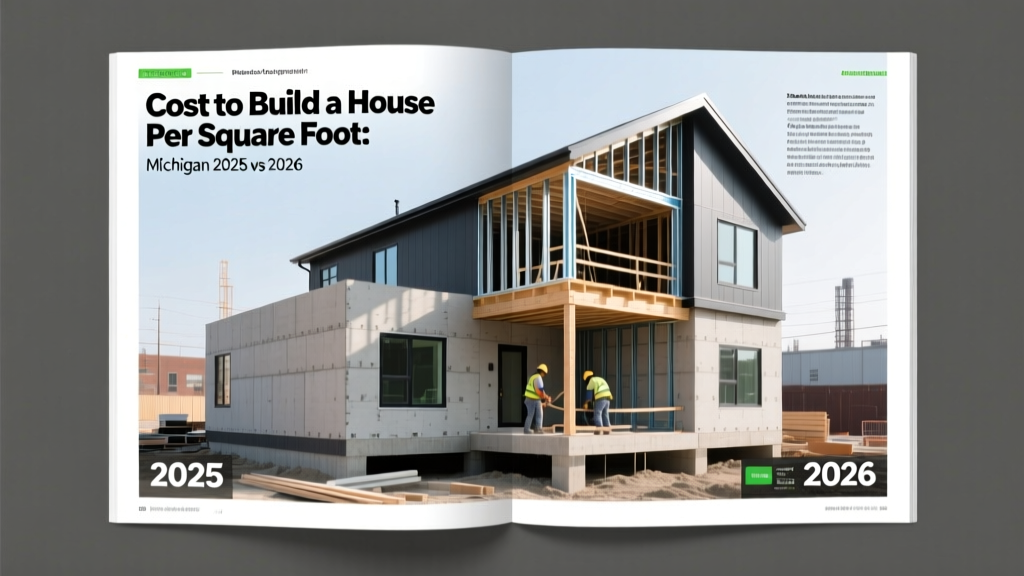
Cost to Build a House Per Square Foot: Michigan 2025 vs 2026
Discover the exact cost to build a house per square foot in Michigan. Detailed 2025-2026 breakdown of materials, labor, and regional price variations.
The Baseline: Tracking Construction Costs in the Great Lakes State
Building a custom home in Michigan requires navigating a unique intersection of extreme weather requirements, varied soil conditions, and distinct regional labor markets. When analyzing the cost to build a house per square foot Michigan 2025 metrics, the statewide median settled at approximately $182 per square foot for mid-tier construction. Moving into 2026, supply chain stabilization has offset some material costs, but skilled labor shortages and updated energy code compliance have pushed the projected average to $195 per square foot.
However, relying on a single statewide average is a critical estimating error. A 2,000-square-foot build in Ann Arbor will carry a vastly different financial profile than the exact same footprint in Marquette or Traverse City. This detailed breakdown dissects the hard costs, soft costs, and climate-specific engineering requirements that dictate your actual budget.
Core Cost Matrix: 2025 Actuals vs. 2026 Projections
The following matrix categorizes costs by build quality. These figures represent hard construction costs (foundation, framing, MEPs, finishes) and exclude land acquisition, site preparation, and soft costs.
| Build Class | 2025 Cost / Sq Ft | 2026 Projected / Sq Ft | Typical Material & System Specifications |
|---|---|---|---|
| Economy / Spec | $145 - $165 | $155 - $175 | Asphalt shingles, vinyl siding, LVP flooring, 80% AFUE furnace, standard 2x4 framing. |
| Mid-Range / Custom | $175 - $225 | $185 - $240 | Architectural shingles, James Hardie fiber cement, engineered hardwood, 95% AFUE furnace, 2x6 framing. |
| High-End / Luxury | $260 - $350+ | $280 - $380+ | Standing seam metal roof, masonry veneer, radiant floor heating, geothermal HVAC, ICF foundation. |
The 'Michigan Penalty': Climate and Code Variables
Michigan's climate imposes strict structural and thermal demands that do not exist in southern states. These requirements inherently inflate the cost per square foot.
1. Frost Line Depth and Foundation Engineering
The Michigan Residential Code mandates that foundation footings extend below the frost line to prevent frost heave, which can crack foundations and destroy structural integrity. In the Lower Peninsula, the frost line is generally 42 inches. In the Upper Peninsula (UP), it extends to 60 inches or deeper.
Cost Impact: Digging a 42-inch to 60-inch trench for continuous footings requires significantly more excavation and concrete than a 12-inch slab-on-grade foundation in Texas or Florida. Expect to pay between $14 and $18 per linear foot for formed and poured 4,000 PSI concrete frost walls. For a standard 2,000 sq ft footprint, a full poured basement (8-foot walls) will add $35,000 to $55,000 to your baseline budget, heavily dependent on soil conditions.
2. Insulation and Energy Code Compliance
Michigan operates under strict energy conservation codes. According to the Michigan Bureau of Construction Codes, modern builds must meet rigorous thermal envelope standards. Walls require a minimum of R-21, and ceilings demand R-60 insulation.
To achieve R-21 in a standard 2x4 wall, builders must use exterior continuous insulation (like Huber ZIP System R-sheathing) or transition to 2x6 framing with high-density fiberglass batts (such as Owens Corning ProPink). Upgrading to closed-cell spray foam in the rim joists and attic spaces can add $8,000 to $12,000 to a 2,500-square-foot home but is often necessary to prevent ice damming on roof eaves—a pervasive issue in Michigan winters.
3. Heating Degree Days (HDD) and HVAC Sizing
Michigan experiences between 6,500 and 8,500 Heating Degree Days annually, depending on the region, as tracked by the U.S. Energy Information Administration. This necessitates oversized, high-efficiency heating systems. A standard 2,000-square-foot home in Grand Rapids requires a 90,000 to 100,000 BTU furnace. Specifying a 96% AFUE variable-speed gas furnace (like the Lennox EL296E) will cost between $4,500 and $6,500 installed, compared to $2,500 for a basic 80% AFUE unit that will fail to meet current code minimums for new construction.
Regional Price Variations Across Michigan
Geography dictates labor availability, material transport logistics, and site prep complexity. Here is how the cost to build a house per square foot shifts across major Michigan regions in 2026.
- Southeast Michigan (Detroit, Ann Arbor, Oakland County): Multiplier: 1.15x. High union labor density, strict municipal zoning, and premium permit fees drive costs up. Ann Arbor frequently sees mid-range builds pushing $230/sq ft due to local prevailing wage requirements and complex site engineering on sloped, wooded lots.
- West Michigan (Grand Rapids, Holland, Kalamazoo): Multiplier: 1.0x (Baseline). A robust network of local subcontractors and proximity to major manufacturing hubs keeps material transport costs low. This region represents the most accurate reflection of the statewide median.
- Traverse City & Northern Lower Peninsula: Multiplier: 1.20x. High demand for luxury vacation properties skews local contractor availability. Furthermore, sandy soil conditions near the Great Lakes often require specialized helical piers or deep foundation engineering, adding $10,000+ to site prep.
- Upper Peninsula (Marquette, Traverse City): Multiplier: 1.35x. The 'Logistics Premium.' Transporting specialized materials (like engineered trusses or custom windows) across the Mackinac Bridge incurs heavy freight surcharges. Extreme winter conditions also limit the building season, forcing contractors to compress schedules and charge premium rates for winter concrete pours using calcium chloride accelerators and insulated blankets.
Hard Costs vs. Soft Costs: The Hidden Budget Eaters
When calculating your total project cost, the 'per square foot' metric often excludes soft costs, which can consume 15% to 25% of your total budget. Data from the U.S. Census Bureau on new residential construction highlights the growing proportion of soft costs in modern building.
Michigan-Specific Soft Costs to Budget For:
- Geotechnical Soil Borings ($1,500 - $3,000): Essential in Michigan due to the prevalence of expansive clays in the south and loose sands in the north. Skipping this can result in catastrophic foundation settling.
- Tap Fees and Impact Assessments ($3,000 - $8,000): Municipal water and sewer connection fees vary wildly. Rural townships relying on well and septic will require a perc test ($1,200) and a specialized septic system ($15,000 - $25,000) if the soil drainage is poor.
- Winter Construction Premiums (5% - 10% of hard costs): If your build schedule pushes into November through March, budget for concrete heating, temporary enclosures, and snow removal.
Value Engineering Framework for Michigan Builds
To keep your cost per square foot manageable without sacrificing durability in a freeze-thaw climate, implement these specific value engineering strategies:
1. Opt for ICF (Insulated Concrete Forms) over Traditional Poured Basements: While ICF blocks (like Fox Blocks or Nudura) carry a 5% to 8% upfront premium over traditional poured walls, they eliminate the need for exterior rigid foam insulation and wood framing. In Michigan's climate, the R-23 continuous insulation of ICF drastically reduces basement heat loss, paying for the premium via energy savings within 7 years.
2. Specify 2x6 Advanced Framing (Optimum Value Engineering): By spacing studs 24 inches on-center instead of 16 inches, you reduce lumber usage by up to 20% while creating a deeper wall cavity. This allows for R-21 fiberglass batts to achieve their full rated value without compression, satisfying Michigan energy codes more cheaply than adding exterior continuous foam.
3. Metal Roofing on Complex Pitches: While standing seam metal costs 2.5x more than architectural asphalt shingles upfront, the severe ice damming in Michigan destroys asphalt shingles in 12-15 years. Metal roofs shed snow instantly when properly pitched (minimum 4:12), eliminating ice-and-water shield replacement cycles.
Final Estimating Takeaway
Accurately forecasting the cost to build a house per square foot in Michigan requires moving beyond national averages. By anchoring your 2026 estimates to regional labor multipliers, strictly adhering to the 42-inch frost line foundation requirements, and engineering the thermal envelope for 8,000+ Heating Degree Days, you will develop a budget that survives the first winter without costly change orders.
Written by
Elena RodriguezElena Rodriguez is a civil engineer and technical writer specializing in concrete technology, masonry systems, and ASTM/ACI compliance. She earned her B.S. in Civil Engineering from Texas A&M University and spent a decade at a materials testing laboratory, performing over 2,000 concrete compressive strength tests and masonry prism evaluations. Elena is an ACI-certified Field Testing Technician (Grade I) and a member of ASTM Committee C12 on Natural Building Stone. She currently consults on forensic engineering cases involving concrete failures and moisture intrusion. Based in San Antonio, TX, Elena is a proud member of the Society of Women Engineers (SWE) and coaches her daughter's FIRST Robotics team.
More from Elena Rodriguez
View all
Walls & Panels
Cost Analysis: Light Gauge Steel Framing Advantages and Disadvantages
Evaluate light gauge steel framing advantages and disadvantages through a strict cost analysis lens, comparing material, labor, and lifecycle expenses.
Aug 4, 2026

Walls & Panels
Gypsum Board Types: Exact Specifications, Thickness & Dimensions
Compare standard, Type X, and moisture-resistant gypsum board types. Get exact specifications, thicknesses, dimensions, and ASTM standards for your project.
Aug 4, 2026

Fire Resistance
Best Fire-Resistant Outdoor Decking Materials: 2026 Buyer Guide
Discover the best fire-resistant outdoor decking materials for 2026. Compare Class A PVC, aluminum, and hardwood options for WUI compliance and safety.
Aug 4, 2026