Cost to Build Outdoor Kitchen: Material & Layout Price Comparison
Compare the true cost to build outdoor kitchen layouts from basic prep stations to luxury islands, including material and appliance pricing.
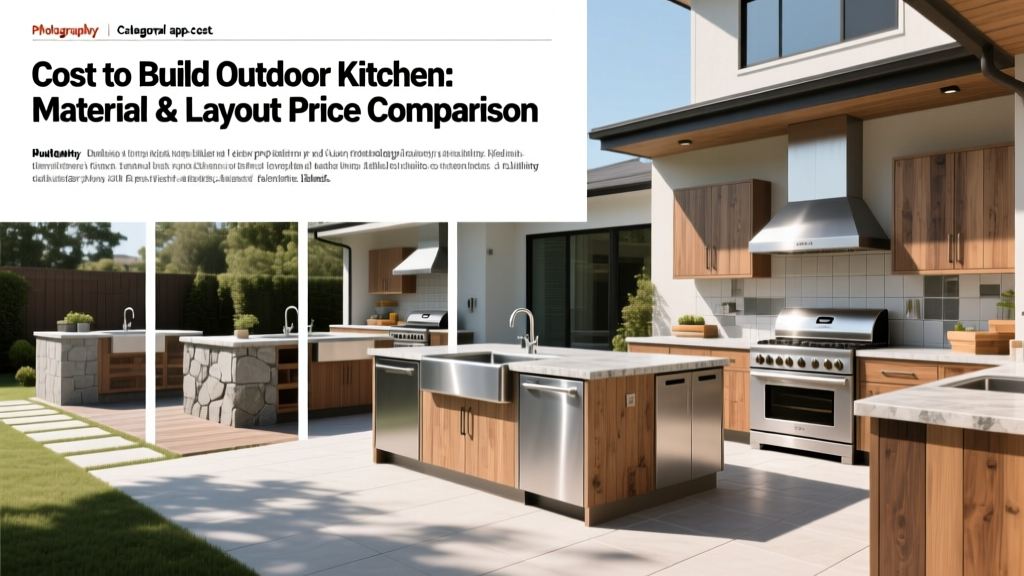
The Real Cost to Build Outdoor Kitchen Layouts
The cost to build outdoor kitchen spaces ranges from $8,500 for a basic prefab grill island to over $85,000 for a fully plumbed, custom masonry U-shaped layout. Unlike interior remodels, outdoor projects require weather-resistant materials, complex utility trenching, and specialized appliance venting. Estimating accurately requires breaking the project down by layout geometry, framing systems, countertop surfaces, and utility rough-ins.
Quick Cost Framework by Tier
- Entry-Level Prep Station (8-10 linear ft): $8,500 – $15,000. Features RTA (Ready-to-Assemble) modular frames, basic granite tile or poured concrete counters, and a mid-tier grill with no plumbing.
- Mid-Range Entertainer’s Island (12-18 linear ft): $25,000 – $45,000. Includes L-shaped CMU (concrete masonry unit) framing, sintered stone countertops, a premium grill, side burners, and a basic cold-water sink.
- Luxury Culinary Estate (20+ linear ft): $60,000 – $120,000+. Custom 304/316 stainless steel cabinetry, ultra-compact porcelain surfaces, high-BTU infrared sears, kegerators, hot/cold plumbing, and integrated pergola structures.
Layout Cost Matrix: Straight-Line vs. L-Shaped vs. U-Shaped
The physical footprint dictates not just material volume, but the complexity of gas and electrical routing. Corners in L-shaped and U-shaped layouts require specialized mitering for countertops and custom corner cabinet solutions, which drive up fabrication costs.
| Layout Type | Linear Footage | Base Framing Cost | Utility Complexity | Total Estimated Range |
|---|---|---|---|---|
| Straight-Line (I-Shape) | 8 - 14 ft | $800 - $1,200 / ft | Low (Single trench run) | $10,000 - $28,000 |
| L-Shaped Island | 12 - 20 ft | $1,100 - $1,600 / ft | Medium (Corner utility drops) | $25,000 - $55,000 |
| U-Shaped / Multi-Island | 20 - 35 ft | $1,400 - $2,200 / ft | High (Multiple zones, 220V) | $60,000 - $120,000+ |
Material Breakdown: Cabinets, Countertops, and Veneers
Exterior environments subject materials to UV radiation, freeze-thaw cycles, and high humidity. Selecting interior-grade materials for outdoor use is the most common cause of premature structural failure.
Cabinet & Frame Systems
- CMU Block Framing ($800 - $1,200 per linear ft): The traditional method. Concrete blocks are stacked, rebar-reinforced, and covered with metal lath, a scratch coat, and a finish veneer (stone or stucco). Highly durable but permanent and difficult to modify.
- High-Density Polymer ($1,200 - $1,800 per linear ft): Brands like NatureKast use polyurethane frameworks that mimic wood grain but will not rot, warp, or harbor insects. Ideal for humid or coastal climates.
- 304 Stainless Steel ($1,800 - $3,000+ per linear ft): Brands like Danver or Brown Jordan offer powder-coated 304 stainless cabinets. Crucial Edge Case: If building within 5 miles of a saltwater coast, you must upgrade to 316L marine-grade stainless to prevent pitting and corrosion.
Countertop Surfaces
Never use quartz outdoors. The petroleum-based resins in quartz will yellow and degrade under direct UV exposure within 12 to 18 months. Instead, specify these UV-stable alternatives:
- Sintered Stone (Dekton / Neolith): $120 - $180 per sq. ft. installed. Manufactured under extreme heat and pressure, it is virtually impervious to UV, scratches, and thermal shock. You can place a hot cast-iron pan directly on it.
- Level 3+ Granite: $75 - $120 per sq. ft. installed. Must be sealed annually with an impregnating siloxane sealer to prevent staining from acidic foods and wine.
- Poured Concrete: $65 - $100 per sq. ft. installed. Requires a high-performance penetrating sealer and is prone to hairline cracking in regions with severe freeze-thaw cycles.
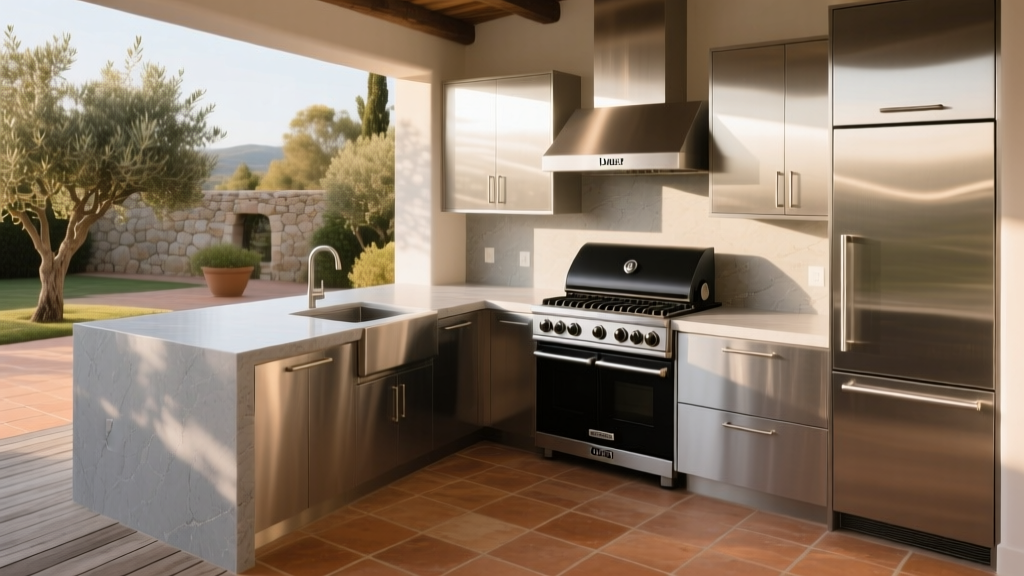
Appliance Tiers and Pricing
Outdoor appliances must be UL-listed for exterior use, featuring sealed control panels and higher BTU outputs to compensate for wind heat loss.
- Entry-Level ($2,500 - $5,500): Napoleon or Bull Outlaw series. 304 stainless burners, basic rotisserie kits, and standard 304 grates.
- Prosumer ($6,000 - $14,000): Alfresco or Fire Magic Echelon. Features infrared rear rotisserie burners, ceramic briquette heat distribution, and heavy-duty 8mm stainless steel cooking grids.
- Luxury ($15,000 - $35,000+): Lynx Professional or Hestan. Includes smart-grill integration, ceramic infrared sear zones reaching 1,000°F, and integrated LED task lighting.
Hidden Utility Costs: Gas, Water, and Electrical Rough-Ins
The most frequently underestimated line items in an outdoor kitchen estimate are the site-work utilities. According to Angi's outdoor kitchen cost data, utility trenching and routing can consume 15% to 25% of the total project budget.
Gas Lines
Running a dedicated natural gas or propane line requires trenching. CSST (Corrugated Stainless Steel Tubing) is the modern standard, costing $20 to $30 per linear foot installed. It requires a dedicated grounding/bonding wire to protect against lightning strikes. If upgrading from a standard 1/2-inch residential gas meter to support a 120,000 BTU grill plus a pizza oven, expect to pay $1,500 to $3,500 for a utility company meter upgrade.
Plumbing and Winterization
Use PEX-A tubing instead of copper for outdoor water lines; PEX-A can expand and contract, reducing the risk of bursting if a line freezes. However, you must install a dedicated shut-off valve and a compressed air blow-out port at the lowest point of the system to winterize the lines. Budget $1,200 to $2,500 for a complete hot/cold rough-in, including a frost-proof sillcock and an insulated sink base cabinet.
Electrical Requirements
Standard 120V GFCI circuits ($150-$250 per drop) are sufficient for blenders and basic lighting. However, high-end electric kamado smokers, large outdoor refrigerators, and infrared heating elements require dedicated 220V/50A circuits. Trenching and pulling 6-gauge THWN wire in rigid PVC conduit adds $40 to $60 per linear foot.
Common Failure Modes to Avoid
- Improper Venting: Built-in grills require a minimum 24-inch clearance to combustible materials above the cooking surface. Failing to install a stainless steel vent hood under a wooden pergola is a severe fire hazard and will void homeowner's insurance.
- Countertop Slope: Outdoor counters must be pitched 1/8-inch per foot away from the house or the back wall to prevent water pooling, which degrades sealants and causes masonry efflorescence.
- Make-Up Air Deficits: If installing a high-CFM outdoor ventilation hood over a pizza oven, you must provide passive make-up air vents in the island base to prevent negative pressure backdrafts.
ROI and Resale Value Considerations
While outdoor kitchens enhance lifestyle utility, their financial return varies by climate and neighborhood comps. The National Association of Realtors (NAR) Remodeling Impact Report indicates that outdoor living upgrades generally recoup between 50% and 70% of their cost at resale. To maximize ROI, ensure the outdoor kitchen's architectural style and veneer materials perfectly match the primary residence's exterior. A disconnected, mismatched masonry island will appraise as a liability rather than an asset. For optimal cost recovery, focus budget allocation on high-visibility elements: premium countertops, integrated LED lighting, and seamless patio integration, rather than overspending on luxury appliances that depreciate immediately upon installation.
Written by
Elena RodriguezElena Rodriguez is a civil engineer and technical writer specializing in concrete technology, masonry systems, and ASTM/ACI compliance. She earned her B.S. in Civil Engineering from Texas A&M University and spent a decade at a materials testing laboratory, performing over 2,000 concrete compressive strength tests and masonry prism evaluations. Elena is an ACI-certified Field Testing Technician (Grade I) and a member of ASTM Committee C12 on Natural Building Stone. She currently consults on forensic engineering cases involving concrete failures and moisture intrusion. Based in San Antonio, TX, Elena is a proud member of the Society of Women Engineers (SWE) and coaches her daughter's FIRST Robotics team.
More from Elena Rodriguez
View all
Walls & Panels
Cost Analysis: Light Gauge Steel Framing Advantages and Disadvantages
Evaluate light gauge steel framing advantages and disadvantages through a strict cost analysis lens, comparing material, labor, and lifecycle expenses.
Aug 4, 2026

Walls & Panels
Gypsum Board Types: Exact Specifications, Thickness & Dimensions
Compare standard, Type X, and moisture-resistant gypsum board types. Get exact specifications, thicknesses, dimensions, and ASTM standards for your project.
Aug 4, 2026

Fire Resistance
Best Fire-Resistant Outdoor Decking Materials: 2026 Buyer Guide
Discover the best fire-resistant outdoor decking materials for 2026. Compare Class A PVC, aluminum, and hardwood options for WUI compliance and safety.
Aug 4, 2026