Palace of Versailles Cost to Build: A Modern Estimator Breakdown
Discover the Palace of Versailles cost to build in today's market. We break down materials, artisan labor, and landscaping for a modern replica.
The Historical Ledger vs. Modern Construction Economics
When evaluating the Palace of Versailles cost to build, historians and economists frequently cite the royal ledgers of Louis XIV, which record expenditures of approximately 10.5 billion livres between 1664 and 1715. Translating this historical figure into modern purchasing power yields estimates ranging from $40 billion to over $300 billion, depending on whether one adjusts for inflation, labor value, or percentage of national GDP. However, for modern construction cost estimators, historical currency conversion is practically useless. The 17th-century French economy relied on coerced labor, localized material extraction without modern transport costs, and an absence of building codes.
To accurately estimate the cost to build a Versailles replica today, we must apply current 2026 construction metrics, union labor rates, global supply chain pricing for luxury materials, and modern mechanical, electrical, and plumbing (MEP) code compliance. The Palace encompasses roughly 721,206 square feet (67,000 square meters) of interior space, 2,300 rooms, and sits within a 2,000-acre estate. According to the official Château de Versailles historical archives, the sheer scale of the masonry, earthmoving, and artisan finishing requires a line-item breakdown that dwarfs standard ultra-luxury residential construction.
Shell, Masonry, and Structural Envelope
The primary structural material of Versailles is Lutetian limestone, specifically the porous Tuffeau stone quarried in the Loire Valley. For a modern equivalent, estimators typically specify high-grade Indiana Limestone or imported French Massangis limestone, which offers superior compressive strength and weathering characteristics. The exterior facade spans approximately 600,000 square feet of visible masonry.
- Material Cost: Premium cut limestone blocks (custom profiled to match 17th-century classical orders) cost between $85 and $120 per square foot, including fabrication.
- Installation Labor: Master stonemasons charge $150 to $220 per hour. Installing heavy ashlar masonry with traditional lime mortar joints pushes the installed cost to $350–$450 per square foot.
- Total Shell Estimate: At an average of $400 per square foot for 600,000 square feet of facade, the exterior masonry envelope alone commands $240 million.
Roofing and Leadwork
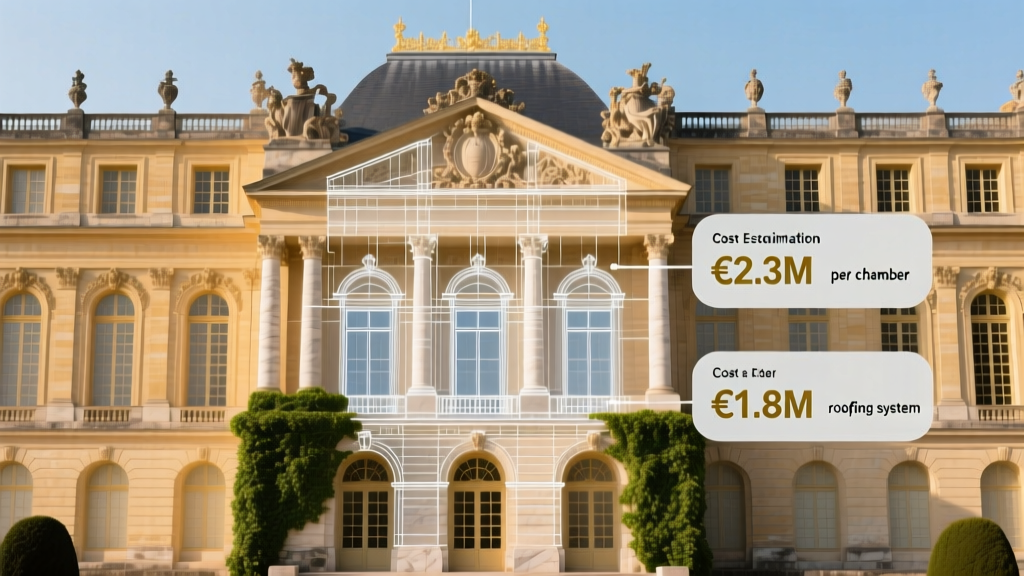
The iconic Mansard roofs and flat terraces of Versailles utilize slate and lead sheeting. Modern building codes restrict the use of raw lead due to environmental runoff, requiring the use of terne-coated stainless steel or copper with lead-patina finishes. Sourcing Angers-style black slate and custom-fabricating the ornate zinc and copper cresting adds an estimated $38 million to the structural envelope.
Interior Finishes: The True Cost Multiplier
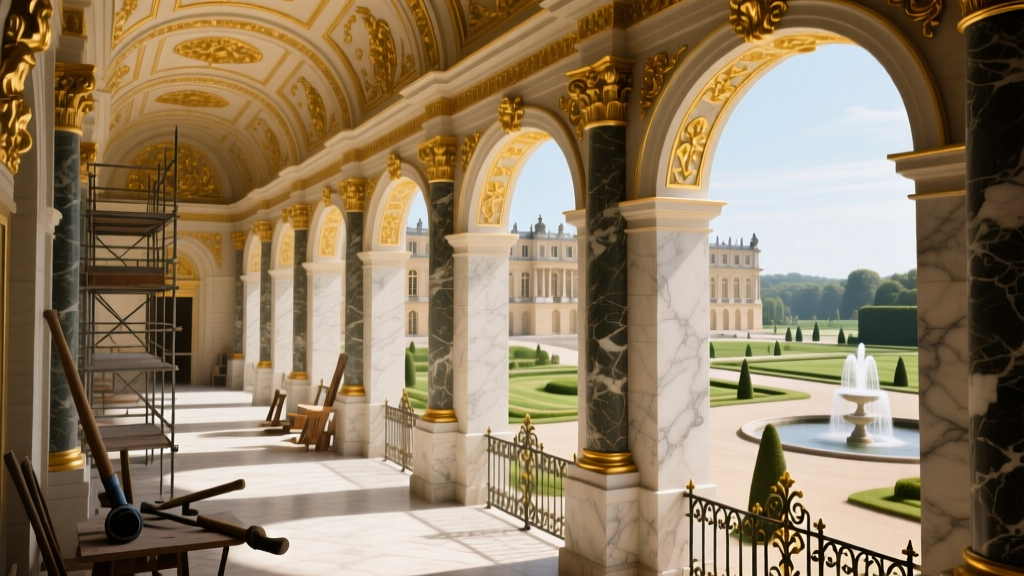
The true financial gravity of the Palace of Versailles cost to build lies in its interior finishes. Standard luxury construction caps out at $1,500 per square foot. Versailles-level ornamentation—featuring hand-carved boiseries, 22-karat gold leaf, and frescoed ceilings—pushes interior build-outs well past $6,000 per square foot.
Sourcing labor capable of executing 17th-century French classical techniques is a critical path bottleneck. In 2026, there are fewer than 500 certified master gilders and fresco artists globally. Securing their contracts requires premium retainers and multi-year scheduling, inflating labor costs by up to 300% compared to standard custom millwork and painting.
| Interior Element | Modern Material Specification | Est. Unit Cost | Total Est. Cost |
|---|---|---|---|
| Gold Leaf (22k) | Hand-applied water gilding on carved wood/plaster | $1,200 / sq ft | $84,000,000 |
| Parquet de Versailles | Custom 3/4' solid oak, hand-scraped, wax finished | $185 / sq ft | $55,500,000 |
| Marble Revetment | Carrara, Sienna, and Campan marble, book-matched | $350 / sq ft | $112,000,000 |
| Antique-Distressed Mirrors | Custom mercury-style silvering, beveled edges | $220 / sq ft | $18,400,000 |
| Fresco & Trompe-l'œil | Pigment on lime plaster, executed by master artists | $800 / sq ft | $72,000,000 |
MEP Integration in Heritage-Style Construction
A modern replica must comply with contemporary commercial building codes, requiring sophisticated HVAC, fire suppression, and electrical systems. The challenge lies in integrating these systems invisibly. You cannot drop a suspended acoustic ceiling to hide ductwork in a space designed for 40-foot vaulted, frescoed ceilings.
Estimators must specify underfloor air distribution (UFAD) systems, utilizing raised access floors hidden beneath the Parquet de Versailles. Furthermore, the Hall of Mirrors and similar grand galleries require specialized climate control to maintain 45-55% relative humidity, preventing the wood boiserie from cracking and the gold leaf from delaminating. Installing museum-grade HVAC with redundant chillers and desiccant dehumidification systems adds roughly $145 per square foot to the MEP budget, totaling $104 million across the palace footprint.
Civil Engineering and the André Le Nôtre Landscapes
The UNESCO World Heritage listing for Versailles emphasizes that the gardens are as architecturally significant as the palace itself. Recreating the 2,000-acre landscape designed by André Le Nôtre is a monumental civil engineering project.
- Earthmoving and Grading: The original construction required moving millions of cubic yards of soil to create the parterres and the Grand Canal. Modern cut-and-fill operations, including soil stabilization and topsoil importation, would cost approximately $45 million.
- Hydraulic Engineering: Versailles features 55 water features and 30 fountains. Replicating the gravity-fed and pumped water systems, including underground cast-iron piping, modern UV filtration, and high-capacity variable frequency drive (VFD) pumps, requires a $62 million plumbing and civil infrastructure budget.
- Mature Tree Transplantation: To achieve the immediate visual impact of the Allée Royale and the bosquets, a developer cannot plant saplings. Transplanting 15,000 mature, 30-foot Linden and Elm trees using hydraulic tree spades and heavy rigging costs an average of $4,500 per tree, including a one-year survival guarantee, totaling $67.5 million.
Final Estimate Summary
Aggregating the structural envelope, hyper-luxury interior finishes, invisible MEP systems, and monumental landscaping, the modern construction cost to build a faithful replica of the Palace of Versailles falls between $2.8 billion and $3.4 billion. This figure excludes land acquisition, architectural and engineering design fees (typically 12-15% for heritage-grade projects), and the decades-long carrying costs of such an endeavor.
Frequently Asked Questions for Estimators
How does the cost of Versailles compare to modern mega-mansions?
While modern mega-mansions like the Biltmore Estate or contemporary billionaires' compounds cost between $150 million and $300 million, they rarely exceed 200,000 square feet. Versailles is nearly four times the size of the Biltmore and features a density of handcrafted artisan finishes that modern luxury homes simply do not attempt, making the cost per square foot exponentially higher.
What is the most expensive single room to replicate?
The Hall of Mirrors (Galerie des Glaces) is the most capital-intensive space. The combination of 357 custom-distressed mirrors, extensive 22-karat gold leafing, intricate stucco work, and massive bronze fixtures pushes the build-out cost for this single 240-foot-long gallery past $110 million.
Would modern building codes force design changes?
Yes. Modern fire codes require compartmentalization, fire-rated stairwells, and ADA-compliant accessibility ramps and elevators. Integrating fire-rated doors that mimic 17th-century carved oak, and installing elevator cabs disguised as classical antechambers, introduces severe engineering premiums not present in the original 1680s construction.
Written by
Marcus ChenMarcus Chen is a licensed structural engineer (PE) and building materials analyst with over 12 years of experience across residential, commercial, and industrial construction. He holds a Master of Science in Civil Engineering from UC Berkeley and spent six years at Thornton Tomasetti before transitioning to independent consulting and technical writing. Marcus specializes in material selection for seismic-prone regions, concrete reinforcement strategies, and lifecycle cost analysis. His work has been cited by the American Concrete Institute (ACI) and the Structural Engineers Association of California (SEAOC). When he is not on a job site or at his desk, you will find him hiking the Sierra Nevada or restoring a 1920s craftsman bungalow in Oakland, CA.
More from Marcus Chen
View all
Construction Cost
How Much Did the Eiffel Tower Cost to Build?
How much did the Eiffel Tower cost to build in 1889? We adjust for inflation and compare its budget to modern skyscraper construction.
Aug 4, 2026

Fire Resistance
What Is a Fire Resistant Material? Testing & Certification Guide
Discover what is a fire resistant material through ASTM and UL testing. Learn how fire ratings, certifications, and assemblies work in construction.
Aug 4, 2026

Construction Cost
How Much Did the Burj Khalifa Cost to Build?
How much did the Burj Khalifa cost to build? We break down the $1.5B project and extract 5 money-saving strategies for your next build.
Jul 30, 2026