Pickleball Court Cost to Build: 2026 Budget Planning Guide
Discover the true pickleball court cost to build in 2026. Break down asphalt, concrete, surfacing, fencing, and lighting expenses for accurate budgeting.
The Real Pickleball Court Cost to Build: Beyond the Basics
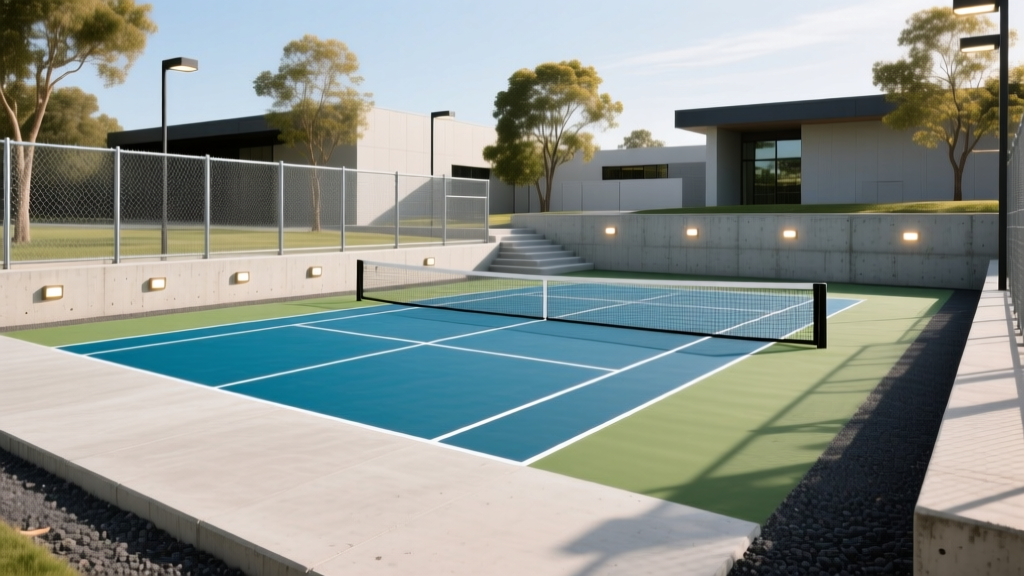
Building a dedicated pickleball court requires precise budget allocation across site preparation, substrate engineering, acrylic surfacing, and perimeter infrastructure. In 2026, the national average cost to build a single, tournament-ready pickleball court ranges from $38,000 to $65,000. However, converting an existing tennis court or cutting corners on the concrete base can skew these numbers dramatically. Proper budget planning demands a granular breakdown of material costs, labor rates, and long-term maintenance liabilities.
• Economy (Asphalt Base, Basic Fencing): $28,000 - $35,000
• Mid-Range (Standard Concrete, 5-Coat Acrylic): $40,000 - $52,000
• Premium (Post-Tensioned Concrete, Cushioned Surface, LED Lighting): $58,000 - $75,000+
Dimensional Requirements and Site Preparation
While the actual playing lines of a pickleball court measure 20 feet by 44 feet, budgeting for this exact footprint is a critical error. The USA Pickleball Facility Development guidelines mandate a minimum total pad size of 30 feet by 60 feet (1,800 square feet) to allow for player runoff. For tournament play or high-end residential builds, a 34-foot by 64-foot pad (2,176 square feet) is the recommended standard. All cost calculations in this guide are based on the 2,176 square foot premium footprint.
Site preparation costs average $4 to $8 per square foot. This includes clearing, grubbing, and grading. A common failure mode in court construction is improper drainage. The substrate must be poured with a strict 1% to 1.5% planar slope (typically side-to-side or end-to-end). Never budget for a crowned court; planar sloping ensures water runoff without creating a visual or physical distortion for the pickleball's low bounce trajectory.
Substrate Engineering: Asphalt vs. Post-Tensioned Concrete
The base slab accounts for 35% to 45% of your total pickleball court cost to build. You have two primary options, each with distinct financial and structural implications.
Asphalt Base Construction
Asphalt is the traditional budget-friendly option, costing between $6 and $9 per square foot installed. However, asphalt is highly susceptible to thermal expansion and contraction. Over a 5-to-7-year period, asphalt courts frequently develop structural cracks that will telegraph through the acrylic surface. Budgeting for an asphalt base requires setting aside a $3,000 to $5,000 maintenance reserve for crack filling and resurfacing within the first decade.
Post-Tensioned Concrete (The 2026 Standard)
Standard rebar-reinforced concrete ($9 to $12 per square foot) is prone to shrinkage cracking. The industry standard for premium court construction is now post-tensioned (PT) concrete, which costs $12 to $16 per square foot. PT concrete uses high-strength steel cables tensioned after the pour, compressing the slab and virtually eliminating shrinkage cracks. While the upfront cost is roughly $6,000 to $8,000 higher than asphalt, the 25-year structural lifespan makes it the superior capital investment.
| Substrate Type | Cost per Sq. Ft. | Expected Lifespan | Crack Risk Profile |
|---|---|---|---|
| Asphalt (4" depth) | $6.00 - $9.00 | 8 - 12 Years | High (Thermal/Heaving) |
| Standard Concrete (Rebar) | $9.00 - $12.00 | 15 - 20 Years | Moderate (Shrinkage) |
| Post-Tensioned Concrete | $12.00 - $16.00 | 25+ Years | Extremely Low |
Acrylic Surfacing Systems: The Hidden Cost Driver
Raw concrete or asphalt is unplayable. The court requires a multi-layered acrylic coating system to provide traction, UV protection, and color contrast. According to the American Sports Builders Association (ASBA), a minimum of five coats is required for a standard non-cushioned surface.
- 5-Coat Standard System ($4.00 - $5.50/sq ft): Includes two resurfacer coats (to fill voids), two color coats, and one finish coat. Ideal for driveways or casual residential play.
- 8-Coat Cushioned System ($7.00 - $9.50/sq ft): Adds three layers of rubberized cushion between the resurfacer and color coats. This reduces player joint fatigue and alters the ball bounce. Highly recommended for dedicated facilities and older demographics.
When selecting surfacing, pay attention to the ITF (International Tennis Federation) Court Pace Rating. While pickleballs are lighter and slower than tennis balls, a medium-slow to medium pace rating (Category 2 or 3) provides the optimal balance of grip and slide for lateral movements. You can verify approved surface classifications via the International Tennis Federation (ITF) database.
Do not build a court within 25 feet of mature deciduous trees or aggressive root systems (like willows or poplars). Roots will cause differential settlement in the substrate, creating ridges that tear through even the most expensive post-tensioned concrete and acrylic layers. If trees are unavoidable, budget an additional $2,500 to $4,000 for a deep root barrier trench along the affected perimeter.
Perimeter Fencing and Wind Breaks
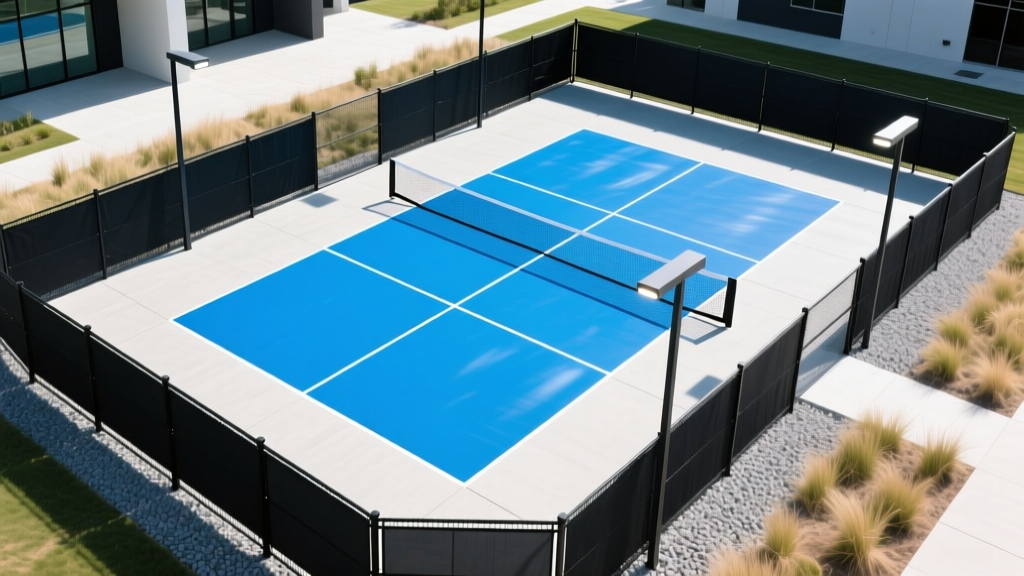
Fencing is non-negotiable for maintaining game flow and preventing property damage. Budget between $40 and $60 per linear foot for a 10-foot high chain-link fence. For a 34' x 64' court, the perimeter is 196 linear feet, placing fencing costs between $7,840 and $11,760.
Critical Specification: You must specify a 2-inch or 1.5-inch chain-link mesh. Standard residential fencing uses a 2.375-inch or 2.5-inch mesh. A standard pickleball (2.87 inches in diameter) will frequently wedge itself into 2.5-inch mesh, causing delays and damaging the balls. Additionally, specify black or dark green vinyl-coated wire; it reduces glare and blends into the background, improving ball visibility for players.
Lighting and Electrical Infrastructure
If you plan to play after dusk, LED lighting is mandatory. Modern 4-pole LED systems cost between $14,000 and $18,000 installed, while 6-pole systems (which eliminate center-court shadows) range from $18,000 to $24,000. Ensure your electrical contractor pulls dedicated 208V or 240V lines, as hardwiring directly into a residential 120V panel often results in voltage drop and flickering.
Target illumination levels should be 30 to 50 foot-candles (fc) for recreational play, and a minimum of 50 fc with a uniformity ratio (max/min) of 2.0 or less for tournament play. Always budget for dark-sky compliant shields to prevent light spill into neighboring properties, which is a primary cause of municipal permit rejections.
Step-by-Step Budget Allocation Framework
To prevent cost overruns, allocate your total capital using the following percentage framework. This model assumes a $50,000 total budget for a mid-tier residential court.
| Project Phase | Budget % | Estimated Cost ($50k Total) | Key Deliverables |
|---|---|---|---|
| Site Prep & Earthwork | 10% | $5,000 | Grading, 1.5% slope, compaction |
| Substrate (Concrete) | 40% | $20,000 | Post-tensioned slab, curing |
| Acrylic Surfacing | 20% | $10,000 | 8-coat cushioned system, line taping |
| Fencing & Gates | 18% | $9,000 | 10' black vinyl 2" mesh, double gates |
| Net, Posts & Accessories | 4% | $2,000 | Center strap, permanent sleeves, benches |
| Contingency / Permits | 8% | $4,000 | HOA approvals, zoning, overruns |
Frequently Asked Cost Questions
Can I just paint lines on my existing driveway?
Yes, but it is not recommended for serious play. Standard residential driveways lack the 1% planar slope, causing puddles that degrade the paint. Furthermore, driveway concrete is usually finished with a heavy broom texture, which will chew through pickleballs rapidly and cause unpredictable ball bounces. Budget at least $2,500 to grind, level, and apply a proper acrylic coating over an existing driveway.
How much does it cost to add a second or third court?
Multi-court builds benefit from economies of scale. While the first court may cost $50,000, adding adjacent courts typically drops the per-court cost by 15% to 22%. Shared fencing lines, consolidated electrical trenching for lighting, and bulk material pricing for concrete and acrylic significantly reduce the marginal cost of expansion.
What are the ongoing maintenance costs?
Budget $400 to $600 annually for professional pressure washing and moss/algae treatment in humid climates. Every 5 to 7 years, the court will require a recoat of the top two acrylic color layers, costing approximately $3,500 to $5,000 depending on surface wear and UV degradation.
Written by
Marcus ChenMarcus Chen is a licensed structural engineer (PE) and building materials analyst with over 12 years of experience across residential, commercial, and industrial construction. He holds a Master of Science in Civil Engineering from UC Berkeley and spent six years at Thornton Tomasetti before transitioning to independent consulting and technical writing. Marcus specializes in material selection for seismic-prone regions, concrete reinforcement strategies, and lifecycle cost analysis. His work has been cited by the American Concrete Institute (ACI) and the Structural Engineers Association of California (SEAOC). When he is not on a job site or at his desk, you will find him hiking the Sierra Nevada or restoring a 1920s craftsman bungalow in Oakland, CA.
More from Marcus Chen
View all
Construction Cost
How Much Did the Eiffel Tower Cost to Build?
How much did the Eiffel Tower cost to build in 1889? We adjust for inflation and compare its budget to modern skyscraper construction.
Aug 4, 2026

Fire Resistance
What Is a Fire Resistant Material? Testing & Certification Guide
Discover what is a fire resistant material through ASTM and UL testing. Learn how fire ratings, certifications, and assemblies work in construction.
Aug 4, 2026

Construction Cost
How Much Did the Burj Khalifa Cost to Build?
How much did the Burj Khalifa cost to build? We break down the $1.5B project and extract 5 money-saving strategies for your next build.
Jul 30, 2026