Proven Ways to Lower the Cost to Build Indoor Basketball Court
Discover actionable strategies to reduce the cost to build indoor basketball court facilities, from budget flooring to post-frame construction savings.
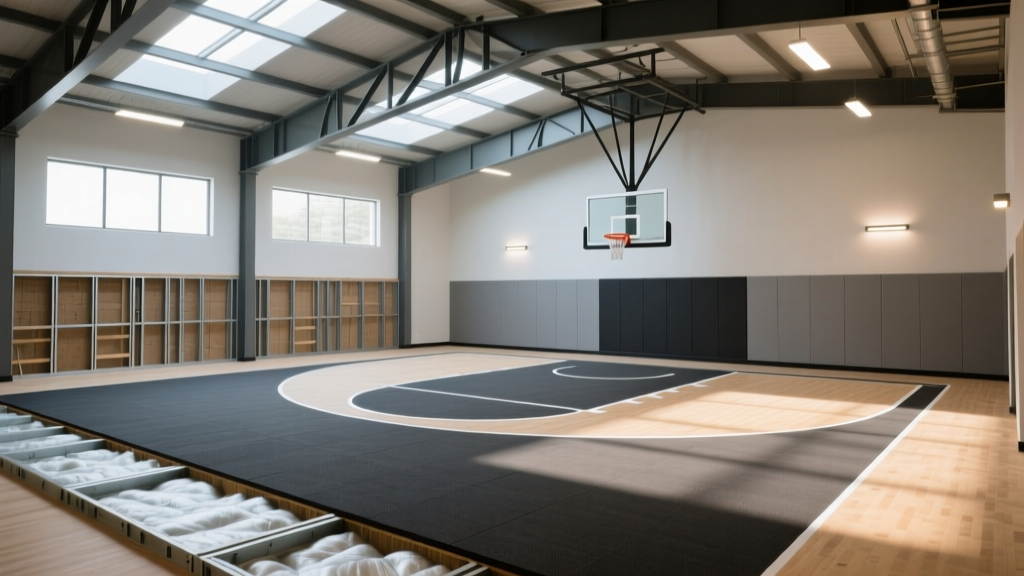
Constructing a private indoor basketball facility is a premier addition to any residential or commercial property, but the financial barrier to entry is notoriously high. When calculating the total cost to build indoor basketball court spaces, estimates typically range from $45,000 for a basic unclimate-controlled half-court shell to over $250,000 for a full-size, finished gymnasium. However, by strategically compromising on non-essential aesthetics and leveraging alternative building methods, you can significantly reduce your capital outlay without sacrificing playability.
Dimension Optimization: Right-Sizing the Playing Surface
The most immediate driver of your budget is the footprint. A standard NBA or NCAA full court measures 94 feet by 50 feet, requiring a minimum building shell of 100 by 60 feet to accommodate out-of-bounds runoff and wall clearance. If your primary use is casual shooting, one-on-one, or youth three-on-three, downsizing to a half-court or "backyard" dimension drastically cuts concrete, framing, and roofing costs.
| Court Configuration | Minimum Slab Size | Estimated Shell & Slab Cost | Best Use Case |
|---|---|---|---|
| Full Court (94' x 50') | 100' x 60' (6,000 sq ft) | $120,000 - $160,000 | Competitive 5v5, Commercial |
| Standard Half (47' x 50') | 55' x 60' (3,300 sq ft) | $65,000 - $85,000 | 3v3, Shooting Practice |
| Compact Half (42' x 40') | 50' x 50' (2,500 sq ft) | $45,000 - $60,000 | Residential, Youth Training |
Post-Frame Construction vs. Traditional Masonry
Traditional stick-built or masonry block gymnasiums require continuous perimeter foundations, extensive interior load-bearing walls, and long construction timelines. To aggressively lower the cost to build indoor basketball court structures, pivot to post-frame (pole barn) construction.
Post-frame buildings utilize large, pressure-treated laminated wooden columns embedded directly into the ground or mounted to concrete piers. This eliminates the need for a continuous poured foundation wall. According to the National Frame Building Association, post-frame construction can reduce structural shell costs by 15% to 25% compared to conventional masonry. Furthermore, the wide truss spans (often up to 80 feet clear-span) eliminate interior support columns, providing the unobstructed floor space required for sports.
Flooring Hacks: Pro Performance on a Fraction of the Budget
Flooring is where budgets routinely explode. A premium, MFMA-certified northern hard maple floor system with resilient pads and polyurethane finish costs between $12 and $18 per square foot installed. For a 3,000 sq ft half-court, that is up to $54,000 just for the floor. Here are the high-performance, budget-friendly alternatives:
1. Modular Polypropylene Tiles (The Best Value)
Interlocking suspended tiles (from brands like SnapSports or Mateflex) provide excellent shock absorption and ball bounce. They cost between $4.50 and $8.00 per square foot. Because they float over the concrete and snap together, they are a 100% DIY-friendly installation, saving $3,000 to $5,000 in professional labor.
2. Polished Concrete with Acrylic Coating (The Budget Option)
If you are pouring a new slab, specify a power-trowel finish and apply a high-traction, cushioned acrylic sport coating (such as SportMaster ColorTuff). At $3.00 to $5.00 per square foot, this is the cheapest viable option. Warning: Do not skip the vapor barrier. A 15-mil polyethylene vapor retarder beneath the slab is mandatory to prevent moisture migration, which will cause acrylic coatings to blister and peel within months.
Lighting and Ceiling Height: Avoiding the Glare Trap
The American Sports Builders Association recommends a minimum ceiling height of 25 feet above the playing surface for competitive basketball. However, if you are building a private residential court, dropping the eave height to 20 feet reduces the volume of air you must heat and cool, and decreases the siding and framing costs.
The DIY vs. Contractor Decision Matrix
To maximize savings, you must bifurcate the project into specialized and general tasks. Use this framework to decide where to deploy your own labor:
- Site Prep & Excavation (DIY Possible): If you own a skid steer and understand grading, you can clear and level the pad. Otherwise, hire a local excavation contractor.
- Concrete Slab (Hire a Pro): A basketball court requires a perfectly flat slab (tolerance of 1/8 inch over 10 feet). Do not DIY this. Hire a commercial flatwork specialist and specify a 4-inch minimum thickness at 3,500 PSI with fiber-mesh reinforcement.
- Shell Erection (Hybrid): Many post-frame kit suppliers (like Morton Buildings or DIY pole barn kit vendors) will deliver the engineered materials. You can hire a local framing crew for a few days to stand the walls and trusses, bypassing the general contractor's 20% markup.
- Flooring & Painting (DIY Recommended): Modular tiles snap together with a rubber mallet. Court line painting on acrylic surfaces can be done with a laser level, painter's tape, and specialized sport-court striping paint.
Hidden Cost Traps That Derail Budgets
Trap 1: Ignoring HVAC Load. A large metal building acts like an oven in summer and a freezer in winter. If you plan to climate-control the space, you must upgrade from single-sheet metal to Insulated Metal Panels (IMPs) with an R-value of at least R-25, or install a reflective radiant barrier bubble insulation under the roof steel.
Trap 2: Acoustic Echo. Hard surfaces (concrete, steel, glass) create deafening echoes when a basketball bounces. Budget $1,500 to $3,000 for suspended acoustic baffles or wall-mounted fiberglass acoustic panels to protect your hearing and improve the play experience.
Summary: The Optimized Budget Build
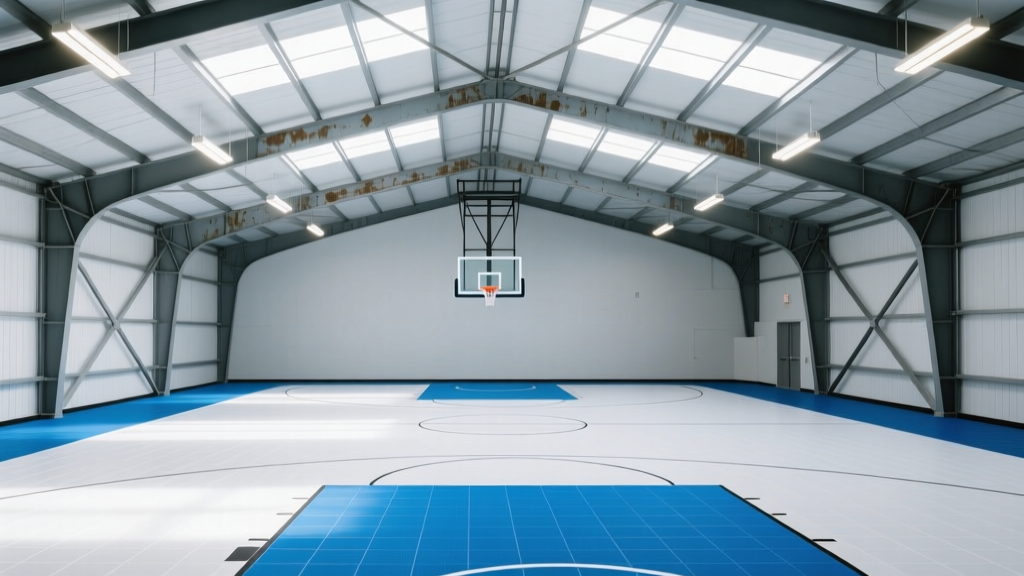
By selecting a 50x50 compact half-court footprint, utilizing post-frame construction with an exposed truss ceiling, and installing DIY modular polypropylene flooring over a perfectly troweled concrete slab, you can realistically cap the cost to build indoor basketball court facilities at roughly $65,000 to $80,000. This approach sacrifices the traditional aesthetics of a polished maple gymnasium but delivers 95% of the athletic performance at less than half the price.
Written by
Elena RodriguezElena Rodriguez is a civil engineer and technical writer specializing in concrete technology, masonry systems, and ASTM/ACI compliance. She earned her B.S. in Civil Engineering from Texas A&M University and spent a decade at a materials testing laboratory, performing over 2,000 concrete compressive strength tests and masonry prism evaluations. Elena is an ACI-certified Field Testing Technician (Grade I) and a member of ASTM Committee C12 on Natural Building Stone. She currently consults on forensic engineering cases involving concrete failures and moisture intrusion. Based in San Antonio, TX, Elena is a proud member of the Society of Women Engineers (SWE) and coaches her daughter's FIRST Robotics team.
More from Elena Rodriguez
View all
Walls & Panels
Cost Analysis: Light Gauge Steel Framing Advantages and Disadvantages
Evaluate light gauge steel framing advantages and disadvantages through a strict cost analysis lens, comparing material, labor, and lifecycle expenses.
Aug 4, 2026

Walls & Panels
Gypsum Board Types: Exact Specifications, Thickness & Dimensions
Compare standard, Type X, and moisture-resistant gypsum board types. Get exact specifications, thicknesses, dimensions, and ASTM standards for your project.
Aug 4, 2026

Fire Resistance
Best Fire-Resistant Outdoor Decking Materials: 2026 Buyer Guide
Discover the best fire-resistant outdoor decking materials for 2026. Compare Class A PVC, aluminum, and hardwood options for WUI compliance and safety.
Aug 4, 2026