How Much Does It Cost to Build an Ice Rink? Regional Price Analysis
Discover how much it costs to build an ice rink. Our regional price analysis breaks down excavation, chiller, and slab costs by US climate zone.
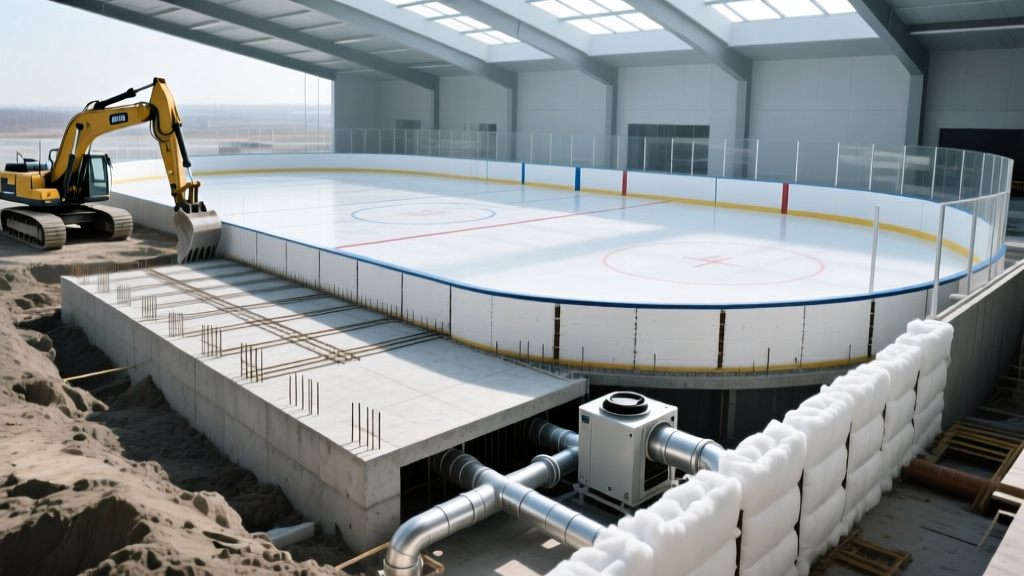
The Baseline: National Average Ice Rink Construction Costs
When evaluating how much does it cost to build an ice rink, contractors and facility planners must first separate temporary DIY flooding methods from permanent, mechanically refrigerated structures. A permanent refrigerated ice rink requires a complex integration of civil engineering, thermodynamics, and structural concrete work. Nationally, the baseline cost for a standard residential or small private club refrigerated rink (measuring 40 feet by 80 feet) ranges from $55,000 to $95,000. For a full-sized community or commercial rink (85 feet by 200 feet, NHL standard dimensions as outlined by U.S. Figure Skating and hockey governing bodies), costs escalate to between $850,000 and $2.2 million.
However, these national averages obscure massive regional variances. The cost to build an ice rink in Minnesota is driven by deep frost-wall excavation, while the same project in Texas is driven by massive ambient heat-load calculations and heavy insulation requirements. Below is a breakdown of baseline national costs before regional modifiers are applied.
| Rink Type | Dimensions | National Average Cost | Primary Cost Driver |
|---|---|---|---|
| Backyard DIY (Liner/Flooding) | 20x40 ft | $800 - $2,500 | Liner quality, site leveling |
| Residential Refrigerated | 40x80 ft | $55,000 - $95,000 | Chiller unit, concrete slab, PEX piping |
| Small Private Club | 60x120 ft | $250,000 - $450,000 | Enclosure, dasher boards, dehumidification |
| Community/Commercial | 85x200 ft | $850,000 - $2.2M+ | HVAC, structural steel, spectator amenities |
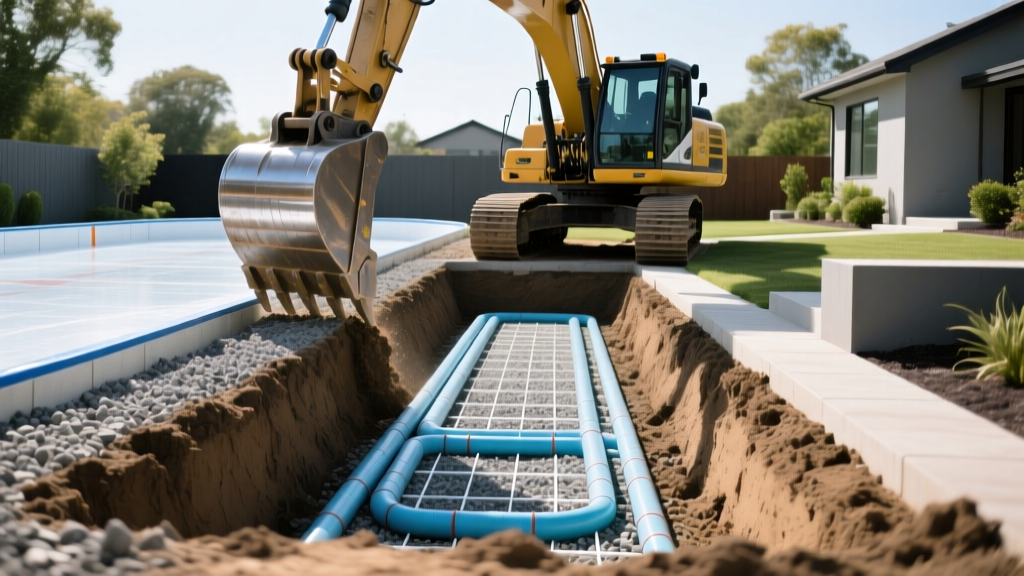
Regional Price Analysis: How Geography Dictates Your Budget
The physical location of your build site fundamentally alters the engineering requirements of the ice slab and the refrigeration plant. We analyze three distinct climate zones to demonstrate how regional factors shift the final price tag.
The Northeast & Midwest (Cold Climates)
In states like Minnesota, Wisconsin, and New York, the primary adversary is frost heave. When the ground freezes and thaws, it expands and contracts, which will crack a rigid concrete ice slab and sever the embedded PEX-AL-PEX tubing. To prevent this, excavation must extend below the local frost line, which can be 60 to 84 inches deep in northern regions.
- Excavation & Sub-base: Requires 12 to 18 inches of compacted crushed limestone or gravel below the frost line. This adds $8 to $14 per square foot to site preparation.
- Chiller Sizing: Because ambient winter temperatures naturally assist in maintaining the ice, a 40x80 rink may only require a 10-ton to 12-ton air-cooled chiller (e.g., Carrier or CIMCO models).
- Insulation: Extruded Polystyrene (XPS) foam board is still required to isolate the slab from the earth, but 2 inches (R-10) is often sufficient, saving roughly $1.50 per square foot compared to southern builds.
The South & Sunbelt (Hot Climates)
Building a refrigerated ice rink in Florida, Texas, or Arizona flips the engineering challenges. Frost heave is non-existent, but ambient heat load and high water tables dominate the budget. According to the U.S. Energy Information Administration, regional electricity rates and peak demand charges in the South heavily influence the operational design, forcing builders to oversize equipment upfront to maintain efficiency.
- Chiller Sizing & Electrical: A 40x80 rink in the Sunbelt requires a 20-ton to 25-ton chiller to combat radiant heat and high humidity. This necessitates a massive electrical service upgrade (often 480V 3-phase), adding $12,000 to $25,000 in utility hookup and panel costs.
- Insulation & Vapor Barriers: You must install a minimum of 4 inches of XPS foam (R-20) beneath the slab. Furthermore, a heavy-duty 20-mil cross-laminated polyethylene vapor barrier (like Stego Wrap) is mandatory to prevent ground moisture from migrating up into the slab and destroying the ice quality.
- Dewatering: High water tables in coastal southern states often require temporary dewatering wellpoints during excavation and permanent French drain systems, adding $5,000 to $15,000 to civil works.
In hot climates where chillers run year-round, the choice of refrigerant is critical. Ensure your chiller utilizes low-GWP (Global Warming Potential) refrigerants like R-449A or R-513A to comply with evolving EPA and state-level environmental mandates, avoiding costly retrofits in the near future.
The West Coast & Pacific Northwest (Moderate Climates)
States like California, Oregon, and Washington feature moderate temperatures but introduce severe regulatory and labor cost variables. The physical materials may cost the same as the national average, but the soft costs and labor rates drastically inflate the budget.
- Labor Rates: Prevailing wage laws and high union labor rates in states like California can increase the concrete pouring and pipe-tying phases by 35% to 50% compared to the Midwest.
- Environmental Permitting: Strict water runoff regulations and environmental impact reviews can delay projects by 6 to 12 months, adding $20,000+ in carrying costs and consulting fees.
- Seismic Engineering: In earthquake-prone zones, the concrete slab and dasher board anchoring systems require specialized seismic rebar tying and flexible pipe connections to prevent rupture during ground movement.
Component Cost Matrix by Region
The following matrix isolates specific line-item costs for a standard 40x80 foot (3,200 sq. ft.) residential/private refrigerated ice rink, demonstrating how regional factors alter individual component pricing.
| Component | Northeast / Midwest | South / Sunbelt | West Coast |
|---|---|---|---|
| Excavation & Grading | $14,500 - $18,000 | $8,000 - $12,000 | $12,000 - $16,000 |
| Sub-base & Frost Wall | $11,000 - $15,000 | $4,500 - $7,000 | $8,000 - $11,000 |
| Vapor Barrier & XPS Insulation | $5,500 - $7,000 | $9,500 - $12,500 | $7,500 - $9,000 |
| PEX Piping & Manifolds | $12,000 - $14,000 | $12,000 - $14,000 | $15,000 - $18,000 |
| Chiller Unit (Sized for Region) | $22,000 (12-Ton) | $38,000 (22-Ton) | $28,000 (15-Ton) |
| Concrete Slab Pour (4,000 PSI) | $18,000 - $22,000 | $18,000 - $22,000 | $28,000 - $35,000 |
Hidden Regional Variables: Soil, Water Tables, and Permitting
Beyond climate, local geology and municipal codes introduce hidden costs that frequently blow up ice rink construction budgets. When estimating how much does it cost to build an ice rink, you must commission a geotechnical soil report ($1,500 - $3,000) before finalizing your budget.
Expansive Clay vs. Sandy Loam
If your site features expansive clay (common in Texas and parts of the Southeast), the soil swells significantly when wet and shrinks when dry. Building a rigid 3,200 sq. ft. concrete slab on expansive clay without soil remediation will result in catastrophic slab failure. Remediation requires over-excavating 3 to 4 feet and backfilling with engineered select fill, adding $10,000 to $18,000 to the project. Sandy loam soils, prevalent in the Midwest and coastal regions, offer excellent drainage and require minimal sub-base modification.
Dehumidification and Enclosure Costs
If you are enclosing the rink, the regional humidity dictates the size of the desiccant dehumidification system. Ice rinks require strict dew-point control to prevent condensation from dripping onto the ice and causing fog. In humid southern states, a commercial desiccant dehumidifier (such as those by Munters or Desert Aire) sized for a 40x80 enclosure will cost 20% to 30% more than a unit sized for the dry air of the Mountain West. Refer to ENERGY STAR commercial refrigeration guidelines for integrated system efficiency standards when pairing chillers with HVAC units.
For residential and small club rinks, secondary coolant systems using a propylene glycol and water mix pumped through PEX tubing are vastly superior to Direct Expansion (DX) refrigerant systems. Glycol systems operate at lower pressures, drastically reducing the risk of catastrophic refrigerant leaks into the soil, which carries severe environmental and financial penalties.
Actionable Framework: Sizing Your Chiller and Slab
To finalize your regional budget, follow this technical framework for specifying the core components of your refrigerated ice rink:
- Calculate the Heat Load: Do not rely on rule-of-thumb chiller sizing. Hire a mechanical engineer to calculate the exact BTU/hr heat load based on your specific zip code's summer design temperature, the presence of overhead lighting, and spectator load. A 10% error in heat load calculation will result in soft ice or a $15,000 chiller upgrade.
- Specify the PEX Layout: Mandate 3/4-inch or 1-inch PEX-AL-PEX (aluminum barrier) tubing spaced at exactly 3-inch or 4-inch centers. Wider spacing (6 inches) will create ridges in the ice surface and force the chiller to work harder to maintain a uniform freezing plane.
- Demand Air-Entrained Concrete: Specify 4,000 PSI concrete with 5% to 7% air entrainment. The air bubbles provide microscopic relief valves for the concrete as it undergoes extreme thermal contraction during the initial freeze-down phase. Ensure the finishers use a steel trowel for a hard, dense finish; a broom finish will trap air and ruin the ice bond.
- Plan the Freeze-Down Schedule: The initial freezing of the slab takes 7 to 14 days. You must drop the slab temperature gradually (no more than 10°F per day) to prevent thermal shock cracking. Factor in 24/7 energy costs for this initial 2-week period in your first-year operational budget.
Ultimately, the cost to build an ice rink is not a single national figure, but a highly localized equation. By adjusting your excavation depth, insulation R-value, and chiller tonnage to match your specific regional climate and soil conditions, you can engineer a permanent ice surface that performs flawlessly while avoiding catastrophic structural failures.
Written by
Priya KapoorPriya Kapoor is a real estate market analyst and construction economics researcher with expertise in housing affordability, development feasibility, and infrastructure investment. She holds a Master of Regional Planning from Cornell University and previously worked as a senior analyst at CBRE's Investment Properties group, where she modeled returns for $4B in mixed-use development pipelines. Priya now runs an independent research practice advising developers, municipalities, and REITs on construction cost forecasting and market timing. She publishes the quarterly "BuildMat Market Pulse" report tracking material price indices across 12 commodity categories. Based in Austin, TX, Priya serves on the board of Habitat for Humanity Austin and is a marathon runner.
More from Priya Kapoor
View all
Construction Cost
Cost to Build a 1600 Sq Ft Home in 2026: Full Breakdown
Accurate 2026 cost to build a 1600 sq ft home—material, labor, and regional pricing breakdowns included. Plan your budget with real-time estimates.
Aug 11, 2026

Wood & Lumber
Name the Types of Wood for Pressure Treatment and Preservation
Learn how to name the types of wood best suited for pressure treatment. Compare species treatability, chemical retention levels, and 2026 preservation costs.
Aug 4, 2026

Stone & Masonry
Stone Veneer Suppliers Lindenhurst: 2026 Cost Analysis
Analyze 2026 stone veneer costs in Lindenhurst, NY. Compare local supplier pricing, delivery fees, and Suffolk County installation labor rates.
Aug 4, 2026