Cost to Build a RV Park: 2026 Regional Price Analysis
Discover the true cost to build a RV park in 2026. Compare regional pricing for utilities, paving, and pedestals across the US to budget accurately.
The True Baseline: National Average vs. Regional Reality
Estimating the cost to build a RV park requires moving beyond generic national averages. While industry aggregators often cite a blanket figure of $45,000 to $75,000 per fully improved site, this metric obscures the massive regional variances driven by local geology, climate codes, and labor markets. According to recent market data tracked by the RV Industry Association (RVIA), the shift toward larger, luxury Class A motorhomes and fifth-wheel trailers has forced developers to increase pad dimensions and upgrade electrical infrastructure, fundamentally altering the baseline cost structure in 2026.
Regional Cost Breakdown Matrix (2026 Projections)
The following matrix illustrates how the cost to build a RV park fluctuates across four distinct US climate and regulatory zones. These figures assume a 50-site boutique park with full hookups and standard amenity packages.
| Region | Land Prep & Grading | Utility Trenching | Paving & Pads | Total Per-Site Cost |
|---|---|---|---|---|
| Sunbelt (TX, FL, AZ) | $6,500 - $9,000 | $8,000 - $11,000 | $12,000 - $16,000 | $55,000 - $78,000 |
| Northeast (NY, MA, PA) | $8,000 - $12,000 | $15,000 - $22,000 | $10,000 - $14,000 | $68,000 - $95,000 |
| Midwest (OH, MI, IL) | $5,500 - $8,000 | $12,000 - $18,000 | $9,000 - $13,000 | $52,000 - $72,000 |
| Pacific NW (WA, OR) | $11,000 - $16,000 | $10,000 - $14,000 | $11,000 - $15,000 | $70,000 - $98,000 |
Deep Dive: Infrastructure & Utility Cost Variations
Utility infrastructure represents the most volatile cost center in RV park construction. The distance from municipal tie-ins, local frost lines, and soil composition dictate the final budget.
Electrical Pedestals and Trenching
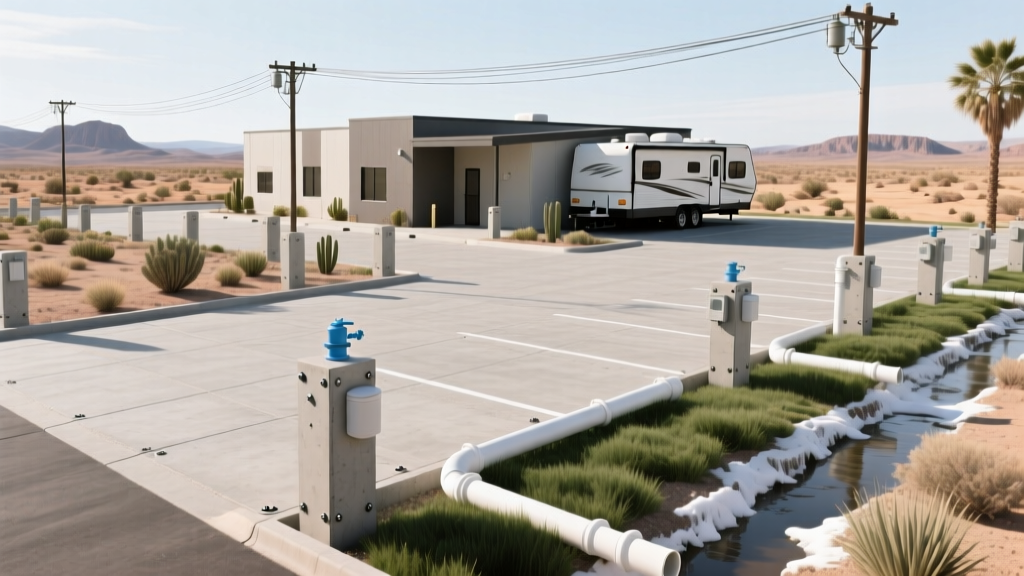
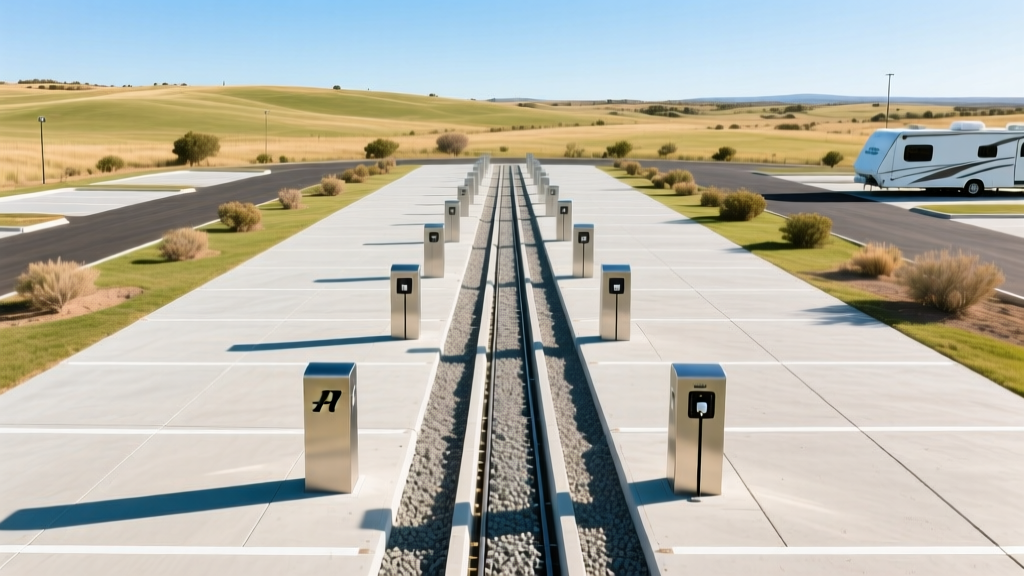
Modern RV parks must accommodate 50-amp service to support high-draw appliances like residential refrigerators and multiple air conditioning units found in 2026 luxury rigs. Developers typically install Milbank or Reliance commercial-grade pedestals, which cost between $900 and $1,400 per unit before installation.
- Sunbelt Advantage: Shallow frost lines (12 to 18 inches) allow for rapid, shallow trenching. Electrical and water lines can often be laid in the same trench with proper separation barriers, saving 20% on backhoe hours.
- Northeast/Midwest Penalty: Frost lines frequently exceed 48 to 60 inches. Water lines must be buried below this depth to prevent freezing, requiring deep excavation. Electrical lines must be run in separate, shallower trenches, effectively doubling the linear footage of trenching required per site.
Wastewater Systems and Frost Line Impacts
Sewer infrastructure requires precise engineering. Gravity-fed systems mandate a strict 1/4-inch per foot slope. In flat terrains like coastal Florida or parts of the Midwest, achieving this slope often requires deep trunk lines and expensive lift stations.
Regions in Texas and Oklahoma feature highly expansive clay soils. When these soils absorb moisture, they swell, potentially crushing rigid PVC sewer laterals. Developers in these zones must specify SDR 35 PVC or use flexible HDPE piping with engineered sand bedding to absorb soil movement, adding $1,200 to $1,800 per site in material and labor costs.
Paving and Pad Materials by Climate Zone
The choice of pad material drastically alters both upfront capital expenditure and long-term maintenance. According to paving standards outlined by the National Asphalt Pavement Association (NAPA), climate dictates the optimal binder and aggregate mix.
Concrete Pads (4000 PSI, Fiber-Reinforced)
Concrete is the premium standard, costing $8.50 to $13.00 per square foot installed. A standard 20' x 60' pad (1,200 sq ft) will cost $10,200 to $15,600. Concrete is mandatory in high-UV regions like Arizona, where asphalt softens and degrades under extreme summer heat and heavy point-loads from hydraulic leveling jacks.
Asphalt Pads (Superpave Mix)
Asphalt remains popular in the Northeast and Pacific Northwest due to its flexibility during freeze-thaw cycles. Installed costs range from $4.50 to $7.50 per square foot. However, developers must budget for sealcoating every three years and accept a shorter lifespan of 15-20 years compared to concrete's 40+ years.
Crushed Aggregate (Class 5 or Limestone)
For budget-conscious developments or overflow areas, compacted aggregate costs $2.50 to $4.00 per square foot. While inexpensive, aggregate requires annual re-grading and is highly susceptible to weed intrusion and mud generation during heavy rains, which can negatively impact premium nightly rates.
Permitting, Impact Fees, and Stormwater Management
Soft costs and municipal impact fees are the hidden variables that frequently derail RV park pro formas. The KOA North American Camping & Outdoor Hospitality Report frequently highlights that regulatory hurdles are the primary bottleneck for new supply.
- Pacific Northwest Stormwater Mandates: Counties in Washington and Oregon enforce strict Critical Areas Ordinances. Developers must engineer complex bioswales, retention ponds, and permeable paving systems to manage runoff. This can consume up to 15% of the total site acreage and add $4,000 to $6,000 per site in civil engineering and earthwork costs.
- Sunbelt Water/Sewer Tap Fees: While trenching is cheaper in the South, municipal tap fees are exorbitant. In high-growth corridors around Austin, TX, or Orlando, FL, water and sewer capacity fees can exceed $15,000 per site, payable before a single shovel hits the dirt.
- Northeast Environmental Reviews: States like New York and Massachusetts often require extensive Phase I and Phase II environmental site assessments, wetland delineations, and traffic impact studies, adding $40,000 to $80,000 in soft costs and delaying groundbreaking by 12 to 18 months.
Amenity Cost Multipliers
To compete in the 2026 market, basic hookups are insufficient. Developers must integrate amenities, which are calculated as a cost-per-site multiplier.
| Amenity | Estimated Total Cost | Cost Per Site (50-Site Park) |
|---|---|---|
| Modern Bathhouse (3,000 sq ft) | $600,000 - $850,000 | $12,000 - $17,000 |
| Concrete Dump Station w/ Potable Water | $45,000 - $65,000 | $900 - $1,300 |
| Fenced Dog Park (5,000 sq ft, agility equip) | $25,000 - $40,000 | $500 - $800 |
| Clubhouse w/ Pool & Fitness (6,000 sq ft) | $1,200,000 - $1,800,000 | $24,000 - $36,000 |
Actionable Framework: Estimating Your Specific Site
To accurately forecast the cost to build a RV park on your target parcel, execute this four-step due diligence framework before purchasing land:
- Order a Geotechnical Soil Report: Do not rely on county soil maps. A $3,000 borehole test will reveal bedrock depth (which requires blasting) or high water tables (which require dewatering during trenching), both of which can add $10,000+ per site in earthwork.
- Request a Will-Serve Letter: Obtain a formal letter from the local water and sewer authority confirming they have the capacity to serve your proposed number of sites. Verify the exact tap fees and whether off-site main extensions are required at your expense.
- Audit the Zoning Code for Setbacks and Density: Calculate the net usable acreage after subtracting mandatory buffers, stormwater retention areas, and road rights-of-way. A 20-acre parcel may only yield 60 usable sites, drastically increasing your per-site land cost.
- Secure 3-Phase Power Verification: Contact the local rural electric cooperative or utility provider to confirm the distance to the nearest 3-phase power lines. Running new medium-voltage lines and installing a step-down transformer can cost $30,000 to $80,000 if the existing grid is undersized.
By isolating these regional variables and focusing on per-site infrastructure realities, developers can build highly accurate financial models that withstand the scrutiny of commercial lenders and equity partners.
Written by
Priya KapoorPriya Kapoor is a real estate market analyst and construction economics researcher with expertise in housing affordability, development feasibility, and infrastructure investment. She holds a Master of Regional Planning from Cornell University and previously worked as a senior analyst at CBRE's Investment Properties group, where she modeled returns for $4B in mixed-use development pipelines. Priya now runs an independent research practice advising developers, municipalities, and REITs on construction cost forecasting and market timing. She publishes the quarterly "BuildMat Market Pulse" report tracking material price indices across 12 commodity categories. Based in Austin, TX, Priya serves on the board of Habitat for Humanity Austin and is a marathon runner.
More from Priya Kapoor
View all
Construction Cost
Cost to Build a 1600 Sq Ft Home in 2026: Full Breakdown
Accurate 2026 cost to build a 1600 sq ft home—material, labor, and regional pricing breakdowns included. Plan your budget with real-time estimates.
Aug 11, 2026

Wood & Lumber
Name the Types of Wood for Pressure Treatment and Preservation
Learn how to name the types of wood best suited for pressure treatment. Compare species treatability, chemical retention levels, and 2026 preservation costs.
Aug 4, 2026

Stone & Masonry
Stone Veneer Suppliers Lindenhurst: 2026 Cost Analysis
Analyze 2026 stone veneer costs in Lindenhurst, NY. Compare local supplier pricing, delivery fees, and Suffolk County installation labor rates.
Aug 4, 2026