Residential Windmill Cost to Build: Financing and Tax Credit Guide
Discover how to finance your residential windmill cost to build. Explore USDA grants, tax credits, loan options, and ROI calculations.
Terminology and Capital Expenditure Realities
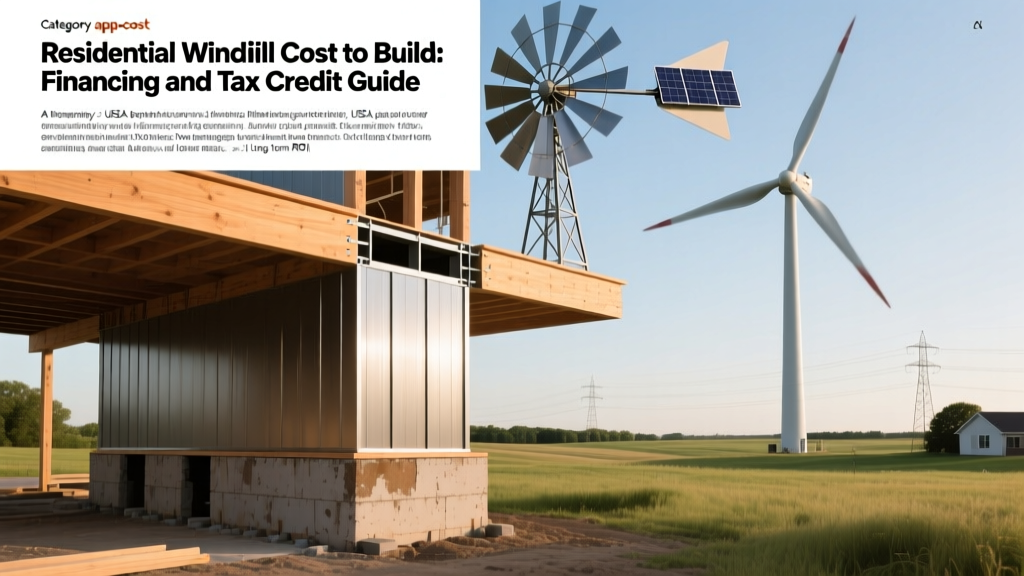
When evaluating the windmill cost to build, property owners must first clarify their mechanical objectives. In modern construction and energy sectors, the term "windmill" is frequently conflated with "wind turbine." A traditional mechanical windmill harnesses kinetic energy to pump water, primarily serving agricultural irrigation and livestock. A wind turbine converts kinetic energy into electricity for residential or commercial grid consumption. The financing pathways, tax incentives, and capital expenditures (CapEx) for these two structures diverge significantly.
CapEx Breakdown: Where the Capital Goes
Securing financing requires a precise understanding of the line-item costs. Lenders and grant administrators will scrutinize your project budget. The total windmill cost to build is not limited to the turbine hardware; it encompasses site preparation, engineering, and grid interconnection.
| System Component | 10kW Turbine Cost Range | Mechanical Water Pump Cost Range |
|---|---|---|
| Turbine/Mill Head & Rotor | $22,000 - $35,000 | $4,500 - $7,000 |
| Tower (60ft - 100ft Lattice/Tubular) | $8,000 - $14,000 | $2,500 - $5,000 |
| Foundation & Concrete Engineering | $3,500 - $6,000 | $1,000 - $2,500 |
| Inverter & Balance of System (BOS) | $4,500 - $8,000 | N/A |
| Labor, Trenching & Interconnection | $7,000 - $12,000 | $1,500 - $3,000 |
| Total Estimated CapEx | $45,000 - $75,000 | $9,500 - $17,500 |
Strategic Financing Pathways
Funding a wind energy project out-of-pocket is rarely the most capital-efficient route. By leveraging federal tax codes, rural development grants, and specialized green financing, you can reduce the net windmill cost to build by 30% to 70%.
1. The Federal Investment Tax Credit (ITC)
Under the Inflation Reduction Act (IRC Section 48), residential and commercial wind turbines qualify for a 30% Federal Investment Tax Credit through 2032. This is a dollar-for-dollar reduction of your federal income tax liability, not a mere deduction.
- Eligibility: Applies strictly to electricity-generating wind turbines. Mechanical water-pumping windmills do not qualify for the ITC.
- Carryforward Provision: If your tax liability in the year of installation is lower than the 30% credit (e.g., a $16,500 credit on a $55,000 system), the remainder can be carried forward to subsequent tax years.
- Battery Storage Bonus: If you pair your turbine with a qualified battery storage system (minimum 3 kWh capacity), the storage component independently qualifies for its own 30% ITC.
2. USDA REAP and EQIP Grants (Agricultural & Rural)
For property owners in designated rural areas or those operating agricultural enterprises, the USDA Rural Energy for America Program (REAP) is the most lucrative financing vehicle available.
If you are building a mechanical windmill specifically for livestock watering or irrigation efficiency, you should instead apply for the USDA’s Environmental Quality Incentives Program (EQIP), which offers cost-share payments for conservation-focused water management infrastructure.
3. Specialized Green Energy Loans
When grant funding is unavailable or tax credits do not cover immediate cash flow needs, specialized energy loans offer superior terms compared to standard personal loans or HELOCs.
- FHA Title I Property Improvement Loans: Insured by the federal government, these loans allow homeowners to borrow up to $25,000 for single-family homes to fund energy-efficient structural improvements, including wind turbines, often with lower down-payment requirements.
- Fannie Mae HomeStyle Energy: This mortgage product allows borrowers to finance up to 15% of the property's "as-completed" appraised value specifically for energy improvements. The underwriting process factors in the projected utility savings, making it easier to qualify for higher debt-to-income ratios.
- Credit Union Green Loans: Many regional credit unions offer unsecured wind and solar loans with terms up to 15 years. In the 2026 lending environment, expect APRs for specialized green loans to range between 6.5% and 8.5%, significantly lower than the 12%+ rates on standard unsecured home improvement loans.
Calculating ROI and the Payback Matrix
Before signing a loan agreement, you must model the payback period. The return on investment for a wind turbine is entirely dependent on local wind speeds (measured in meters per second at hub height) and local utility retail electricity rates.
The Anemometer Rule: Never finance a wind project based on regional airport wind data. Airport anemometers are mounted at 10 meters (33 feet) in open, flat areas. Your turbine will likely be mounted at 24 to 30 meters (80 to 100 feet) near trees and structures. Budget $1,500 to $3,000 to install a temporary, site-specific anemometer tower for 12 months prior to securing financing. Lenders will require this data to underwrite the project's revenue projections.
Sample 10kW Payback Scenario (Midwest US, 12 mph average wind speed):
- Gross CapEx: $55,000
- Federal ITC (30%): -$16,500
- Net System Cost: $38,500
- Annual Energy Production: 14,500 kWh
- Local Utility Rate: $0.14 / kWh
- Annual Utility Savings: $2,030
- Simple Payback Period: 18.9 years ($38,500 / $2,030)
While an 18-year payback period may seem lengthy, factoring in a conservative 3% annual utility rate inflation reduces the real payback period to roughly 14 years. Furthermore, properties with owned, permitted wind energy systems typically see a 3% to 5% premium in resale valuation.
Hidden Costs and Zoning Edge Cases
Financial models frequently fail because they omit soft costs and regulatory friction. When drafting your budget, allocate a 15% contingency fund for the following edge cases:
Zoning Variances and Setback Requirements
Most municipal zoning codes dictate that a wind tower must be set back from property lines by a distance equal to 1.1 or 1.5 times its total height (including the rotor tip). If you have a small lot and require a variance to bypass setback rules, expect to pay $1,500 to $4,000 in legal, surveyor, and municipal hearing fees.
Geotechnical Soil Boring
A 100-foot lattice tower exerts massive uplift and compressive forces on its foundation. If your local building department requires a geotechnical soil boring report to engineer the concrete pad, add $2,500 to your pre-construction budget. Skipping this step risks catastrophic foundation failure during high-shear wind events.
Grid Interconnection Upgrades
If your rural property requires a transformer upgrade or a new bi-directional smart meter to accommodate net metering, the local utility cooperative may pass these infrastructure costs directly to you. Interconnection fees typically range from $500 to $2,500, but transformer upgrades can exceed $5,000.
Expert Verdict: Structuring Your Capital
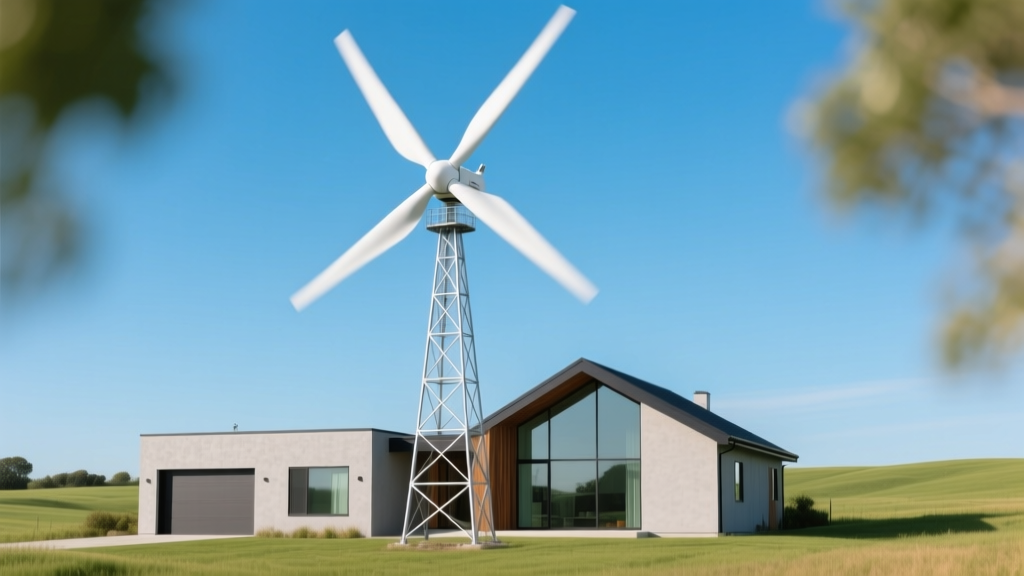
Financing the windmill cost to build is highly viable if you approach the project as an infrastructure investment rather than a simple home improvement. For agricultural producers, stacking a USDA REAP grant with the 30% ITC creates an unmatched financial leverage scenario, often yielding payback periods under 7 years. For standard residential homeowners, the project's financial viability hinges entirely on securing low-interest green financing, verifying site-specific wind resources via anemometer testing, and ensuring local zoning ordinances permit towers exceeding 60 feet. Always cross-reference your state-specific incentives using the DSIRE (Database of State Incentives for Renewables & Efficiency) before finalizing your loan documents, as local property tax exemptions and state-level rebates can further compress your net capital requirements.
Written by
Marcus ChenMarcus Chen is a licensed structural engineer (PE) and building materials analyst with over 12 years of experience across residential, commercial, and industrial construction. He holds a Master of Science in Civil Engineering from UC Berkeley and spent six years at Thornton Tomasetti before transitioning to independent consulting and technical writing. Marcus specializes in material selection for seismic-prone regions, concrete reinforcement strategies, and lifecycle cost analysis. His work has been cited by the American Concrete Institute (ACI) and the Structural Engineers Association of California (SEAOC). When he is not on a job site or at his desk, you will find him hiking the Sierra Nevada or restoring a 1920s craftsman bungalow in Oakland, CA.
More from Marcus Chen
View all
Construction Cost
How Much Did the Eiffel Tower Cost to Build?
How much did the Eiffel Tower cost to build in 1889? We adjust for inflation and compare its budget to modern skyscraper construction.
Aug 4, 2026

Fire Resistance
What Is a Fire Resistant Material? Testing & Certification Guide
Discover what is a fire resistant material through ASTM and UL testing. Learn how fire ratings, certifications, and assemblies work in construction.
Aug 4, 2026

Construction Cost
How Much Did the Burj Khalifa Cost to Build?
How much did the Burj Khalifa cost to build? We break down the $1.5B project and extract 5 money-saving strategies for your next build.
Jul 30, 2026