How Much Does It Cost to Build a Skating Rink? 2026 Breakdown
Detailed 2026 cost breakdown for building a skating rink. Compare pricing for refrigerated concrete, synthetic ice, and natural flooded backyard rinks.
The Short Answer: 2026 Skating Rink Cost Ranges
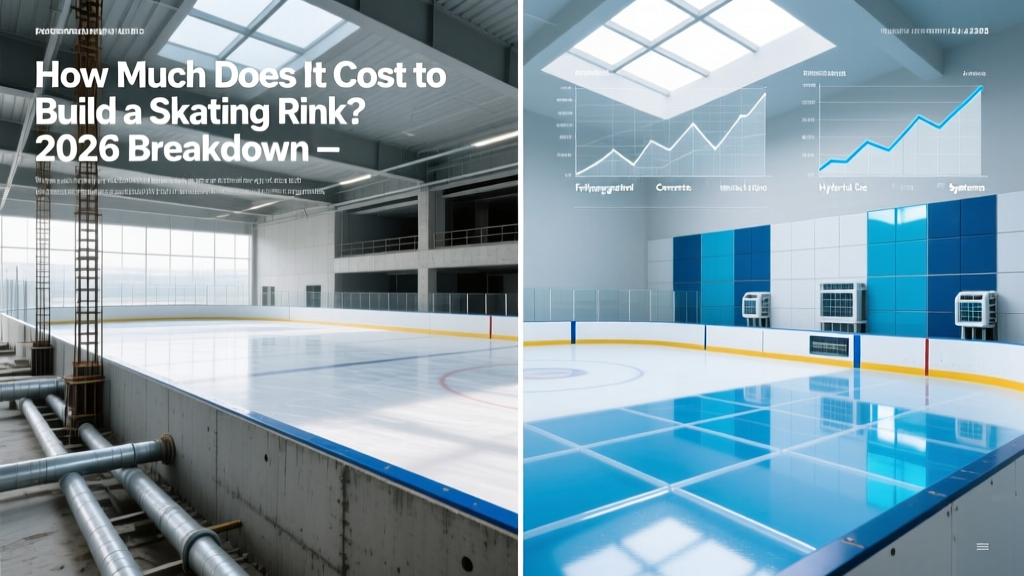
Building a skating rink is a highly variable investment dictated by thermodynamics, material science, and site preparation. In 2026, the cost to build a skating rink ranges from $500 for a basic flooded backyard tarp rink to over $250,000 for a fully engineered, refrigerated concrete residential or small commercial rink. The primary cost drivers are the cooling methodology, sub-grade insulation requirements, and the structural integrity of the skating surface.
Cost Comparison Matrix by Rink Type
The following table breaks down the capital expenditure (CapEx) for a standard 3,200 square foot rink (40' x 80') across the three primary construction methodologies.
| Rink Type | Total Cost Range (3,200 sq ft) | Cost Per Sq Ft | Lifespan |
|---|---|---|---|
| Natural Flooded (Tarp/Liner) | $800 - $2,500 | $0.25 - $0.78 | 1 - 3 Seasons |
| Synthetic Ice (UHMWPE Panels) | $80,000 - $144,000 | $25.00 - $45.00 | 10 - 15 Years |
| Refrigerated Concrete | $135,000 - $260,000+ | $42.00 - $81.00+ | 30+ Years |
Deep Dive: Refrigerated Concrete Rinks (The Gold Standard)
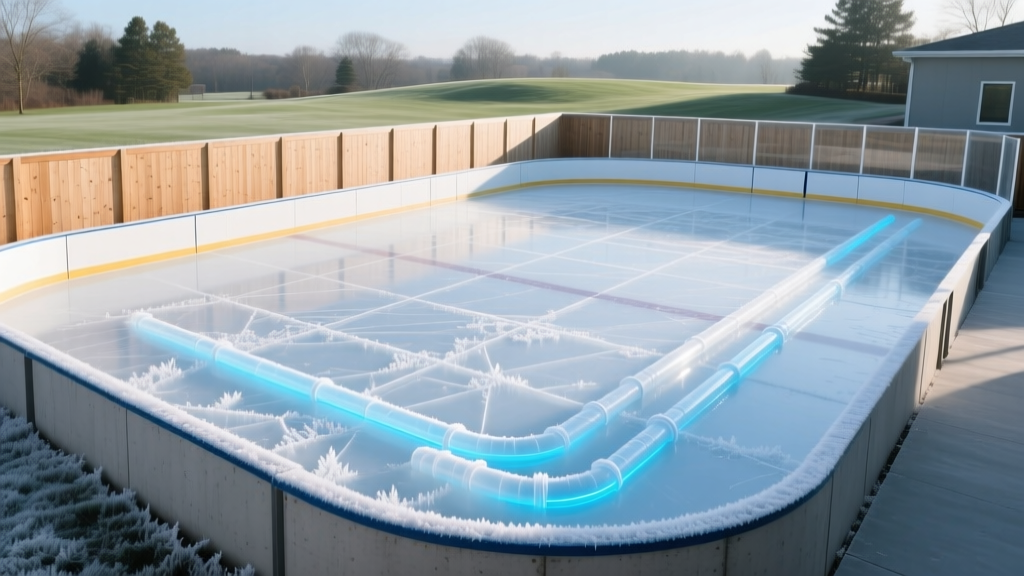
A refrigerated concrete rink provides true, year-round ice quality but requires rigorous civil engineering. The system circulates chilled propylene glycol through a network of pipes embedded in a reinforced concrete slab. According to ASHRAE's Design and Operation of Ice Arenas, improper thermal break design is the leading cause of catastrophic slab failure in residential and commercial rinks.
1. Excavation, Sub-Base, and Insulation ($18,000 - $32,000)
You cannot pour a refrigerated rink slab directly on dirt. The ground must be excavated 12 to 18 inches and filled with compacted crushed limestone (3/4-inch minus). Crucially, a continuous thermal break is required to prevent the chiller from freezing the underlying soil moisture, which causes severe frost heave. You must install 2-inch to 3-inch Extruded Polystyrene (XPS) insulation with a minimum compressive strength of 25 PSI beneath the entire slab footprint. A 10-mil polyethylene vapor barrier must be placed below the XPS to block capillary moisture migration.
2. Piping and Manifolds ($22,000 - $38,000)
The refrigeration grid typically utilizes 3/4-inch PEX-a (cross-linked polyethylene) tubing or specialized PVC, spaced exactly 3.5 to 4 inches on center. For a 3,200 sq ft rink, this requires approximately 10,000 linear feet of tubing. The pipes are tied to a rebar grid or wire mesh elevated 1.5 inches above the insulation. Manifolds must be housed in a heated, insulated vault to prevent the glycol mixture from freezing during power outages.
3. Concrete Pour and Finishing ($35,000 - $55,000)
Ice rink slabs require a specialized 4-inch to 5-inch thick concrete pour using a minimum 4,000 PSI compressive strength mix reinforced with synthetic fiber mesh and steel rebar. The surface must be laser-screeded to a tolerance of +/- 1/8 inch over 10 feet. Unlike standard flatwork, the concrete receives a specific 'ice-rink trowel' finish—smooth enough for uniform ice adhesion, but micro-textured to prevent the ice sheet from delaminating during thermal expansion.
4. The Chiller Plant and Glycol ($25,000 - $60,000)
The heart of the system is the chiller. Sizing is calculated at roughly 1 ton of refrigeration per 350-400 square feet of ice surface, meaning a 3,200 sq ft rink requires an 8 to 10-ton chiller. Due to the EPA AIM Act phasing down high-GWP HFC refrigerants, modern chillers in 2026 utilize transitional blends like R-448A or natural CO2 systems, which carry a 15-20% premium over legacy R-404A units but offer superior long-term compliance and efficiency. The system is charged with a 30% propylene glycol and water solution.
Synthetic Ice Polymer Rinks (UHMWPE)
Synthetic ice is constructed from interlocking panels of Ultra-High-Molecular-Weight Polyethylene (UHMWPE). It requires no electricity, water, or chillers, making it viable for indoor facilities, rooftops, or warm climates. However, the friction coefficient is 10-15% higher than real ice, requiring skaters to exert more energy.
Pros
- Zero utility costs for refrigeration.
- Can be installed over existing concrete, asphalt, or wooden subfloors.
- Allows for year-round skating in any climate.
- Panels can be disassembled and relocated.
Cons
- High initial material cost ($25-$45 per sq ft for sintered UHMWPE).
- Generates plastic shavings (dust) that require daily vacuuming.
- Requires periodic application of liquid glide enhancers (silicone-based).
- Subfloor must be perfectly level; otherwise, panels separate and create trip hazards.
Natural Flooded Backyard Rinks
The traditional method relies on ambient winter temperatures (consistently below 20°F / -6°C). Construction involves grading the lawn, erecting a perimeter of wooden dasher boards or inflatable bumpers, and laying a heavy-duty 6-mil woven polyethylene liner. Water is added in thin 1/2-inch layers, allowing each to freeze solid before adding the next. While the upfront cost is under $2,000, the hidden cost is water usage (a 40x80 rink requires roughly 18,000 gallons of water to achieve a 4-inch base ice thickness) and the high risk of liner punctures from rocks or roots.
Critical Engineering & Hidden Failure Modes
When estimating how much it costs to build a skating rink, contractors often omit secondary infrastructure requirements that can derail a budget.
According to frozen ground research from the NSIDC, continuous freezing of the soil beneath a refrigerated slab creates an artificial permafrost layer. If the sub-grade contains silt or clay (which hold water), the freezing process will cause massive volumetric expansion (frost heave). This will crack the concrete slab and snap the embedded PEX tubing, resulting in a total loss of the rink. Always conduct a soil bore test and over-excavate to replace frost-susceptible soils with clean, free-draining gravel.
- Electrical Upgrades: A 10-ton commercial chiller and ice resurfacer require 3-phase, 480V power. Upgrading a residential or small commercial property from single-phase 200A to 3-phase 400A service can add $15,000 to $35,000 to the project.
- Dehumidification: Indoor rinks require desiccant dehumidifiers to maintain a dew point below the ice surface temperature. Failing to install a $20,000+ dehumidification system results in dense fog, condensation on the roof deck, and rapid structural rot of steel trusses.
- Dasher Boards and Glass: Professional-grade HDPE dasher boards with acrylic shielding cost between $150 and $250 per linear foot. For a 240-linear-foot perimeter, expect to add $36,000 to $60,000.
Operating & Maintenance Realities
The CapEx is only the beginning. Operating a 3,200 sq ft refrigerated outdoor rink in a climate with 40°F average winter daytime highs requires the chiller to run 60-70% of the time. Expect electrical costs of $1,200 to $2,500 per month during the ice season. Furthermore, maintaining the ice surface requires an ice resurfacer. While a full-sized Zamboni costs upwards of $150,000, small-scale ride-on resurfacers (like the Olympia Millennium or smaller electric models) range from $35,000 to $65,000. Manual resurfacing with a flood tank and squeegee is labor-intensive and yields inferior ice quality for hockey or figure skating.
Frequently Asked Questions
Can I install a refrigerated rink over an existing concrete driveway?
No. Existing driveways lack the underlying XPS thermal insulation and the embedded PEX tubing grid. You cannot retrofit cooling pipes under cured concrete. The existing slab must be demolished, the ground excavated for insulation, and a new rink-specific slab poured.
How much does it cost to build a skating rink using synthetic ice indoors?
For a standard 20x40 foot (800 sq ft) indoor training room, sintered UHMWPE panels will cost between $20,000 and $36,000 for the materials. You must also budget $3,000 to $6,000 for a perfectly leveled plywood or OSB subfloor system to ensure the interlocking tongue-and-groove joints do not separate under lateral skating forces.
What is the best glycol mixture for the chiller system?
Use only inhibited propylene glycol mixed with distilled or reverse-osmosis water at a 30% to 35% concentration. Never use automotive ethylene glycol; it is highly toxic, degrades rapidly under thermal stress, and turns acidic, which will corrode the chiller's copper brazed plate heat exchangers and ruin the system.
Written by
Priya KapoorPriya Kapoor is a real estate market analyst and construction economics researcher with expertise in housing affordability, development feasibility, and infrastructure investment. She holds a Master of Regional Planning from Cornell University and previously worked as a senior analyst at CBRE's Investment Properties group, where she modeled returns for $4B in mixed-use development pipelines. Priya now runs an independent research practice advising developers, municipalities, and REITs on construction cost forecasting and market timing. She publishes the quarterly "BuildMat Market Pulse" report tracking material price indices across 12 commodity categories. Based in Austin, TX, Priya serves on the board of Habitat for Humanity Austin and is a marathon runner.
More from Priya Kapoor
View all
Construction Cost
Cost to Build a 1600 Sq Ft Home in 2026: Full Breakdown
Accurate 2026 cost to build a 1600 sq ft home—material, labor, and regional pricing breakdowns included. Plan your budget with real-time estimates.
Aug 11, 2026

Wood & Lumber
Name the Types of Wood for Pressure Treatment and Preservation
Learn how to name the types of wood best suited for pressure treatment. Compare species treatability, chemical retention levels, and 2026 preservation costs.
Aug 4, 2026

Stone & Masonry
Stone Veneer Suppliers Lindenhurst: 2026 Cost Analysis
Analyze 2026 stone veneer costs in Lindenhurst, NY. Compare local supplier pricing, delivery fees, and Suffolk County installation labor rates.
Aug 4, 2026