Estimating Your SoFi Cost to Build for ADUs and Garage Projects
Learn how to calculate your SoFi cost to build for ADUs, garages, and sheds. Compare SoFi personal loans and HELOCs with 2026 construction benchmarks.
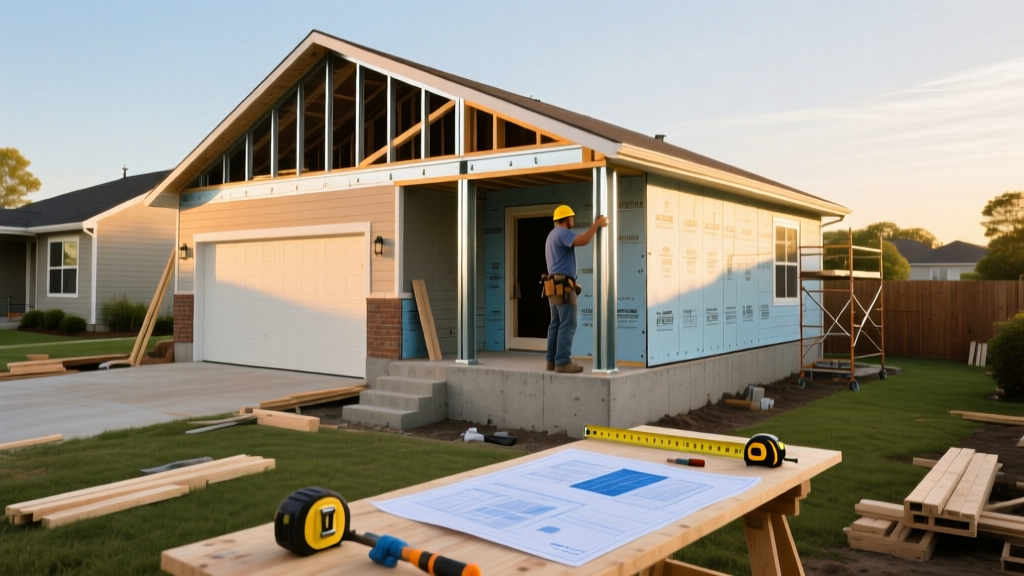
The Reality of Financing Construction with SoFi
Securing capital for a new structure requires matching your exact SoFi cost to build with the appropriate financial product. Unlike traditional construction-to-permanent loans that require extensive draw schedules and builder approvals, SoFi’s lending ecosystem primarily relies on unsecured personal loans and secured Home Equity Lines of Credit (HELOCs). Choosing the wrong product can result in excessive interest payments or funding shortfalls mid-project.
- SoFi Personal Loans: $5,000 to $100,000 (Unsecured, fixed rates, no origination fees)
- SoFi HELOCs: Up to $500,000+ (Secured by home equity, variable rates, draw period)
To accurately estimate your borrowing needs, you must move beyond basic square-footage multipliers and account for site-specific variables, material volatility, and municipal impact fees. According to National Association of Home Builders (NAHB) housing economics data, material and labor fluctuations can shift final project costs by 8% to 12% from initial estimates.
Matching Your Build Type to the Right SoFi Product
The physical scope of your project dictates which SoFi product is mathematically viable. Here is how different structures align with current lending limits.
Scenario A: The Detached Garage or Workshop (Under $100k)
A standard 24x24 detached garage (576 sq. ft.) with a 4000 PSI concrete slab, LP SmartSide engineered wood siding, and an architectural shingle roof typically costs between $35,000 and $55,000. Because this falls well under the $100,000 maximum for SoFi Personal Loans, this is the ideal financing vehicle. You avoid the appraisal requirements, closing costs, and equity constraints of a secured loan, receiving funds in a single lump sum to pay your contractor upfront.
Scenario B: The Accessory Dwelling Unit (ADU) ($150k+)
Building a detached 800 sq. ft. ADU involves complex utility tie-ins, foundation engineering, and interior finish-outs. At $200 to $300 per square foot, total costs range from $160,000 to $240,000. This exceeds SoFi’s unsecured personal loan limits. For this scope, you must utilize a SoFi HELOC, leveraging your existing home equity to draw funds progressively as the ADU construction milestones are met.
Hard Numbers: Construction Cost Benchmarks
Use this matrix to baseline your SoFi cost to build before applying for financing. These figures assume standard soil conditions and exclude extreme architectural customizations.
| Structure Type | Typical Size | Cost per Sq. Ft. | Total Estimated Cost | Recommended SoFi Product |
|---|---|---|---|---|
| Storage Shed (Wood) | 120 sq. ft. | $40 - $75 | $4,800 - $9,000 | Personal Loan |
| Pole Barn (Unfinished) | 1,200 sq. ft. | $25 - $45 | $30,000 - $54,000 | Personal Loan |
| Detached Garage (2-Car) | 576 sq. ft. | $60 - $95 | $34,560 - $54,720 | Personal Loan |
| Garage with Loft/Apartment | 900 sq. ft. | $110 - $160 | $99,000 - $144,000 | HELOC / Split Financing |
| Detached ADU (Full Kitchen) | 800 sq. ft. | $200 - $300 | $160,000 - $240,000 | HELOC |
Step-by-Step: Calculating Your Exact Borrowing Amount
Never borrow the exact base quote provided by your contractor. Construction projects inherently encounter unforeseen variables. Follow this framework to calculate your final SoFi loan request.
- Establish the Base Hard Cost: Sum the contractor’s quote for materials and labor. For a garage, this includes the 4000 PSI concrete pour, 2x6 framing, trusses, and roofing.
- Add Soft Costs (10-15%): Include architectural drawings, structural engineering stamps, municipal building permits, and soil testing. These are rarely included in base contractor bids.
- Factor in Utility Trenching: If you are running a 200-amp electrical subpanel or a 4-inch sewer line from the main house to an ADU, add $45 to $85 per linear foot for trenching and backfilling.
- Apply the Contingency Buffer: Multiply your subtotal by 1.15 (15%). This covers material price escalation, weather delays, and hidden site issues like hitting bedrock during excavation.
Warning: If your calculated total for a garage project lands at $92,000, do not borrow $100,000 just because it is the SoFi maximum. SoFi personal loans accrue interest on the full disbursed amount from day one. Borrow exactly what your buffered estimate dictates to minimize interest waste.
SoFi Personal Loan vs. HELOC: The Decision Matrix
Understanding the mechanical differences between these products is critical for long-term cost management. The Consumer Financial Protection Bureau (CFPB) HELOC guidelines emphasize the risks of variable rates, which must be weighed against the speed of unsecured funding.
| Feature | SoFi Personal Loan | SoFi HELOC |
|---|---|---|
| Best For | Garages, sheds, pole barns, minor renovations | ADUs, major additions, full property overhauls |
| Max Limit | $100,000 | $500,000+ |
| Interest Rate Type | Fixed (Predictable monthly payments) | Variable (Fluctuates with prime rate) |
| Collateral Required | None (Unsecured) | Home equity (Secured) |
| Funding Speed | Same-day to 48 hours | 30 to 45 days (Requires appraisal) |
| Fees | No origination, prepayment, or late fees | Potential closing costs, annual fees, or early closure fees |
Hidden Costs That Derail Construction Loans
When calculating your SoFi cost to build, contractors frequently omit site-specific infrastructure requirements. Failing to budget for these will force you to apply for secondary, high-interest financing mid-build.
- Municipal Impact Fees: Building an ADU often triggers school district and park impact fees. In high-cost municipalities, these can range from $10,000 to $25,000, payable before the building permit is issued.
- Utility Capacity Upgrades: If your main house has a 100-amp electrical panel, adding an ADU or a garage with EV charging capabilities will require a $2,500 to $4,500 upgrade to a 200-amp or 400-amp service from the local utility provider.
- Geotechnical Engineering: If your build site is on a slope or features expansive clay soil, a structural engineer may require a reinforced grade beam foundation or helical piers, adding $8,000 to $15,000 to the foundation budget.
- Permit Expediting: In jurisdictions with 6-month permit backlogs, paying an expediting service ($1,500 to $3,000) can save thousands in carrying costs and loan interest.
Finalizing Your Application Strategy
Before submitting your application, obtain three itemized bids from licensed contractors. Ensure each bid separates hard materials, labor, and permit allowances. Use the highest bid plus your 15% contingency buffer as your target loan amount. If the total exceeds $100,000, pivot immediately to a HELOC or explore splitting the project into phases to utilize a personal loan for the initial shell construction, followed by a second loan for interior finish-outs.
Written by
Priya KapoorPriya Kapoor is a real estate market analyst and construction economics researcher with expertise in housing affordability, development feasibility, and infrastructure investment. She holds a Master of Regional Planning from Cornell University and previously worked as a senior analyst at CBRE's Investment Properties group, where she modeled returns for $4B in mixed-use development pipelines. Priya now runs an independent research practice advising developers, municipalities, and REITs on construction cost forecasting and market timing. She publishes the quarterly "BuildMat Market Pulse" report tracking material price indices across 12 commodity categories. Based in Austin, TX, Priya serves on the board of Habitat for Humanity Austin and is a marathon runner.
More from Priya Kapoor
View all
Construction Cost
Cost to Build a 1600 Sq Ft Home in 2026: Full Breakdown
Accurate 2026 cost to build a 1600 sq ft home—material, labor, and regional pricing breakdowns included. Plan your budget with real-time estimates.
Aug 11, 2026

Wood & Lumber
Name the Types of Wood for Pressure Treatment and Preservation
Learn how to name the types of wood best suited for pressure treatment. Compare species treatability, chemical retention levels, and 2026 preservation costs.
Aug 4, 2026

Stone & Masonry
Stone Veneer Suppliers Lindenhurst: 2026 Cost Analysis
Analyze 2026 stone veneer costs in Lindenhurst, NY. Compare local supplier pricing, delivery fees, and Suffolk County installation labor rates.
Aug 4, 2026