Cost to Build Taj Mahal: Historical Estimating & Modern Financing
Discover the true cost to build Taj Mahal in historical and modern terms, plus how mega-monuments are financed today through sovereign and private capital.
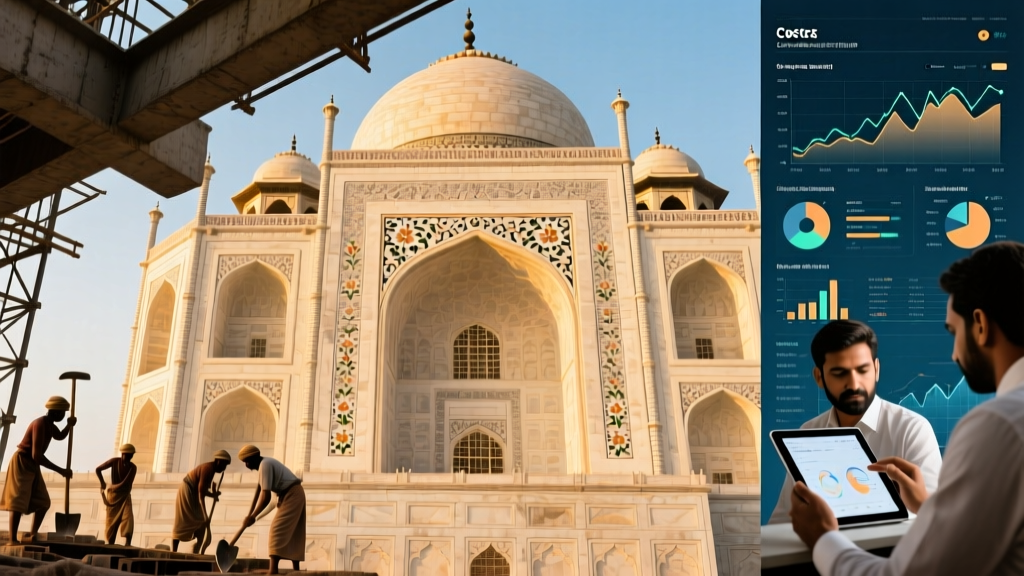
The Imperial Ledger: Original Construction Cost Breakdown
Estimating the cost to build Taj Mahal requires bridging 17th-century Mughal economics with modern construction finance. Commissioned in 1632 by Emperor Shah Jahan, the complex took approximately 22 years to complete. Historical archives record the total expenditure at roughly 32 million rupees. However, analyzing this figure through a modern cost estimator’s lens reveals a highly sophisticated, centrally planned mega-project that relied on sovereign wealth, forced labor arbitrage, and early endowment models.
The capital expenditure (CAPEX) was distributed across three primary vectors:
- Material Procurement (45%): Sourcing Makrana marble from Rajasthan, jasper from Punjab, and semi-precious stones (jade, crystal, lapis lazuli) from across Asia. Transport logistics required a fleet of 1,000 elephants and specialized ox-drawn carts, representing a massive supply chain overhead.
- Labor and Artisan Guilds (35%): The workforce peaked at 20,000 artisans, including master masons, calligraphers from Syria, and inlay specialists from Florence. While basic labor was often conscripted or minimally compensated, specialized ustads (master architects) commanded premium retainers paid in gold and land grants.
- Site Preparation and Infrastructure (20%): The Yamuna riverbank required extensive foundational work. Engineers sank 150 deep timber wells packed with rubble and mortar to stabilize the mausoleum against seismic activity and soil liquefaction—a geotechnical feat that consumed a significant portion of the early budget.
Translating 17th-Century Rupees to Modern Capital
To understand the true cost to build Taj Mahal today, we must adjust for inflation, purchasing power parity (PPP), and modern building codes. Standard Consumer Price Index (CPI) calculators fail over 400-year timelines due to fundamental shifts in economic structures. Instead, construction economists use labor-value, gold-parity, and modern replacement-cost metrics.
| Valuation Metric | Estimated Modern Value | Methodology & Application |
|---|---|---|
| $650 Million USD | Converts 1650s rupees to gold weight, then to current spot prices. Useful for raw material benchmarking. | |
| $1.2 Billion USD | Calculates the cost of 20,000 workers over 22 years at modern developing-nation construction wages. | |
| $2.8 Billion+ USD | Factors in modern OSHA safety standards, union labor, seismic engineering, and CNC marble milling. | |
| Heritage Premium Multiplier | $4.5 Billion USD | Includes the irreplaceable parchin kari (pietra dura) inlay work requiring extinct artisan techniques. |
According to data from the UNESCO World Heritage Centre, the structural integrity and material purity of the Taj Mahal remain unparalleled. Replicating the parchin kari inlay—where 28 types of semi-precious stones are carved into marble with zero visible tolerances—would require a specialized global workforce that simply does not exist at scale today, pushing the heritage premium well past $4 billion.
Structuring Capital: How to Finance a Modern Mega-Monument
Shah Jahan financed the project through the imperial treasury and a waqf (an Islamic charitable endowment). He dedicated the revenues of 30 surrounding villages to fund the complex's perpetual maintenance. If a sovereign state or private consortium were to finance a $1.5 billion cultural mega-project today, the capital stack would require complex, multi-tranche structuring.
1. Sovereign and Municipal Cultural Bonds
For state-sponsored monuments, issuing 50-year municipal or sovereign bonds is the primary vehicle. In the current high-interest-rate environment of the mid-2020s, a sovereign entity might issue tax-exempt cultural bonds yielding 4.5% to 5.5%. A $1 billion issuance would require annual debt service of roughly $55 million, necessitating a robust, legally ring-fenced revenue stream to satisfy bond rating agencies like Moody's or S&P.
2. Tourism-Backed Securitization
Modern mega-projects often borrow against future cash flows. The Taj Mahal currently attracts over 7 million visitors annually, generating substantial ticketing and regional hospitality revenue. A modern equivalent could utilize tourism-backed securitization—similar to the Bowie Bonds of the 1990s—where future ticket revenues are packaged into asset-backed securities (ABS) to raise upfront CAPEX. This shifts the risk from the sovereign balance sheet to private institutional investors seeking yield in emerging market tourism.
3. The Modern Endowment (OPEX Funding)
The most critical lesson from the Mughal financing model is the separation of CAPEX and OPEX. The original waqf endowment ensured that maintenance did not drain the central treasury. Today, developers must establish a capitalized maintenance trust prior to groundbreaking. For a $1.5 billion marble complex, a $300 million endowment invested in a diversified portfolio yielding 4% generates $12 million annually—sufficient to cover specialized marble cleaning, structural monitoring, and landscaping without relying on volatile annual appropriations.
Supply Chain Finance and Material Procurement
The macroeconomic logistics of sourcing monumental materials require aggressive supply chain financing (SCF). The original builders sourced white marble from Makrana, over 250 miles away, and lapis lazuli from Afghanistan. Today, procuring 50,000 tons of high-grade, structurally sound white marble (such as Carrara or high-grade domestic equivalents) requires international trade finance.
- Letters of Credit (LCs): Quarry operators require guaranteed payment before extracting massive custom blocks. Irrevocable, confirmed LCs issued by top-tier global banks protect both the developer and the supplier against cross-border default risks.
- Macro-Hedging: Because the cost to build Taj Mahal's modern equivalent spans a decade of construction, developers must hedge against commodity fluctuations. Fuel surcharges for heavy transport and energy costs for marble cutting can inflate material costs by 30% over a 10-year build. Forward contracts on diesel and industrial electricity are mandatory for accurate cost control.
- Surety Bonds: To protect the principal from supplier insolvency, modern projects require supply bonds. If a specialized quarry in Italy goes bankrupt mid-extraction, the surety company finances the completion of the material order from an alternate source, preventing catastrophic schedule delays.

Risk Management and Contingency Allocation
A 22-year construction timeline introduces severe macroeconomic and environmental risks. Historical records indicate that the Yamuna river's shifting course and seasonal flooding constantly threatened the foundational wells. Modern estimators must allocate a minimum 18% to 22% contingency reserve for mega-heritage projects, significantly higher than the standard 10% for commercial real estate.
Key Takeaways for Mega-Project Estimators
Analyzing the cost to build Taj Mahal provides a masterclass in long-horizon capital planning. The Mughal empire succeeded not merely through vast wealth, but through structural financial foresight: securing the supply chain via sovereign mandate, importing specialized labor at premium rates, and permanently capitalizing the maintenance phase via endowment. Modern construction estimators and financial engineers must adopt this holistic view. Whether utilizing public-private partnerships (as outlined by the World Bank) or tourism-backed securitization, the survival of a monumental structure relies entirely on the durability of its financial architecture.
Written by
Priya KapoorPriya Kapoor is a real estate market analyst and construction economics researcher with expertise in housing affordability, development feasibility, and infrastructure investment. She holds a Master of Regional Planning from Cornell University and previously worked as a senior analyst at CBRE's Investment Properties group, where she modeled returns for $4B in mixed-use development pipelines. Priya now runs an independent research practice advising developers, municipalities, and REITs on construction cost forecasting and market timing. She publishes the quarterly "BuildMat Market Pulse" report tracking material price indices across 12 commodity categories. Based in Austin, TX, Priya serves on the board of Habitat for Humanity Austin and is a marathon runner.
More from Priya Kapoor
View all
Construction Cost
Cost to Build a 1600 Sq Ft Home in 2026: Full Breakdown
Accurate 2026 cost to build a 1600 sq ft home—material, labor, and regional pricing breakdowns included. Plan your budget with real-time estimates.
Aug 11, 2026

Wood & Lumber
Name the Types of Wood for Pressure Treatment and Preservation
Learn how to name the types of wood best suited for pressure treatment. Compare species treatability, chemical retention levels, and 2026 preservation costs.
Aug 4, 2026

Stone & Masonry
Stone Veneer Suppliers Lindenhurst: 2026 Cost Analysis
Analyze 2026 stone veneer costs in Lindenhurst, NY. Compare local supplier pricing, delivery fees, and Suffolk County installation labor rates.
Aug 4, 2026