How Much Does a Tennis Court Cost to Build? Budget & Saving Tips
Discover how much a tennis court costs to build. Compare asphalt, concrete, and clay prices, and learn proven strategies to save thousands on construction.
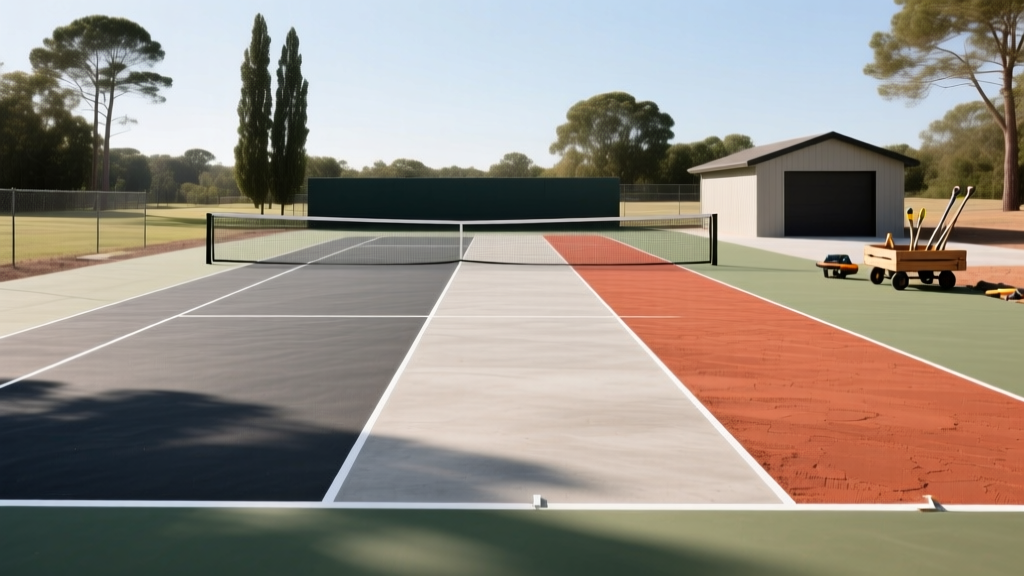
Building a residential tennis court is a major excavation and paving project that requires precise grading, specialized materials, and strict adherence to dimensional standards. The national average to build a standard 60' x 120' court ranges from $55,000 to $110,000. However, by strategically selecting base materials, phasing optional amenities, and optimizing site preparation, you can reduce your total expenditure by 20% to 35% without sacrificing playability.
Baseline Costs by Surface Material
The surface material dictates both the upfront construction cost and the long-term maintenance budget. According to the American Sports Builders Association (ASBA), the base must be engineered to withstand freeze-thaw cycles and heavy water runoff. Below is the 2026 cost breakdown for the four most common residential court surfaces.
| Surface Type | Base Construction | Surfacing / Finish | Total Estimated Cost | Lifespan |
|---|---|---|---|---|
| Asphalt + Acrylic | $25,000 - $40,000 | $15,000 - $25,000 | $40,000 - $65,000 | 15-20 years |
| Post-Tensioned Concrete | $45,000 - $70,000 | $15,000 - $25,000 | $60,000 - $95,000 | 25+ years |
| Har-Tru (Hydrostone) Clay | $30,000 - $45,000 | $15,000 - $20,000 | $45,000 - $65,000 | Indefinite (with upkeep) |
| Modular Polypropylene Tile | $20,000 - $35,000 | $25,000 - $40,000 | $45,000 - $75,000 | 15-20 years |
The Hidden Cost Multipliers
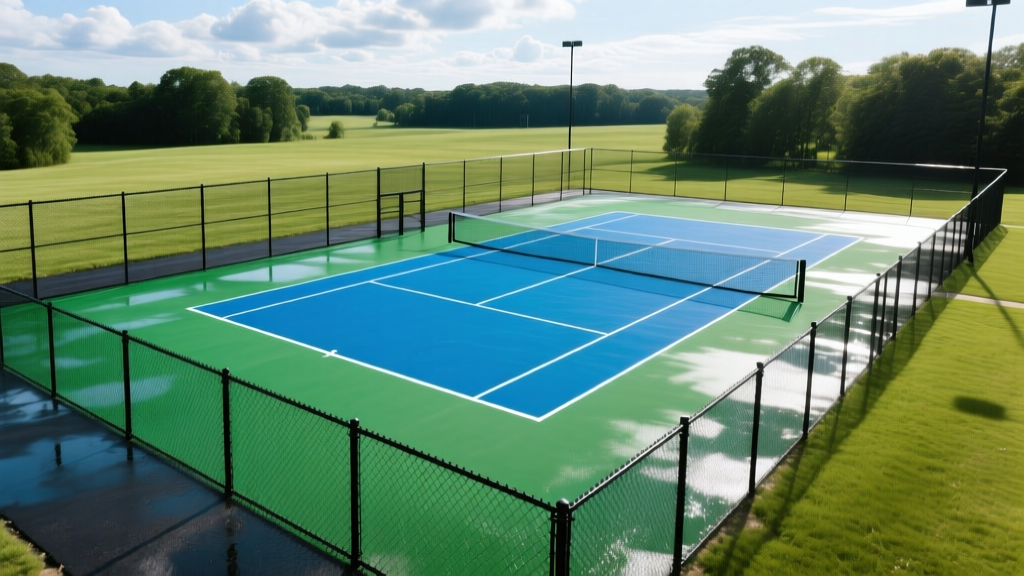
The base paving is only half the equation. Budget overruns typically occur in the peripheral construction elements. Factor these mandatory and optional costs into your initial estimate:
- Fencing: A standard 60' x 120' court requires 360 linear feet of 10-foot-high chain-link fencing. At $35 to $45 per linear foot, expect to pay $12,600 to $16,200.
- Site Clearing and Grubbing: Removing trees, stumps, and topsoil can cost $3,000 to $15,000 depending on the terrain and vegetation density.
- Retaining Walls: If your lot has a slope greater than 2%, you will need engineered retaining walls to create a flat pad, adding $10,000 to $30,000+.
- LED Lighting: A 4-pole or 6-pole LED sports lighting system costs between $18,000 and $35,000, including trenching and electrical panel upgrades.
Do not build within 20 feet of large deciduous trees (like oaks or maples). Root systems will inevitably grow under the court and heave the asphalt base, causing structural cracks that acrylic coatings cannot hide. Removing roots post-construction is impossible without destroying the court foundation.
5 Proven Money-Saving Strategies for Court Construction
1. Opt for Asphalt with Geotextile Fabric Over Post-Tensioned Concrete
Post-tensioned (PT) concrete is the gold standard for preventing structural cracking, but it costs roughly 40% more than asphalt. To save money without sacrificing durability, specify an asphalt base reinforced with a non-woven geotextile fabric (like Mirafi 500X). The fabric separates the subgrade from the aggregate base, preventing water from pumping fine soils up into the stone layer. Combine this with a 4-inch compacted aggregate base and 3 inches of asphalt, and apply a premium 100% acrylic color coating system like Plexipave or DecoTurf. This yields a tournament-quality surface at a fraction of the PT concrete price.
2. Build to the Minimum ASBA Dimensions
The International Tennis Federation (ITF) and ASBA recommend an ideal total court size of 70' x 130' (9,100 sq ft) to allow for player runoff. However, the absolute minimum standard for recreational play is 60' x 120' (7,200 sq ft). By building to the 60x120 minimum, you save 1,900 square feet of paving and grading, and reduce your fencing perimeter by 20 linear feet. This single decision saves between $6,000 and $9,000 in raw materials and labor.
3. Phase Your Lighting Infrastructure
If night play is a future goal but not an immediate necessity, do not skip the lighting prep. Trenching and pouring concrete footings after the court is paved will destroy your new surface. Instead, have your contractor install the PVC conduit, pull the wiring, and pour the concrete light pole footings during the initial build. Cap the conduit and leave the poles and LED fixtures for a later date. This reduces your day-one cost by $20,000+ while preserving the integrity of the court surface.
4. Choose Modular Polypropylene Tiles for Problematic Soil
If your soil has high clay content or poor drainage, pouring asphalt or concrete will require massive excavation and imported fill dirt to create a stable base. In these scenarios, modular interlocking polypropylene tiles (such as Mateflex or SportCourt) are highly cost-effective. They can be installed over a thinner, less expensive crushed stone base because the tiles flex and drain water through their open-grid design. They also allow for DIY installation, saving $5,000 to $8,000 in specialized surfacing labor.
5. Handle Site Clearing and Topsoil Stripping Yourself
General contractors typically mark up site preparation work by 20% to 30%. If you are willing to manage a subcontractor directly, hire a local land-clearing crew to remove vegetation and strip the topsoil before the tennis court builder arrives. You must ensure they strip exactly to the subgrade elevation specified by your court engineer, but managing this phase independently can save $3,000 to $7,000.
Long-Term Maintenance vs. Upfront Savings
A cheaper build often shifts costs to the maintenance phase. Evaluate these long-term financial commitments before finalizing your material choice:
Har-Tru Clay
Annual Cost: $2,500 - $4,000
Requires daily watering (increasing utility bills), weekly brushing, and an annual application of new top-dressing stone. You must also winterize and spring-open the court, which requires specialized labor.
Asphalt + Acrylic
Annual Cost: $800 - $1,500 (averaged)
Requires annual crack sealing and power washing. Every 5 to 8 years, the acrylic color coatings must be completely resurfaced at a cost of $8,000 to $12,000 to maintain proper traction and UV protection.
Modular Tile
Annual Cost: $100 - $300
Virtually maintenance-free. Requires occasional leaf blowing and power washing. Individual tiles can be replaced for under $10 each if damaged by heavy equipment or extreme impacts.
Decision Framework: Which Court Fits Your Budget?
Use this framework to align your budget with the correct construction methodology:
- Budget Under $45,000: Build a 60x120 court using a crushed stone base and modular polypropylene tiles. Skip lighting and use standard 10-foot chain-link fencing without windbreaks.
- Budget $45,000 to $75,000: Build a 60x120 asphalt court with a geotextile fabric base and a 5-layer acrylic color coating system. Include standard fencing and phase the lighting conduit for future installation.
- Budget $75,000 to $110,000: Build a 70x130 post-tensioned concrete court with premium cushioned acrylic surfacing (like Plexipave Cushion). Include full LED lighting, upgraded black vinyl-coated fencing, and integrated stone retaining walls if the lot requires grading.
By understanding the exact material costs and leveraging strategic phasing, you can construct a high-performance tennis court that maximizes your property value without unnecessarily inflating your initial capital outlay.
Written by
Sarah WhitfieldSarah Whitfield is a chartered quantity surveyor (MRICS) and construction cost analyst with 15 years of experience in material pricing, procurement strategy, and project budgeting. She earned her degree in Construction Management from the University of Reading (UK) and has worked on projects ranging from $2M custom homes to $180M mixed-use developments across North America and Europe. Sarah currently leads cost estimating for BuildMat Insight, maintaining a proprietary database of 4,000+ material price points updated quarterly. She is a frequent contributor to RSMeans cost data panels and has presented at the International Cost Engineering Council (ICEC) congress. Based in Denver, CO, Sarah is an avid trail runner and volunteer mentor for Women in Construction.
More from Sarah Whitfield
View all
Wood & Lumber
What Are the Different Types of Wood? A Builder's Guide
Compare structural softwoods, finish hardwoods, and engineered lumber. Analyze Janka ratings, MOE values, and 2026 pricing for construction.
Aug 4, 2026

Walls & Panels
Steel Framing vs Wood Framing: Corrosion and Moisture Defense
Compare steel framing vs wood framing for moisture resistance. Learn about galvanized coatings, condensation risks, and corrosion protection strategies.
Jul 21, 2026

Stone & Masonry
How to Cut Stone Veneer: Wet Saw vs Grinder Comparison
Compare the best tools for cutting stone veneer. We review wet saws, angle grinders, and chop saws to help you achieve clean, chip-free cuts.
Jul 21, 2026