How Much Does It Cost to Build a Tennis Court? (2026 Budget Guide)
Discover exactly how much it costs to build a tennis court in 2026. Compare asphalt vs. concrete bases, surface options, and hidden budget factors.
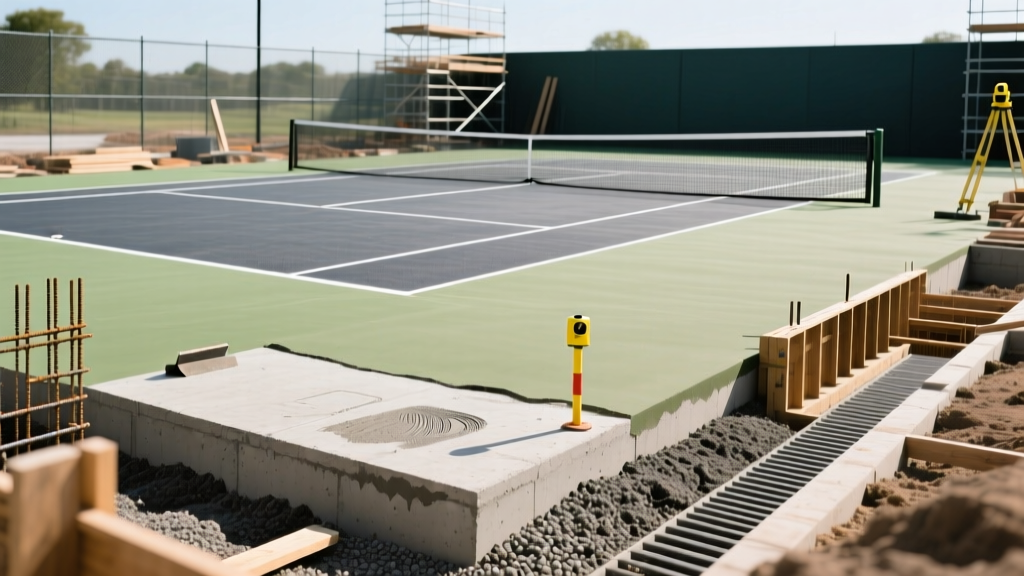
The True Footprint: Sizing and Site Preparation Realities
Before calculating material costs, you must define the physical footprint. The United States Tennis Association (USTA) mandates a tournament-standard playing area of 120 feet by 60 feet (7,200 square feet). While residential courts are sometimes squeezed into 108 by 54-foot dimensions to save money, this compromises the mandatory clear zones: 21 feet behind each baseline and 12 feet on each sideline. Shrinking these zones creates a hazardous, claustrophobic playing environment and drastically lowers property value appeal.
Critical Earthwork Variables
Gradient Requirement: A tennis court requires a precise 1% slope (1 inch of drop per 10 feet) in a single plane to prevent water pooling. Post-tensioned concrete can sometimes be engineered to 0.83%, but asphalt strictly requires 1%.
Tree Root Clearance: Maintain a minimum 20-foot clearance from any mature tree drip line. Root heaving will destroy an asphalt base within 3 to 5 years.
Cut and Fill Costs: If your lot has a natural slope exceeding 2%, expect to pay $15,000 to $35,000+ in earthmoving and retaining wall construction just to achieve a level pad.
Base Construction Matrix: Asphalt vs. Post-Tensioned Concrete
The structural base accounts for 40% to 50% of your total budget. Choosing the wrong base for your specific soil type is the most common and expensive failure mode in court construction.
| Feature | Asphalt Base | Post-Tensioned (PT) Concrete |
|---|---|---|
| 2026 Cost Range | $35,000 - $50,000 | $55,000 - $80,000 |
| Thickness & Specs | 4-6 inches over compacted aggregate | 5-inch slab, 270 ksi low-relaxation steel tendons |
| Soil Suitability | Stable, well-draining soils only | Expansive clays, reactive soils, high water tables |
| Primary Failure Mode | Thermal cracking, structural settling, birdbaths | Surface crazing if troweled improperly (rare) |
| Lifespan | 15 - 20 years | 40+ years |
Surface Systems: Acrylic, Cushioned, and Clay
Once the base is cured (asphalt requires 30-45 days to off-gas oils; concrete requires 28 days to cure), the playing surface is applied. Your choice here dictates ball speed, player joint impact, and ongoing maintenance.
1. Standard Acrylic (Plexipave / DecoTurf)
The industry standard for hard courts. This involves applying 5 to 8 layers of 100% acrylic resin mixed with specially graded silica sand. The sand particle size dictates the court speed (ITF Category 1 to 5).
Cost: $12,000 - $18,000.
Best For: Budget-conscious builders who want a durable, low-maintenance, tournament-style surface.
2. Cushioned Acrylic Systems
These systems (like Premier Court or Plexicushion) embed poured rubber granules or interlocking rubber mats beneath the acrylic color coats. This reduces shock to the knees and lower back, making it ideal for aging residential players or high-school facilities.
Cost: $22,000 - $32,000.
Best For: Luxury residential builds and commercial clubs prioritizing player comfort.
3. Har-Tru (American Red Clay Alternative)
True red clay is rare in the US; instead, Har-Tru (crushed metabasalt green stone) is the standard. It requires a specialized laser-graded stone dust base, hydro-stone watering systems, and daily brushing.
Cost: $65,000 - $90,000 (includes specialized base and irrigation).
Best For: Traditionalists willing to commit to 30 minutes of daily maintenance and annual resurfacing ($3,000+).
Hidden Budget Killers: Fencing, Lighting, and Perimeter
Novice budget planners often calculate the slab and surface costs, only to be blindsided by the perimeter infrastructure. Do not underestimate these line items.
- Commercial-Grade Fencing ($18,000 - $28,000): A standard court requires 10-foot high fencing. You must specify 9-gauge or 11-gauge galvanized chain link with a 2-inch mesh (standard 2.5-inch mesh allows tennis balls to wedge tightly, ruining the ball and frustrating players). Black or dark green vinyl coating reduces glare and blends with landscaping.
- LED Lighting Systems ($25,000 - $45,000): Modern recreational courts require 60 foot-candles of uniform illumination. A 4-pole or 6-pole LED system (from manufacturers like Musco or Qualite) with spill-light shields is mandatory to avoid blinding neighbors and violating local dark-sky ordinances. Trenching and running 480V or 240V dedicated electrical lines adds significant labor costs.
- Windbreaks and Nets ($1,500 - $3,500): High-density polyethylene (HDPE) windbreaks reduce wind interference by up to 70% and provide privacy. They must be tied with breakaway zip-ties so they tear away in hurricane-force winds rather than pulling down the fence posts.
2026 Master Budget Breakdown: The Complete Financial Picture
The following matrix provides a realistic 2026 cost estimation for a standard 120' x 60' residential tennis court on a moderately level lot with stable soil.
| Project Phase | Economy Build (Asphalt) | Premium Build (PT Concrete) |
|---|---|---|
| Site Prep & Earthwork | $12,000 | $15,000 |
| Base Construction | $40,000 | $65,000 |
| Surface System (Acrylic) | $14,000 | $24,000 (Cushioned) |
| Fencing (10ft, 9-gauge) | $18,000 | $22,000 |
| LED Lighting (4-pole) | $0 (Omitted) | $30,000 |
| Equipment & Accessories | $3,500 | $5,500 |
| TOTAL ESTIMATED COST | $87,500 | $161,500 |
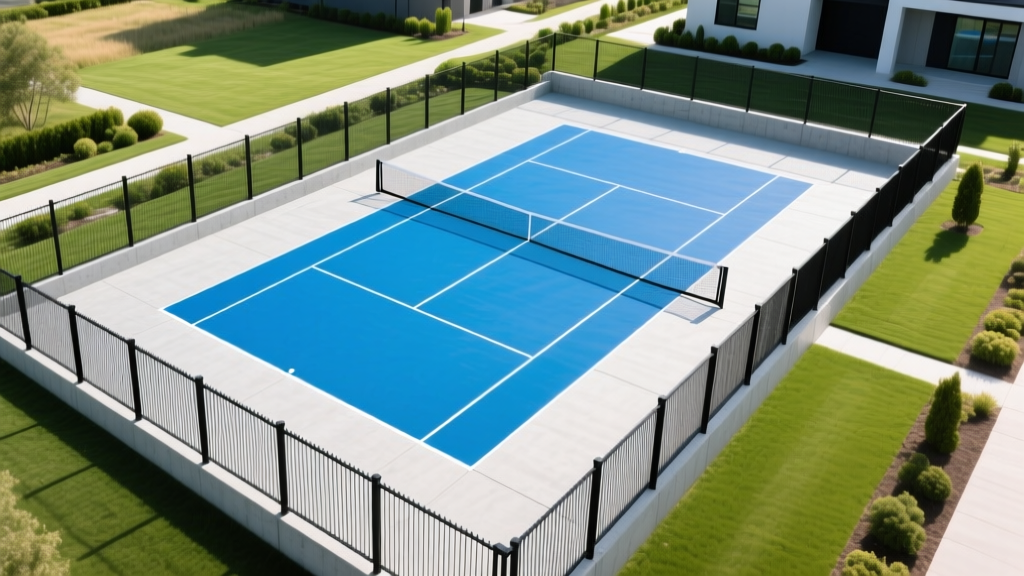
Lifecycle Maintenance and Long-Term ROI
A tennis court is a living structure that requires scheduled capital expenditures. Failing to budget for lifecycle maintenance will result in a degraded playing surface that costs twice as much to rehabilitate.
Year 1-3: Routine Upkeep
Cost: $500 - $1,000 annually.
Tasks include pressure washing, clearing debris from drainage swales, checking net post tension, and tightening fence hardware. For Har-Tru courts, this jumps to $3,000+ for daily dragging, watering, and annual top-dressing.
Year 5-7: Surface Re-coating
Cost: $6,000 - $10,000.
UV degradation and player foot traffic will wear down the acrylic color coats and sand texture. A professional resurfacing (2-3 new coats of color and line painting) is required to maintain proper ball bounce and ITF speed ratings.
Year 12-15: Base Rehabilitation (Asphalt Only)
Cost: $15,000 - $25,000.
Asphalt bases will inevitably develop structural cracks and birdbaths by year 12. This requires crack routing, hot-pour sealing, fiberglass membrane application, and acrylic patching before the surface can be re-coated. PT concrete courts bypass this phase entirely.
Final Budget Planning Directive
When securing contractor bids, ensure the proposal explicitly details the soil compaction testing (Proctor test) and the exact number of acrylic coats. Vague line items like 'install court surface' are a red flag for corner-cutting. Demand a specification sheet referencing ASBA guidelines, and allocate a 10% contingency fund specifically for unforeseen sub-grade soil stabilization.
Written by
Marcus ChenMarcus Chen is a licensed structural engineer (PE) and building materials analyst with over 12 years of experience across residential, commercial, and industrial construction. He holds a Master of Science in Civil Engineering from UC Berkeley and spent six years at Thornton Tomasetti before transitioning to independent consulting and technical writing. Marcus specializes in material selection for seismic-prone regions, concrete reinforcement strategies, and lifecycle cost analysis. His work has been cited by the American Concrete Institute (ACI) and the Structural Engineers Association of California (SEAOC). When he is not on a job site or at his desk, you will find him hiking the Sierra Nevada or restoring a 1920s craftsman bungalow in Oakland, CA.
More from Marcus Chen
View all
Construction Cost
How Much Did the Eiffel Tower Cost to Build?
How much did the Eiffel Tower cost to build in 1889? We adjust for inflation and compare its budget to modern skyscraper construction.
Aug 4, 2026

Fire Resistance
What Is a Fire Resistant Material? Testing & Certification Guide
Discover what is a fire resistant material through ASTM and UL testing. Learn how fire ratings, certifications, and assemblies work in construction.
Aug 4, 2026

Construction Cost
How Much Did the Burj Khalifa Cost to Build?
How much did the Burj Khalifa cost to build? We break down the $1.5B project and extract 5 money-saving strategies for your next build.
Jul 30, 2026