The True Cost to Build a House in the Bay Area in 2026
Discover the true cost to build a house in the Bay Area in 2026. Detailed breakdown of hard costs, soft costs, and regional pricing across all nine counties.
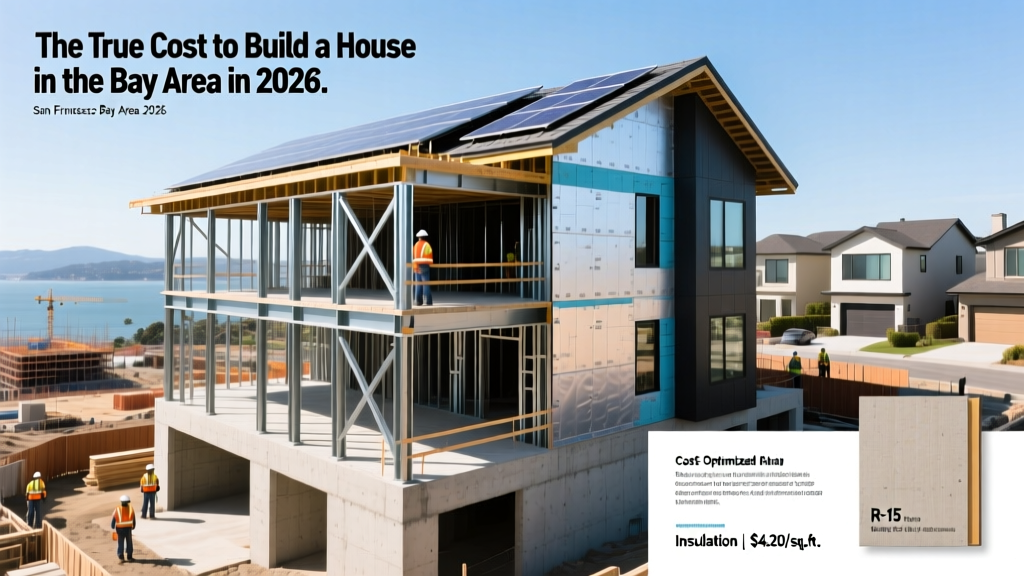
The Baseline: 2026 Bay Area Construction Costs Per Square Foot
Calculating the exact cost to build a house in the Bay Area requires moving beyond national averages. As of 2026, the national median for custom single-family construction hovers around $180 to $220 per square foot for hard costs. The San Francisco Bay Area, however, operates in an entirely different economic stratum. Driven by stringent seismic codes, aggressive union labor markets, complex topography, and some of the most restrictive zoning laws in the country, Bay Area builders face a unique cost matrix.
For a custom, architect-designed single-family home in 2026, expect baseline hard costs (materials and labor) to range from $450 to $850+ per square foot. When you factor in soft costs (architecture, engineering, permitting, and impact fees), the total all-in cost frequently lands between $650 and $1,200 per square foot. A 2,500-square-foot home will realistically require a total budget of $1.6 million to $3 million, excluding land acquisition.
Critical Distinction: Hard Costs vs. Soft Costs
Hard Costs (65-75% of budget): Physical construction. Lumber, concrete, roofing, HVAC, plumbing, electrical, and the hourly wages of the tradespeople installing them.
Soft Costs (25-35% of budget): Non-physical expenses. Architectural design (8-12%), structural and geotechnical engineering (3-5%), city planning and building permit fees, school and park impact fees, soil testing, and Title 24 energy compliance reporting.
Regional Variance Matrix: The 9 Bay Area Counties
The 'Bay Area' is not a monolith. Building in the flatlands of Solano County presents vastly different financial and logistical challenges than building on a steep, fire-prone ridge in Marin. Below is the 2026 regional breakdown for hard costs per square foot.
| County | Est. Hard Cost / Sq Ft | Primary Cost Drivers & Local Challenges |
|---|---|---|
| San Francisco | $750 - $1,100+ | Zero laydown space, mandatory prevailing wage on some projects, extreme parking logistics, deep foundation requirements. |
| San Mateo | $600 - $900 | Coastal commission overlays in western areas, high impact fees in Palo Alto/Menlo Park, strict tree preservation ordinances. |
| Santa Clara | $550 - $850 | Massive affordable housing impact fees (often exceeding $70k), high demand for tech-integrated smart home infrastructure. |
| Marin | $650 - $950 | Steep hillside grading, caisson foundations, WUI (Wildland-Urban Interface) fire zone material mandates, environmental reviews. |
| Alameda | $500 - $750 | Expansive clay soils in the East Bay hills requiring deepened grade beams, high seismic retrofitting standards. |
| Contra Costa | $450 - $700 | Varies wildly between flatland Orinda (expansive soils) and rural East County. Generally lower labor rates than the Peninsula. |
| Sonoma | $500 - $800 | Post-wildfire rebuilding codes mandate Class A roofing and ember-resistant vents. Well and seystem costs if off-municipal water. |
| Napa | $550 - $850 | Hillside ordinances, agricultural preserve restrictions, luxury finish expectations driving up interior hard costs. |
| Solano | $400 - $600 | Most affordable Bay Area county. Flatter terrain reduces site work costs, though Delta peat soils require specialized engineering. |
Phase-by-Phase Hard Cost Breakdown
To understand where your capital is actually going, we must deconstruct the build into its core phases. The following metrics assume a 2,500 sq. ft. custom build on a moderately sloped lot.
1. Site Work & Foundation ($45 - $95 per sq. ft.)
In the Bay Area, you are rarely building on a pristine, flat pad. Site preparation is a massive budget sink. If your lot is in the Berkeley Hills or Los Gatos mountains, expect to pay $40,000 to $80,000 just for grading, retaining walls, and erosion control. Foundations here are not simple slab-on-grade. Seismic requirements dictate heavily reinforced continuous footings. On expansive soils (common in Alameda and Contra Costa counties), structural engineers will specify deepened grade beams or drilled concrete caissons extending 15 to 30 feet into bedrock, adding $30,000+ to the foundation budget.
2. Framing & Exterior Envelope ($110 - $160 per sq. ft.)
Lumber prices have stabilized compared to the pandemic peaks, but Bay Area framing labor remains exceptionally expensive. Furthermore, the California Energy Commission’s Title 24 Building Energy Efficiency Standards mandate rigorous building envelope sealing. Builders are increasingly utilizing structural insulated panels (SIPs) or advanced 2x6 framing with continuous exterior rigid foam insulation (like ZIP System R-sheathing) to meet thermal bridging requirements. In Wildland-Urban Interface (WUI) zones, exterior cladding must be non-combustible, forcing a shift from wood siding to fiber cement (e.g., James Hardie) or stucco, which carries higher installation labor costs.
3. MEP Systems & Solar Mandates ($75 - $110 per sq. ft.)
Mechanical, Electrical, and Plumbing (MEP) costs have surged due to statewide electrification mandates. The California Department of Housing and Community Development (HCD) enforces strict heat-pump readiness and solar PV requirements for all new low-rise residential buildings. You are not just installing a standard HVAC system; you are installing high-SEER mini-split heat pumps or ducted heat pump systems, alongside heat pump water heaters (HPWHs). Furthermore, the mandatory solar array must be sized to offset 100% of the home's calculated electrical load, frequently requiring a $35,000 to $50,000 solar and battery storage (Tesla Powerwall or Enphase IQ) investment upfront.
The 'Hidden' Soft Costs That Derail Bay Area Budgets
First-time custom builders in the Bay Area are routinely blindsided by soft costs. According to data tracked by the U.S. Census Bureau Construction Reports, soft costs nationally average 15-20%. In the Bay Area, they routinely consume 30-35% of the total budget.
- Geotechnical Engineering: Before a single shovel hits the dirt, you need a soils report. In seismic zones, this costs $5,000 to $12,000 and dictates your entire foundation strategy.
- Impact Fees: Cities use impact fees to fund infrastructure. In San Jose, the combined affordable housing, park, and school impact fees for a new single-family home can easily exceed $80,000. In smaller towns like Atherton or Portola Valley, fees are lower, but the baseline home cost is exponentially higher.
- Permitting Expediters: Because local planning departments are notoriously understaffed, many Bay Area architects hire third-party permit expediters ($3,000 - $8,000) just to navigate the bureaucratic queue and prevent 6-month delays.
- Fire Marshal Reviews: In Sonoma, Napa, and Marin, separate fire marshal reviews for WUI compliance add $2,500 to $5,000 in consulting and revision fees.
“The biggest mistake out-of-area developers make when building in the Bay Area is underestimating the timeline and cost of the entitlement and permitting phase. A $5 million build can easily bleed $150,000 in holding costs and architectural revision fees if the initial submittal is rejected by the local design review board.”
— Senior Project Manager, Peninsula Custom Builders
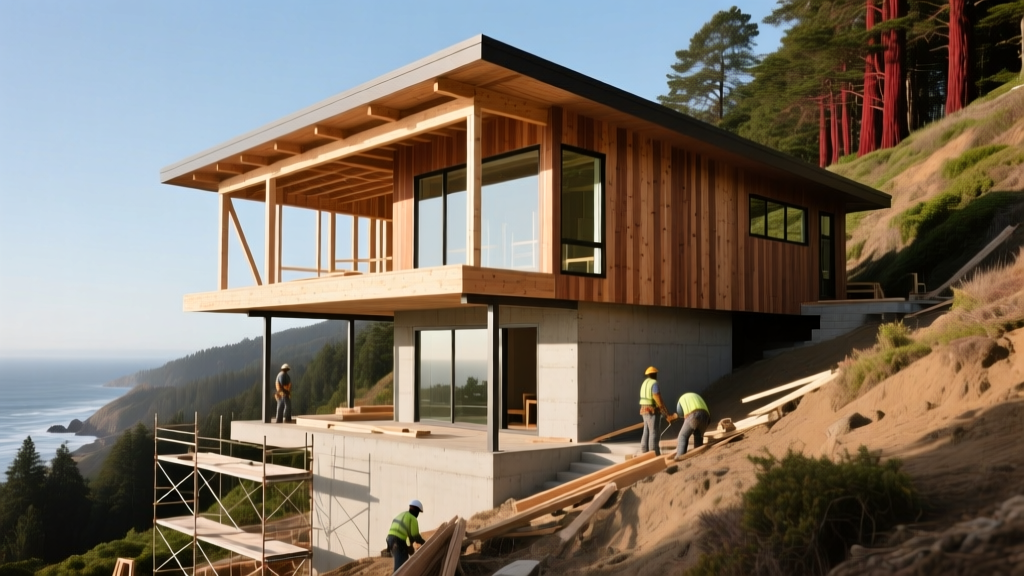
Actionable Framework: How to Value-Engineer Your Build
Value engineering is not about buying cheap materials; it is about optimizing the cost-to-value ratio of every design decision. If your bids are coming in 20% over budget, implement these specific swaps:
1. Optimize the Roofline and Footprint
Every jog, valley, and dormer in a roofline adds exponential labor and material waste. A complex Spanish-style clay tile roof with multiple valleys will cost $45+ per square foot. Simplifying to a modern shed roof or a clean gable with standing-seam metal roofing (like Petersen PAC-150) drops the cost to $22-$28 per square foot while simultaneously improving solar panel integration and fire resistance.
2. Strategic Glazing Ratios
Floor-to-ceiling custom aluminum-clad wood windows (e.g., Marvin Ultimate or Andersen E-Series) cost $1,200 to $2,500+ per unit installed. To maintain the aesthetic without the penalty, use high-performance vinyl or fiberglass frames (like Marvin Essential) for secondary bedrooms and bathrooms, reserving the premium architectural aluminum systems (like Fleetwood or Western Window Systems) strictly for the primary living spaces and view corridors.
3. Rethink the Interior Finishes
Instead of paying $18-$25 per square foot for site-finished white oak hardwood, consider large-format porcelain tile that mimics wood, or a polished concrete slab on grade (which costs $6-$10 per square foot and provides excellent thermal mass for passive heating). For cabinetry, switch from fully custom millwork ($800+ per linear foot) to semi-custom European frameless lines (like IKEA Sektion wrapped in custom local veneer panels), which can cut millwork costs by 50% while maintaining a high-end architectural look.
Building in the Bay Area is an exercise in financial endurance and logistical precision. By understanding the granular breakdown of hard and soft costs, respecting the local micro-climates and municipal codes, and aggressively value-engineering the design phase, you can deliver a resilient, code-compliant custom home without exhausting your contingency reserves.
Written by
Sarah WhitfieldSarah Whitfield is a chartered quantity surveyor (MRICS) and construction cost analyst with 15 years of experience in material pricing, procurement strategy, and project budgeting. She earned her degree in Construction Management from the University of Reading (UK) and has worked on projects ranging from $2M custom homes to $180M mixed-use developments across North America and Europe. Sarah currently leads cost estimating for BuildMat Insight, maintaining a proprietary database of 4,000+ material price points updated quarterly. She is a frequent contributor to RSMeans cost data panels and has presented at the International Cost Engineering Council (ICEC) congress. Based in Denver, CO, Sarah is an avid trail runner and volunteer mentor for Women in Construction.
More from Sarah Whitfield
View all
Wood & Lumber
What Are the Different Types of Wood? A Builder's Guide
Compare structural softwoods, finish hardwoods, and engineered lumber. Analyze Janka ratings, MOE values, and 2026 pricing for construction.
Aug 4, 2026

Walls & Panels
Steel Framing vs Wood Framing: Corrosion and Moisture Defense
Compare steel framing vs wood framing for moisture resistance. Learn about galvanized coatings, condensation risks, and corrosion protection strategies.
Jul 21, 2026

Stone & Masonry
How to Cut Stone Veneer: Wet Saw vs Grinder Comparison
Compare the best tools for cutting stone veneer. We review wet saws, angle grinders, and chop saws to help you achieve clean, chip-free cuts.
Jul 21, 2026