How Much Does a Waymo Cost to Build? AV Hardware & Depot Savings
Discover how much a Waymo costs to build. We break down 6th-gen AV sensor hardware BOM, depot construction costs, and money-saving fleet strategies.
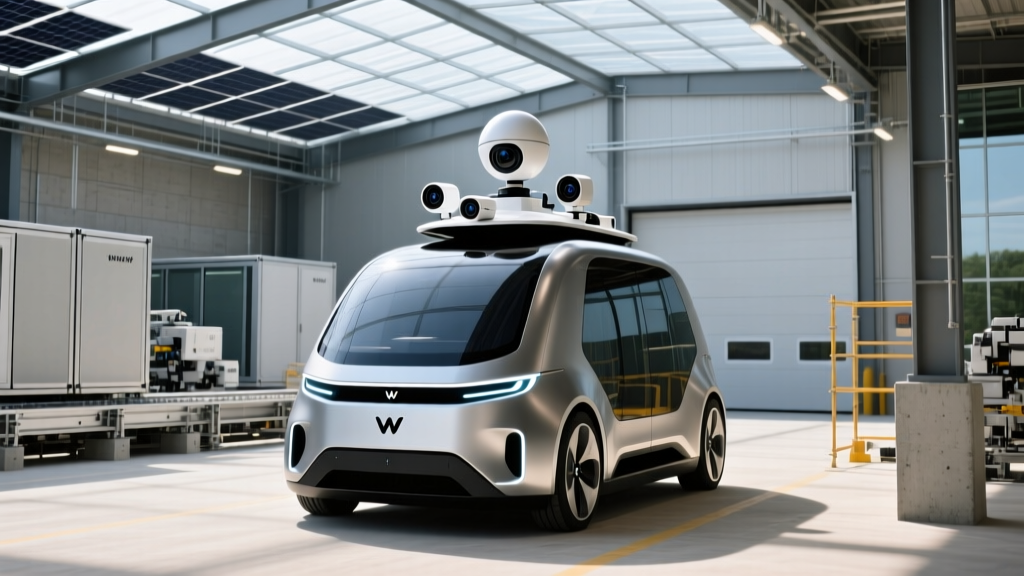
The True Bill of Materials: How Much Does a Waymo Cost to Build?
When fleet operators, municipalities, and logistics companies ask, "how much does a waymo cost to build," the answer extends far beyond the sticker price of the base electric vehicle. Building a fully operational Level 4 autonomous robotaxi requires integrating a highly complex 6th-generation sensor suite, custom edge-computing hardware, and specialized depot infrastructure. While early autonomous prototypes carried hardware price tags exceeding $200,000, modern manufacturing and solid-state advancements have drastically compressed these costs.
To accurately estimate the build cost, we must divide the project into two distinct construction phases: the vehicle hardware integration (the sensor and compute Bill of Materials) and the physical depot infrastructure required to house, charge, and calibrate the fleet. Below is a comprehensive cost breakdown and a strategic framework for minimizing capital expenditure without compromising safety redundancies.
Executive Cost Summary
- Base EV Glider (e.g., Zeekr M-Vision or Jaguar I-PACE): $40,000 – $55,000
- 6th-Gen Autonomous Hardware Kit: $45,000 – $62,000
- Depot Charging & Server Infrastructure (Per Vehicle): $18,000 – $35,000
- Total Estimated Build Cost Per Unit: $103,000 – $152,000
6th-Generation Sensor Suite and Compute Pricing
The physical "build" of the vehicle centers on the autonomous kit. According to Waymo's official 6th-generation hardware specifications, the latest iteration is designed for mass production, modularity, and harsh weather resilience. The cost reductions are primarily driven by transitioning from bulky, multi-part mechanical LiDARs to streamlined, custom-built hybrid solid-state units, alongside the integration of machine-learning-optimized silicon.
| Component Category | Specifications | Estimated Unit Cost |
|---|---|---|
| Custom LiDAR Array | Roof-mounted hybrid solid-state, 360-degree FoV, 500m range | $18,000 - $24,000 |
| Vision System | 29 high-resolution (8MP) cameras with integrated heaters/wipers | $6,500 - $8,500 |
| 4D Imaging Radar | 6x perimeter radars for low-visibility and velocity tracking | $2,800 - $3,600 |
| Edge Compute & TPU | Custom ASIC/TPU trunk-mounted server with liquid cooling | $14,000 - $18,000 |
| Wiring & Integration | Automotive-grade shielded harnesses, EMI shielding, mounts | $3,700 - $7,900 |
The Hidden Construction Cost: AV Depot and Charging Infrastructure
A common estimating error is calculating the vehicle build cost in a vacuum. A Level 4 autonomous fleet requires a specialized physical depot. You cannot simply plug a robotaxi into a standard commercial parking lot. The infrastructure construction required to support the high-density electrical loads of EV charging and edge-data processing represents a massive upfront capital expenditure.
Electrical Trenching and Transformer Upgrades
A standard 50-vehicle depot utilizing 150kW to 350kW DC Fast Chargers (DCFC) requires a massive utility upgrade. Most commercial properties operate on a 480V 3-phase, 400A service. A 50-vehicle DCFC depot will pull upwards of 4 Megawatts of peak power. Constructing the necessary electrical infrastructure involves:
- Utility Transformer Installation: Upgrading to a 5 MVA pad-mounted transformer costs between $120,000 and $250,000, heavily dependent on local utility fees and distance to the main distribution line.
- Concrete Trenching and Conduit: Running heavy-gauge copper wiring to individual charging pedestals requires saw-cutting, trenching, and pouring new concrete. At an average commercial rate of $150 to $220 per linear foot, a large depot can easily incur $80,000+ in hardscape restoration.
- Switchgear and Panelboards: Custom electrical switchgear to manage load-balancing and prevent grid brownouts adds $45,000 to $90,000 to the construction budget.
Money-Saving Strategies for AV Fleet Construction
To optimize the build cost of an autonomous fleet, project managers and facility engineers must implement strategic value-engineering during both the hardware integration and depot construction phases.
The custom TPU compute units generate immense thermal loads. Attempting to save money by substituting liquid-cooling loops with high-CFM forced-air cooling will result in thermal throttling during summer months, leading to compute latency and potential safety disengagements. Always spec closed-loop liquid cooling for the trunk-mounted compute racks.
1. Implement Automated Load Management (ALM) Software
Instead of paying for a massive 5 MVA utility upgrade to charge 50 vehicles simultaneously at 350kW, construct the depot with ALM software integrated into the switchgear. ALM dynamically distributes available power based on the fleet's dispatch schedule. If vehicles are returning at 2:00 AM and do not need to deploy until 6:00 AM, the system trickle-charges them at 40kW. This strategy can reduce your required transformer size by 60%, saving upwards of $100,000 in utility construction fees.
2. Standardize Modular Sensor Pods
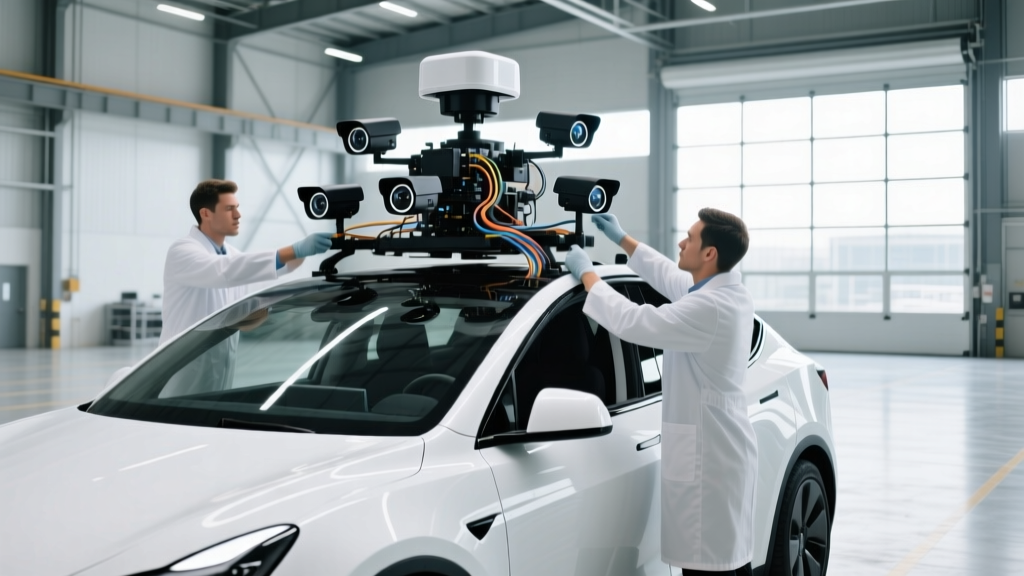
Rather than hardwiring the LiDAR and camera arrays directly into the vehicle's primary chassis harness, build the sensor suite as a removable, pre-calibrated "roof pod." While the initial pod housing costs roughly $1,200 more in molded polymers, it reduces vehicle integration labor time by 40%. More importantly, if a sensor fails or requires an upgrade, technicians can swap the pod in 15 minutes rather than spending 8 hours stripping the vehicle's headliner and interior trim to access wiring faults.
3. Utilize Off-Peak Utility Tariffs for Depot Construction
When negotiating with the local municipality and utility provider for depot construction permits, apply for specialized EV fleet off-peak tariffs. By agreeing to restrict high-speed charging to the hours of 11:00 PM and 5:00 AM, many utilities will subsidize the cost of the trenching and switchgear installation, treating it as a grid-stabilization asset.
Calibration Bay Construction: A Non-Negotiable Expense
According to NHTSA automated vehicle safety guidelines, sensor alignment is critical for safe operation. You cannot calibrate a 6th-generation LiDAR and 8-megapixel camera array in a standard garage. Building a dedicated calibration bay requires stringent construction tolerances that drive up facility costs.
- Sub-Floor Leveling: The calibration bay floor must be poured with self-leveling epoxy to a tolerance of 1/8th of an inch over a 10-foot radius. Standard concrete sloping for drainage will completely invalidate the LiDAR's pitch and roll baseline. Expect to pay $14 to $18 per square foot for precision grinding and epoxy application.
- Lighting Rigs: Camera calibration requires specific lux levels (typically >500 lux) with zero flicker and a Color Rendering Index (CRI) above 90 to ensure the vision system accurately interprets traffic light states and pedestrian clothing. Standard warehouse LED high-bays will cause rolling shutter artifacts in the cameras. You must install specialized, high-frequency, diffused lighting grids.
- Target Alignment Frames: CNC-machined aluminum target frames must be bolted directly into the concrete foundation using surveyor-grade laser alignment to ensure they are perfectly plumb and square to the vehicle's centerline axis.
A single, fully compliant calibration bay costs between $110,000 and $145,000 to construct. For a fleet of 50 vehicles, one bay is sufficient, but it must be factored into the initial facility construction budget.
Final Cost Synthesis and ROI Timeline
Answering the question of how much a Waymo costs to build requires looking at the entire ecosystem. The physical vehicle—combining a $45,000 EV glider with a $55,000 6th-generation sensor and compute kit—lands at approximately $100,000 per unit. However, the amortized cost of the depot construction, electrical trenching, and precision calibration bays adds an estimated $25,000 per vehicle to the initial capital outlay.
By leveraging Automated Load Management to shrink electrical infrastructure requirements and utilizing modular sensor pods to slash maintenance labor, fleet operators can reduce the total build and deployment cost by 18% to 22%. In the high-stakes economics of autonomous logistics and robotaxi operations, these construction and integration savings are the primary drivers of achieving profitability before the 36-month mark.
Written by
Marcus ChenMarcus Chen is a licensed structural engineer (PE) and building materials analyst with over 12 years of experience across residential, commercial, and industrial construction. He holds a Master of Science in Civil Engineering from UC Berkeley and spent six years at Thornton Tomasetti before transitioning to independent consulting and technical writing. Marcus specializes in material selection for seismic-prone regions, concrete reinforcement strategies, and lifecycle cost analysis. His work has been cited by the American Concrete Institute (ACI) and the Structural Engineers Association of California (SEAOC). When he is not on a job site or at his desk, you will find him hiking the Sierra Nevada or restoring a 1920s craftsman bungalow in Oakland, CA.
More from Marcus Chen
View all
Construction Cost
How Much Did the Eiffel Tower Cost to Build?
How much did the Eiffel Tower cost to build in 1889? We adjust for inflation and compare its budget to modern skyscraper construction.
Aug 4, 2026

Fire Resistance
What Is a Fire Resistant Material? Testing & Certification Guide
Discover what is a fire resistant material through ASTM and UL testing. Learn how fire ratings, certifications, and assemblies work in construction.
Aug 4, 2026

Construction Cost
How Much Did the Burj Khalifa Cost to Build?
How much did the Burj Khalifa cost to build? We break down the $1.5B project and extract 5 money-saving strategies for your next build.
Jul 30, 2026