Wind Energy Cost to Build in 2026: Detailed Breakdown
Comprehensive 2026 breakdown of wind energy cost to build, covering utility-scale civil works, heavy rigging, and residential turbine installation pricing.
Deconstructing the Wind Energy Cost to Build
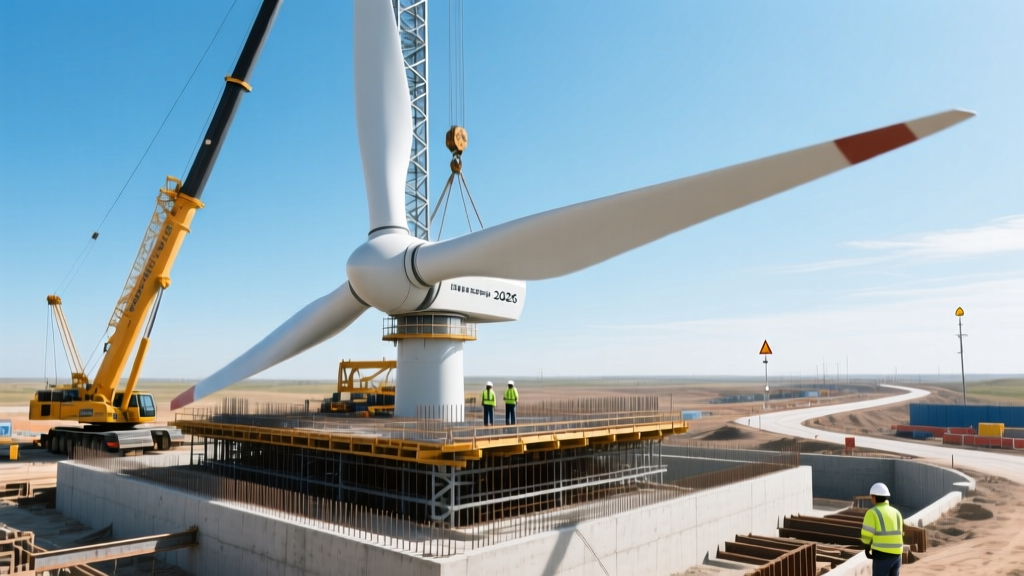
Estimating the wind energy cost to build requires separating the turbine procurement (OEM supply) from the balance-of-plant (BOP) construction and civil engineering. While the nacelle, blades, and tower sections represent the most visible capital expenditure, the site preparation, heavy lift logistics, and electrical interconnection dictate the actual feasibility of the project. In 2026, utility-scale onshore wind projects average between $1,450 and $1,850 per kilowatt (kW) of installed capacity, according to data tracked by the U.S. Department of Energy's Wind Technologies Market Report. For a standard 5 MW turbine, this translates to a total project cost of $7.25 million to $9.25 million. However, this aggregate number obscures the granular construction realities that estimators and project managers must navigate.
Utility-Scale Balance of Plant (BOP) Cost Matrix
The following matrix breaks down the capital expenditure for a typical 100 MW onshore wind farm utilizing modern 5 MW to 7 MW class turbines (e.g., Vestas V162 or GE Vernova Sierra). Costs are represented per megawatt (MW) of installed capacity.
| Construction Phase | Cost Range (per MW) | Percentage of Total BOP | Primary Cost Drivers |
|---|---|---|---|
| Turbine Procurement & Freight | $850,000 - $1,100,000 | 60% - 65% | OEM pricing, specialized blade transport, oversize load permits |
| Civil Works & Foundations | $180,000 - $240,000 | 12% - 15% | Mass concrete, rebar, geotechnical remediation, access roads |
| Electrical & Interconnection | $150,000 - $220,000 | 10% - 14% | 35kV collector systems, step-up transformers, SCADA, substation |
| Heavy Rigging & Erection | $90,000 - $130,000 | 6% - 8% | Main crawler crane mobilization, ground bearing pressure matting |
| Development & Soft Costs | $60,000 - $90,000 | 4% - 6% | Permitting, environmental studies, grid impact studies |
Civil Works: Foundation Engineering and Mass Concrete
The foundation of a utility-scale wind turbine must withstand immense overturning moments. For a 160-meter rotor diameter turbine, the standard design is a reinforced concrete gravity spread footing. A single foundation typically requires 400 to 600 cubic yards of 4,000 PSI concrete and 40 to 60 tons of epoxy-coated Grade 75 rebar.
To mitigate the heat of hydration generated by such a massive continuous pour, engineers specify a mix design utilizing 30% to 40% fly ash or slag cement replacement. This not only reduces thermal cracking but also lowers the carbon footprint of the civil works. The anchor bolt cage, usually comprising 100 to 150 high-strength threaded studs (Grade 8 or 10.9), must be laser-aligned to within 2 millimeters of plumb before the pour begins.
Standard spread footings assume competent soil bearing capacities of at least 3,000 to 4,000 psf. If geotechnical borings reveal karst topography (limestone caves or voids), the foundation design must pivot to a rock-anchored pedestal. This involves drilling 60-foot deep micropiles and post-tensioning them into the bedrock, which can increase the per-turbine civil cost by $85,000 to $120,000 and add three weeks to the critical path.
Access Road Specifications
Transporting 80-meter turbine blades requires highly engineered access roads. Standard specifications mandate a 20-foot wide compacted aggregate surface with a turning radius exceeding 150 feet at all switchbacks. Culverts must be rated for H-20 highway loading to support the 200,000-pound gross vehicle weight of the blade transport trailers. Road construction costs average $120 to $180 per linear foot, heavily dependent on local aggregate sourcing and cut-and-fill earthwork volumes.
Heavy Lift Rigging and Ground Bearing Pressure
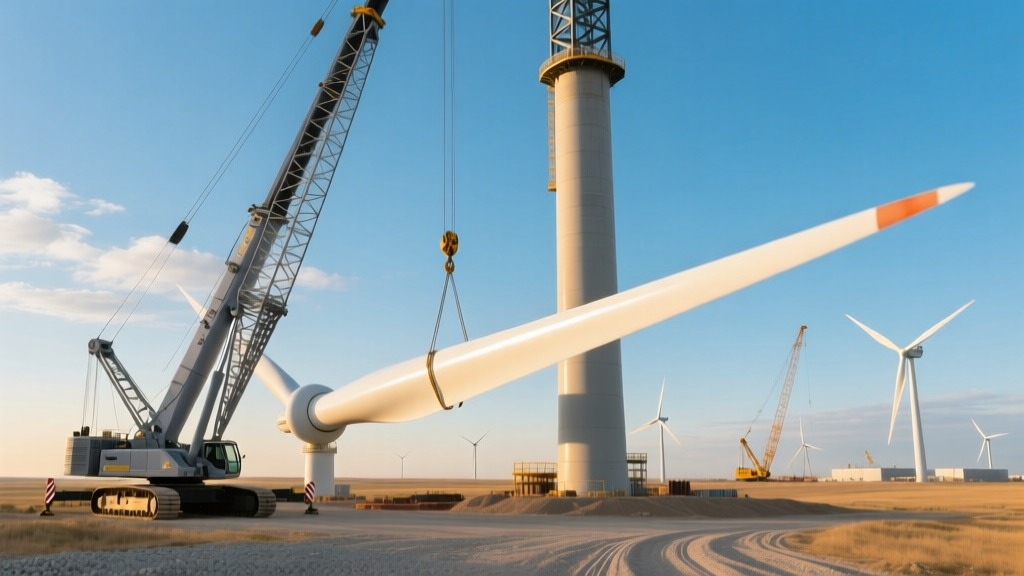
Erecting a 5 MW turbine requires a main crawler crane with a lifting capacity of 1,000 to 1,500 tons, such as the Liebherr LR 11350 or Manitowoc MLC300. The nacelle alone can weigh upwards of 250 metric tons and must be hoisted to a hub height of 110 meters or more.
The primary construction bottleneck is Ground Bearing Pressure (GBP). A fully rigged 1,350-ton crane exerts a GBP of 4,500 to 6,000 psf during the lift. Most native soils cannot support this without catastrophic shear failure. Estimators must account for engineered crane pads consisting of 3 feet of compacted crushed rock, topped with heavy timber crane mats or composite laminate mats. Mobilizing, assembling, and demobilizing a main crawler crane costs between $250,000 and $400,000 per project, making it highly cost-prohibitive for projects with fewer than 10 turbines.
Electrical Infrastructure and Grid Interconnection
The internal collector system aggregates the power generated by individual turbines and routes it to a central substation. Modern wind farms utilize a 34.5 kV underground aluminum conductor system. Aluminum is now universally preferred over copper for direct-buried medium-voltage cables due to a 40% cost reduction and a near-zero theft rate on remote job sites.
Trenching for the collector system costs $25 to $45 per linear foot. However, the most significant electrical bottleneck in 2026 is the procurement of the main step-up transformer (e.g., 120 MVA, 34.5kV to 230kV). Lead times for high-voltage transformers frequently exceed 80 to 110 weeks. Estimators must factor in early procurement strategies and secure storage, as delaying the transformer delivery will idle the entire interconnection crew.
Residential and Agricultural Turbine Cost Breakdown
For off-grid homes, agricultural operations, and small commercial facilities, the wind energy cost to build shifts from megawatt-scale civil engineering to localized tower erection and inverter integration. The U.S. Energy Information Administration notes that distributed generation carries a higher per-watt premium due to the lack of economies of scale.
System Sizing and Tower Selection
A standard residential or farm-scale turbine ranges from 5 kW to 20 kW. The Bergey Excel 10 (10 kW) and Jacobs 20 kW are industry benchmarks. Installed costs for small wind systems range from $4.50 to $8.00 per watt, meaning a 10 kW system will cost between $45,000 and $80,000 fully commissioned.
- Turbine and Inverter Package: $20,000 - $35,000
- Monopole Tower (80ft - 120ft): $12,000 - $22,000 (includes engineered base and guy wires if applicable)
- Electrical Trenching & Panel Upgrades: $5,000 - $12,000
- Heavy Equipment (Mobile Crane for Tower Tilt-Up): $3,000 - $6,000
- Permitting and Interconnection Fees: $2,000 - $5,000
Wind power density increases with the cube of wind speed. Upgrading from an 80-foot tower to a 120-foot tower typically increases material and crane costs by 25%, but it can increase annual energy production (AEP) by 35% to 50% by escaping the turbulent ground-level boundary layer. Always estimate the cost-to-build against the Levelized Cost of Energy (LCOE) rather than just the upfront capital expenditure.
Hidden Cost Drivers and Supply Chain Realities
Accurate construction estimating requires anticipating variables that do not appear on standard architectural drawings. When modeling the wind energy cost to build, incorporate contingency line items for the following:
- Aviation Lighting and FAA Compliance: Turbines exceeding 200 feet above ground level (AGL) require FAA L-864 synchronized red flashing lights. Wiring these through the nacelle and down the tower adds $15,000 per unit.
- Shadow Flicker Mitigation: If residential structures are within 1,500 feet of the turbine array, automated curtailment sensors must be installed on the nacelle to shut down the rotor during specific solar angles, requiring specialized SCADA programming.
- Blade De-icing Systems: For projects in northern latitudes, passive hydrophobic coatings are insufficient. Active electro-thermal blade de-icing systems add $40,000 to $60,000 per turbine but prevent catastrophic ice-throw liability and winter generation losses.
- End-of-Life Decommissioning Bonds: Local municipalities increasingly require surety bonds or escrow accounts to guarantee the removal of the mass concrete foundation and steel tower after 25 years. Estimators must calculate the present value of this bond, typically $50,000 to $80,000 per turbine, into the initial project financing model.
By isolating these granular construction phases—from the chemical composition of the foundation pour to the heavy-lift ground bearing requirements—estimators can produce highly accurate, defensible budgets that withstand the rigorous scrutiny of project financiers and EPC contractors.
Written by
David NakamuraDavid Nakamura is a licensed architect (AIA) and construction technology writer focused on sustainable building methods, mass timber engineering, and high-performance building envelopes. He holds a Master of Architecture from the University of Washington and is a certified Passive House Consultant (CPHC). David spent eight years at the Seattle firm Mithun, where he led the design of three LEED Platinum projects, before founding his own practice specializing in net-zero residential design. He serves on the editorial advisory board of GreenBuilder Magazine and has authored peer-reviewed papers on cross-laminated timber (CLT) connections for the Journal of Structural Engineering. In his spare time, David teaches woodworking at Pratt Fine Arts Center and kayaks the Puget Sound.
More from David Nakamura
View all
Construction Cost
Labor Cost to Build a Deck Per Sq Ft: 2026 Installation Guide
Discover the exact labor cost to build a deck per sq ft in 2026. This installation guide breaks down contractor rates, complexity factors, and hidden fees.
Aug 4, 2026

Construction Cost
How Much Does It Cost to Build a 3 Bedroom House? Financing Guide
Learn exactly how much it costs to build a 3 bedroom house and explore 2026 financing options, construction loan types, and budget frameworks for your build.
Aug 4, 2026

Construction Cost
Cost to Build a Tennis Court: 2026 Guide
How much does it cost to build a tennis court in 2026? Breakdowns for asphalt, concrete, and synthetic surfaces plus fencing and lighting.
Jul 30, 2026