Labor Cost to Build a Deck in 2026: The Complete Pricing Guide
Discover the average labor cost to build a deck in 2026. Break down contractor rates, per-square-foot pricing, and hidden fees for your outdoor project.
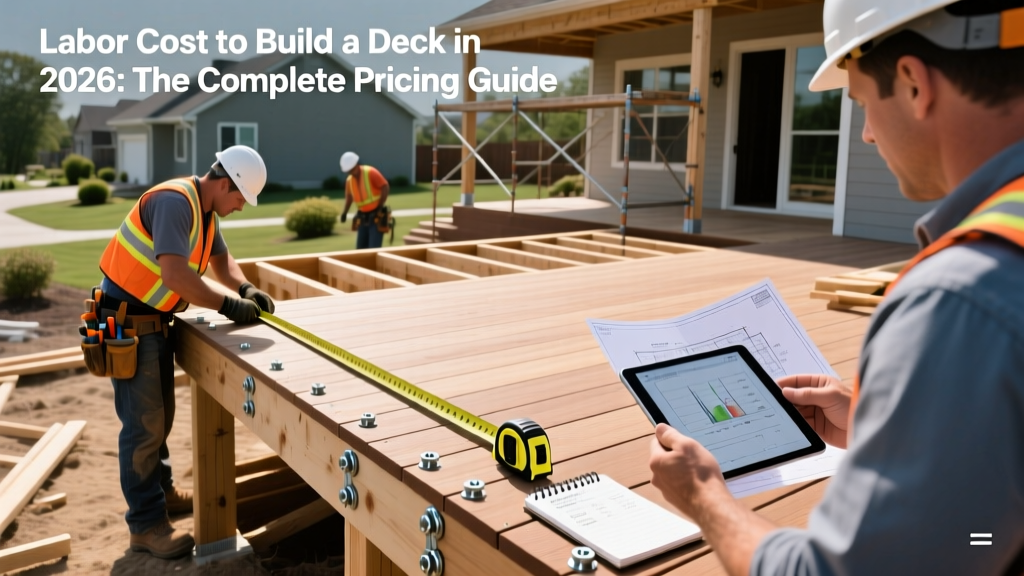
The Baseline: Average Labor Cost to Build a Deck in 2026
When budgeting for an outdoor living space, materials often dominate the conversation, but the labor cost to build a deck typically accounts for 40% to 60% of your total project expenditure. In 2026, the national average for professional deck installation labor ranges from $18 to $35 per square foot. For a standard 200-square-foot attached deck, you can expect to pay between $3,600 and $7,000 strictly for the physical construction, excluding materials, permits, and site preparation.
Labor rates have stabilized following the post-pandemic construction boom, but a severe shortage of skilled carpenters specializing in composite and aluminum decking keeps premium installation rates high. According to industry data tracked by the National Association of Home Builders (NAHB), specialized exterior carpentry commands a 15% to 22% premium over general framing labor due to the precision required for weatherproofing and hidden fastener systems.
- National Average (All Materials): $24 per sq. ft.
- Low-End (Basic Wood, Ground-Level): $14 - $18 per sq. ft.
- High-End (Composite/PVC, Elevated): $30 - $45 per sq. ft.
- Typical Hourly Rate: $75 - $135 per hour, per carpenter
Labor Breakdown by Decking Material
The material you choose dictates the complexity of the build. Contractors price labor based on the time required for cutting, fastening, and finishing. Composite and PVC materials require specialized carbide-tipped blades, specific hidden fastener systems, and "picture framing" techniques to hide end grains, which significantly increases labor time compared to traditional face-screwed wood.
| Decking Material | Labor Cost per Sq. Ft. | Labor Hours (200 sq. ft.) | Key Labor Drivers |
|---|---|---|---|
| Pressure-Treated Pine | $14 - $20 | 40 - 55 hours | Standard joist spacing, face-screwing, minimal cutting complexity. |
| Composite (e.g., Trex, Deckorators) | $22 - $32 | 60 - 80 hours | Hidden fastener installation, picture framing perimeter, heat-bending for curves. |
| Capped PVC (e.g., AZEK) | $26 - $36 | 65 - 85 hours | Tighter expansion/contraction tolerances, specialized edge-trim routing. |
| Aluminum (e.g., Wahoo Decks) | $35 - $50 | 70 - 95 hours | Proprietary interlocking systems, metal-cutting requirements, rare installer skill set. |
For composite installations, adhering to manufacturer specifications is non-negotiable. The Trex Installation Guide explicitly requires specific gapping and joist spacing (often 12 inches on center for diagonal patterns versus 16 inches for straight). Failing to account for the extra labor required to double the joist framing for diagonal composite layouts is a common budgeting error.
Hourly vs. Per-Square-Foot: How Contractors Quote
Understanding how your contractor structures their bid is critical for avoiding scope creep. Most reputable deck builders will offer a fixed bid based on square footage, but hourly billing still exists in specific scenarios.
When Per-Square-Foot Pricing is Standard
For new construction, complete tear-downs, and standard rectangular builds, contractors use per-square-foot metrics. This transfers the risk of weather delays and minor material defects to the contractor. A fixed bid of $28/sq. ft. means you pay $5,600 for labor regardless of whether it takes the crew three days or five days to complete the decking and railing.
When Hourly Rates Apply (Time & Materials)
Hourly rates ($75–$135/hr) are typically reserved for:
- Deck Repairs & Rot Remediation: Replacing specific joists or sistering damaged framing members where the full extent of the rot is hidden until the deck boards are removed.
- Custom Integration: Building custom planter boxes, integrating low-voltage lighting into composite stair risers, or modifying existing structures to accommodate new hot tubs.
- Unforeseen Site Conditions: Hitting bedrock while digging footings or discovering extensive root systems that require manual excavation.
Hidden Labor Costs That Destroy Budgets
The base labor rate rarely includes the ancillary work required to make a deck legal and structurally sound. When reviewing bids, ensure these specific labor line items are explicitly addressed.
⚠️ Demolition and Haul-Away
Tearing down an existing 200-square-foot deck and disposing of the debris adds $600 to $1,200 in labor and dump fees. If the old deck contains pressure-treated wood manufactured before 2004, it may contain CCA (chromated copper arsenate), requiring specialized disposal protocols that increase labor costs by up to 30%.
⚠️ Stair Construction
Stairs are the most labor-intensive component of any deck. Contractors do not price stairs by the square foot. Expect to pay $250 to $600 per tread in labor alone. A standard 4-tread staircase will add $1,000 to $2,400 to your labor bill. Custom curved stairs or floating concrete-integrated stairs will push this figure well past $3,500.
Structural Framing and Code Compliance Labor
The deck boards are just the aesthetic surface; the structural framing is where the true craftsmanship and liability lie. Modern building codes (based on the IRC and guidelines from the American Wood Council) have drastically increased the labor required to build a code-compliant deck.
Lateral Load Connectors: Simply toe-nailing a deck ledger board to the house rim joist is no longer code-compliant in most jurisdictions. Contractors must now install specialized lateral load connectors (such as the Simpson Strong-Tie DTC2). Installing these requires drilling through the interior drywall and floor joists of your home to secure the tension bolts. Budget an extra $85 to $150 per connection point (typically 4 to 6 are required) for this interior/exterior labor.
Footings and Helical Piles: Digging 36-inch deep holes for Sonotubes in rocky or clay-heavy soil is backbreaking, time-consuming labor. Many 2026 contractors are shifting to helical piles (e.g., Diamond Pier). While the material cost per pier is higher, a helical pile can be driven into the ground with a rotary hammer in 20 minutes, saving days of manual digging and concrete curing time. If your contractor suggests helical piles, expect the footing labor to drop by 40%, offsetting the material premium.
Regional Labor Rate Variations
Geography heavily influences the labor cost to build a deck. Union density, local permit complexity, and the cost of living create distinct pricing tiers across the country.
- Tier 1: High-Cost (Northeast, Bay Area, Seattle): $30 - $45+ per sq. ft. Strict municipal inspections, prevailing wage requirements, and high insurance minimums drive costs up.
- Tier 2: Moderate-Cost (Midwest, Texas, Southeast): $18 - $28 per sq. ft. Favorable soil conditions, lower insurance burdens, and high competition among independent carpenters keep rates competitive.
- Tier 3: Specialized Markets (Mountain West, Coastal Florida): $25 - $35 per sq. ft. Requires specialized engineering for heavy snow loads (mountain) or hurricane-rated uplift connectors and stainless steel hardware (coastal).
Frequently Asked Questions: Deck Labor Economics
Does the labor cost to build a deck include the railing installation?
In most comprehensive bids, yes. However, railing labor is highly dependent on the material. Installing standard 4x4 wood posts with aluminum balusters takes roughly 1.5 hours per 8-foot section. Installing glass panel railings or heavy composite post sleeves with embedded LED lighting can double the labor time per linear foot. Always verify if "decking only" or "complete turnkey" is specified in the labor scope.
How much extra labor does a second-story or elevated deck require?
Elevated decks (over 8 feet high) require scaffolding, specialized bracing during construction, and often a structural engineer's stamp. Expect labor costs to increase by 25% to 40% compared to a ground-level build. The time required to safely hoist materials, plumb the support posts, and install diagonal bracing or structural shear panels adds significant man-hours.
Should I pay a deposit upfront for deck labor?
Standard industry practice dictates a deposit of 10% to 30% of the total contract price (materials + labor) to secure your spot on the contractor's schedule and cover initial permit fees. Never pay more than 50% upfront. Subsequent labor payments should be tied to verifiable milestones: completion of footings, completion of framing (pre-inspection), and final completion of decking and railings.
Finalizing Your Contractor Bid
To accurately assess the labor cost to build a deck, solicit at least three itemized bids. An itemized bid separates site prep, demolition, framing labor, decking installation, and railing installation. This transparency allows you to identify if a contractor is padding the framing labor to compensate for underbidding the finish work. Ensure the contract explicitly states who is responsible for pulling the municipal building permit and scheduling the required footing and final framing inspections, as administrative labor can quietly add $300 to $600 to your final invoice.
Written by
Sarah WhitfieldSarah Whitfield is a chartered quantity surveyor (MRICS) and construction cost analyst with 15 years of experience in material pricing, procurement strategy, and project budgeting. She earned her degree in Construction Management from the University of Reading (UK) and has worked on projects ranging from $2M custom homes to $180M mixed-use developments across North America and Europe. Sarah currently leads cost estimating for BuildMat Insight, maintaining a proprietary database of 4,000+ material price points updated quarterly. She is a frequent contributor to RSMeans cost data panels and has presented at the International Cost Engineering Council (ICEC) congress. Based in Denver, CO, Sarah is an avid trail runner and volunteer mentor for Women in Construction.
More from Sarah Whitfield
View all
Wood & Lumber
What Are the Different Types of Wood? A Builder's Guide
Compare structural softwoods, finish hardwoods, and engineered lumber. Analyze Janka ratings, MOE values, and 2026 pricing for construction.
Aug 4, 2026

Walls & Panels
Steel Framing vs Wood Framing: Corrosion and Moisture Defense
Compare steel framing vs wood framing for moisture resistance. Learn about galvanized coatings, condensation risks, and corrosion protection strategies.
Jul 21, 2026

Stone & Masonry
How to Cut Stone Veneer: Wet Saw vs Grinder Comparison
Compare the best tools for cutting stone veneer. We review wet saws, angle grinders, and chop saws to help you achieve clean, chip-free cuts.
Jul 21, 2026