Decking Deck Boards: Critical Performance Ratings & Specs
Compare critical performance specs for decking deck boards, including fire ratings, slip resistance, structural spans, and thermal expansion limits.
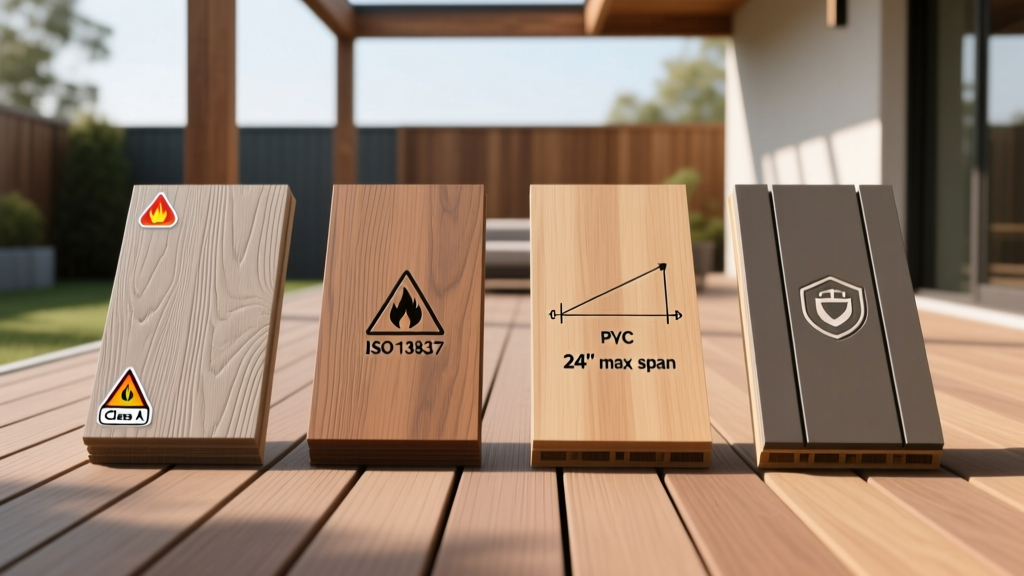
The Anatomy of Deck Board Performance Ratings
When specifying decking deck boards for residential or commercial projects, visual aesthetics are secondary to structural and environmental performance. Every major manufacturer must submit their products to independent testing to generate an ICC-ES (International Code Council Evaluation Service) Evaluation Report. These reports, governed by acceptance criteria like AC174 for composite decking, dictate the exact limitations of the material. Relying solely on marketing brochures leads to catastrophic field failures, including sagging joists, fire code violations, and severe slip-and-fall liabilities.
According to the ICC Evaluation Service, an ESR (Evaluation Service Report) provides the legally recognized basis for a building official to approve alternative materials. Before purchasing any composite, PVC, or aluminum decking deck boards, contractors and architects must verify the specific ESR number and cross-reference the allowable spans and fire classifications.
Structural Load and Joist Span Specifications
The International Building Code (IBC) mandates that exterior decks support a minimum uniform live load of 40 pounds per square foot (psf) and a dead load of 10 psf. However, the maximum allowable joist spacing for decking deck boards varies wildly based on the extrusion profile and material density.
Span Limits by Profile and Layout
| Material / Profile | Perpendicular Span (Max OC) | Diagonal Span (Max OC) | Max Cantilever Overhang |
|---|---|---|---|
| Solid WPC (Wood-Plastic Composite) | 16 inches | 12 inches | 2 inches |
| Scalloped / Hollow WPC | 12 inches | 10 inches | 1.5 inches |
| Solid Cellular PVC | 16 inches | 12 inches | 2 inches |
| Aluminum (Extruded, Ribbed) | 24 inches | 16 inches | 4 inches |
When installing decking deck boards on a 45-degree diagonal pattern, the effective span across the joists increases by a factor of 1.414. A 16-inch on-center (OC) perpendicular layout becomes a 22.6-inch span diagonally, which exceeds the structural limit of almost all composite and PVC materials. Always reduce joist spacing to 12 inches OC for diagonal installations.
Fire Resistance and WUI Compliance
In regions prone to wildfires, building codes strictly regulate exterior combustible materials. The Wildland-Urban Interface (WUI) code, heavily influenced by Chapter 7A of the California Building Code, requires exterior decking deck boards to pass rigorous flame spread and ember intrusion tests. According to the National Fire Protection Association (NFPA), WUI compliance is non-negotiable in designated hazard zones.
ASTM E84 and Class A Ratings
Fire performance is measured using ASTM E84 (Standard Test Method for Surface Burning Characteristics of Building Materials). Materials are assigned a Flame Spread Index (FSI):
- Class A (FSI 0-25): Required for WUI compliance. Typically achieved by cellular PVC boards (e.g., Azek Vintage) or specialized fire-retardant treated composites (e.g., Fiberon Paramount PVC).
- Class B (FSI 26-75): Standard for many premium capped wood-plastic composites. Fails WUI requirements.
- Class C (FSI 76-200): Common in uncapped composites and lower-density bamboo blends.
Critical Edge Case: Even if a specific composite board holds a Class A rating, the underlying pressure-treated wood joists and the gap spacing between boards can cause the overall deck assembly to fail a WUI inspection. WUI codes often require 1/8-inch maximum gaps to prevent ember intrusion, which conflicts with the drainage requirements of standard composite installations.
Slip Resistance and COF Metrics
Slip-and-fall accidents on exterior decks generate massive liability claims. The slip resistance of decking deck boards is quantified using the Dynamic Coefficient of Friction (DCOF), tested under ANSI A326.3 or ASTM D2394 standards. The FEMA Building Science division emphasizes that exterior surfaces must maintain traction under wet, algae-prone conditions.
Wet vs. Dry Traction Performance
A DCOF of 0.42 or higher is generally considered safe for level exterior surfaces. However, composite materials behave differently than natural wood when wet:
- Uncapped Composite: Absorbs moisture, leading to a DCOF drop from 0.65 (dry) to 0.45 (wet). Prone to mold growth, which acts as a lubricant and drops DCOF below 0.30.
- Capped Composite with Micro-Texturing: Modern polymer caps feature embossed wood-grain patterns that channel water away. These maintain a wet DCOF of 0.55 to 0.60.
- Aluminum Decking: Bare aluminum drops to a hazardous 0.20 DCOF when wet. Only powder-coated aluminum boards with integrated abrasive grit strips (yielding a 0.65+ wet DCOF) should be used in residential or commercial pedestrian zones.
Thermal Expansion and Contraction Matrices
Ignoring thermal movement is the leading cause of buckled boards, popped fasteners, and fractured fascia. Decking deck boards expand and contract at rates dictated by their core material chemistry. Installers must calculate butt joint gaps based on the ambient temperature on the day of installation versus the historical maximum temperature of the region.
| Material Type | Expansion Rate (per 10 ft / 50°F change) | Required Butt Joint Gap (at 70°F) | Fastening System Requirement |
|---|---|---|---|
| Wood-Plastic Composite (WPC) | 1/32 inch | 1/16 inch | Standard hidden clips |
| Cellular PVC | 1/16 inch | 1/8 inch | Slotted hidden clips |
| Mineral-Based Composite | Virtually Zero | 1/16 inch (for drainage) | Face-screwed or standard clips |
| Extruded Aluminum | 1/64 inch | 1/16 inch | Proprietary interlocking rails |
Decoding Fade, Stain, and Structural Warranties
Manufacturer warranties for decking deck boards are heavily nuanced. A "Lifetime Limited Warranty" rarely covers the aesthetic degradation that homeowners actually care about. Understanding the prorated schedules and exclusions is vital for setting accurate client expectations.
The Proration Trap
Most premium composite brands offer a 25-year fade and stain warranty. However, this is almost always prorated. If a board exhibits unacceptable UV fading in year 15, the manufacturer will only reimburse 40% of the original material cost—and critically, they will not cover the labor to remove and replace the board. Labor often accounts for 60% of the total deck replacement cost.
Stain vs. Mold Exclusions
Warranties explicitly differentiate between "staining" (e.g., spilled wine, grease) and "mold/mildew growth." If a composite board turns black due to organic matter accumulation in the micro-texture of the polymer cap, the manufacturer will classify it as a maintenance failure, not a product defect, voiding the warranty. Only boards featuring integrated microban or zinc-based antimicrobial agents within the cap layer offer genuine protection against biological staining.
Structural Integrity Guarantees
Structural warranties cover splitting, splintering, and catastrophic delamination of the cap from the core. To maintain this coverage, installers must strictly adhere to the manufacturer's approved fastener list. Using unapproved third-party hidden clips or face-screws that lack the exact specified head geometry will immediately void the structural warranty, leaving the homeowner liable for any load-bearing failures.