Essential Metal Roofing Materials List for Leak Repair and Care
Access the definitive metal roofing materials list for repair and maintenance. Learn which sealants, fasteners, and coatings fix leaks and stop rust.
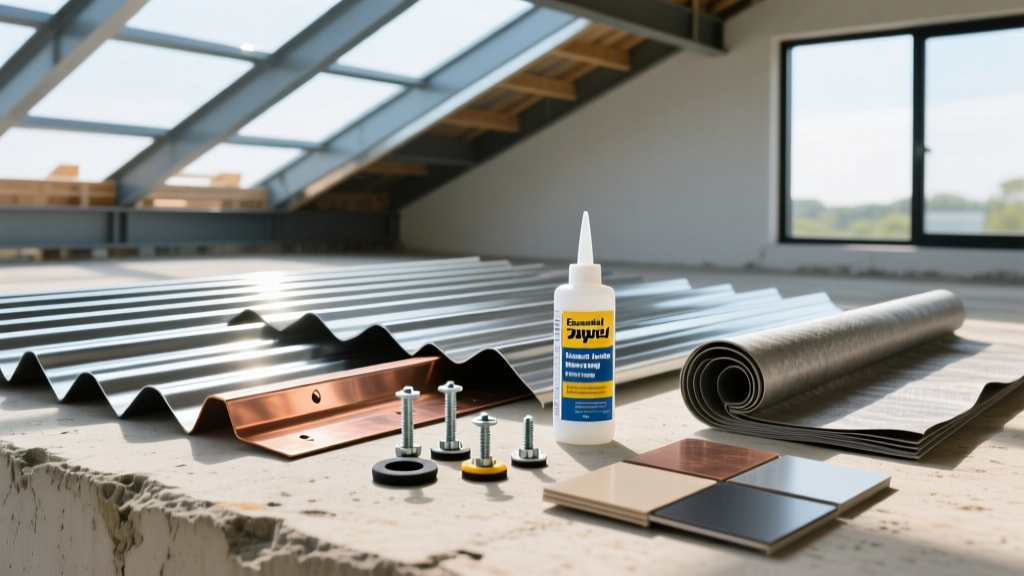
The Core Metal Roofing Materials List for Seam and Penetration Repair
Metal roofing systems routinely last 40 to 70 years, but the weakest links—seams, fastener penetrations, and flashing transitions—often fail within the first 10 to 15 years due to thermal expansion, UV degradation, and wind uplift. When compiling a metal roofing materials list for proactive maintenance or emergency leak repair, selecting the correct chemical compounds and hardware is non-negotiable. Using incompatible materials accelerates galvanic corrosion and voids manufacturer warranties.
Polyurethane vs. Silicone Sealants
For repairing gaps around pipe boots, HVAC curbs, and ridge caps, polyurethane sealants are the industry standard for painted metal panels (such as those coated with Kynar 500 or Hylar 5000 PVDF resins). Products like Geocel 2320 Construction Sealant or MasterSeal NP1 offer superior adhesion to factory-applied fluoropolymer paints. Silicone sealants, while highly UV-resistant, often fail to bond securely to PVDF-coated metals without an aggressive primer, leading to capillary water intrusion beneath the sealant bead.
- Application Specifics: Apply polyurethane sealant in a continuous 3/8-inch bead. Tool the joint within 10 minutes to ensure contact with both substrates.
- Cure Time: Skin-over occurs in 2 hours; full depth cure (at 1/8-inch thickness) requires 24 hours at 70°F and 50% relative humidity.
Butyl Tape for Lap Seams
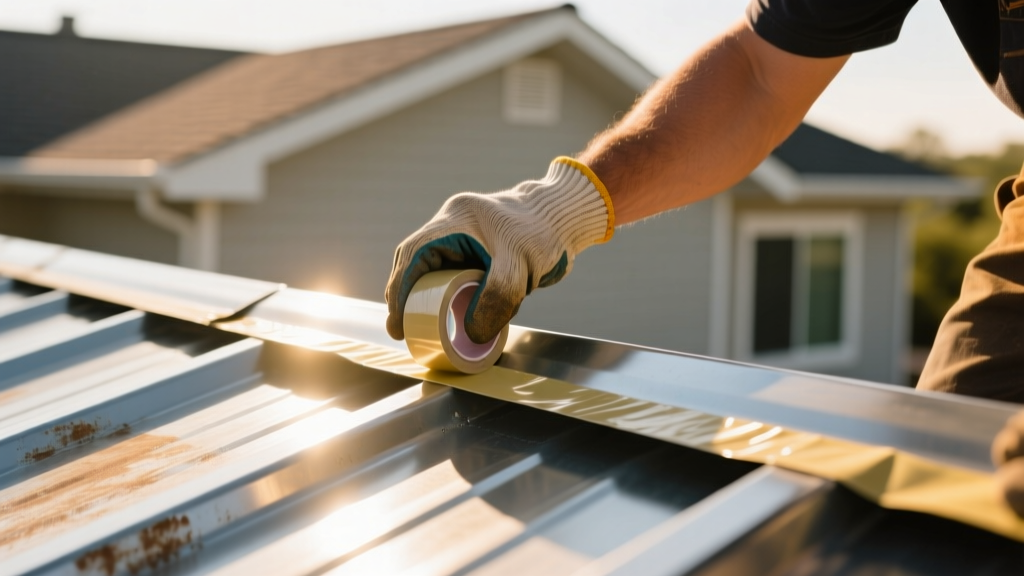
For horizontal and vertical lap seams on exposed fastener or standing seam panels, high-solids butyl rubber tape is required. EternaBond RoofSeal (available in 4-inch and 6-inch widths) features a 40-mil thickness with a built-in primer that activates under pressure. When repairing a weeping lap seam, the 4-inch width is critical; narrower tapes fail to bridge the micro-gaps created by panel deflection under wind loads.
Fasteners and Hardware: The Hidden Culprits of Metal Roof Leaks
Over-torqued, under-driven, or degraded fasteners account for over 60% of metal roof leaks. When updating your metal roofing materials list for hardware replacement, the washer material is just as important as the screw metallurgy.
| Fastener Type | Washer Material | Expected Lifespan | Best Application |
|---|---|---|---|
| #10 x 1" Pancake Head | EPDM (0.250" OD) | 20-25 Years | Attaching flashing to structural purlins |
| #12 x 1.5" Hex Washer | EPDM (0.375" OD) | 20-25 Years | Primary panel-to-purlin attachment (re-roofing) |
| #10 x 1" Stitch Screw | Neoprene | 5-7 Years | Avoid for exterior; use only for interior liner panels |
| #14 x 2" Self-Driller | EDPM with Metal Cap | 30+ Years | Heavy gauge structural standing seam clips |
Critical Warning: Never use neoprene washers for exterior metal roof repairs. Neoprene dries out, cracks, and loses elasticity after 5 to 7 years of UV exposure. Always specify EPDM (Ethylene Propylene Diene Monomer) washers, which maintain flexibility across temperature extremes from -40°F to 250°F. According to the National Roofing Contractors Association (NRCA), fastener back-out due to thermal cycling is best mitigated by using screws with a minimum 0.250-inch outer diameter washer and ensuring the drill clutch is set to stop driving exactly when the washer is compressed to the diameter of the screw head—never "pancaked" or squeezed out past the metal edge.
Rust Conversion and Elastomeric Coatings for Long-Term Care
Surface oxidation and localized rust spots require immediate intervention before structural perforation occurs. The correct sequence involves chemical conversion followed by an elastomeric barrier.
Step 1: Phosphoric Acid Rust Converters
Mechanical wire-brushing alone leaves microscopic iron oxide in the pores of the steel. Apply a phosphoric acid-based rust converter (such as Ospho or Corroseal) to the affected area. This chemically converts iron oxide (rust) into iron phosphate, a stable, black, inert layer that halts further oxidation and provides a superior bonding surface for primers.
Step 2: High-Solids Acrylic Elastomeric Topcoats
Once the rust is converted and primed with an acrylic metal primer, apply a high-solids elastomeric roof coating. Products like GacoFlex or Rust-Oleum Roof Mate are engineered to stretch up to 600% without tearing, accommodating the significant thermal expansion and contraction of metal panels.
Specification Requirement: The coating must be applied to achieve a minimum of 20 dry mils of thickness. Because most coatings contain 50-60% solids by volume, applying 20 dry mils requires a wet film thickness of roughly 35 to 40 mils, typically achieved in two separate coats applied perpendicular to each other.
Diagnostic Decision Matrix: Matching Material to Failure Mode
Use this diagnostic framework to identify the exact material needed from your inventory based on the visual symptoms of the roof failure.
Symptom-to-Material Flowchart
- Symptom: Water staining on interior ceiling directly beneath a panel lap joint.
Cause: Capillary action drawing wind-driven rain up the seam.
Required Material: 4-inch Butyl Tape (applied to the upper 2/3 of the lap joint) and #10 stitch screws with EPDM washers spaced 12 inches on center. - Symptom: Leaks originating around a plumbing vent pipe during heavy rain.
Cause: UV degradation of the rubber pipe boot or separation of the base flashing.
Required Material: Retro-fit split pipe boot (lead or aluminum base) sealed with Geocel 2320 polyurethane, secured with 8 perimeter rivets. - Symptom: Chalking, fading, and localized pitting on south-facing panels.
Cause: PVDF paint film failure and underlying galvanic corrosion.
Required Material: Phosphoric acid converter, epoxy metal primer, and 20-mil acrylic elastomeric coating.
Critical Application Protocols and Edge Cases
Possessing the correct materials is only half the battle; improper surface preparation and installation techniques cause the majority of repair callbacks. The Metal Construction Association (MCA) emphasizes strict adherence to substrate preparation guidelines to ensure warranty compliance.
Chemical Cleaning Before Adhesion
Never apply sealant or butyl tape directly over dirt, chalk, or oxidized paint. Wipe the repair area with methyl ethyl ketone (MEK) or denatured alcohol using a clean, lint-free cloth. MEK aggressively cuts through industrial fallout and silicone residue. Allow the solvent to flash off completely (usually 3-5 minutes) before applying adhesive products. Applying tape over residual solvent traps vapors, creating blisters that eventually rupture.
The Galvanic Corrosion Trap
Temperature Thresholds for Repair Materials
Most roofing contractors attempt repairs in marginal weather, leading to immediate failures. Polyurethane sealants and butyl tapes require a minimum ambient and surface temperature of 40°F (4°C) and rising. If emergency repairs are required in sub-freezing temperatures, you must switch to a specialized cold-weather solvent-based flashing cement or use a hot-air welder to raise the localized panel temperature to 50°F before applying standard butyl tape. Storing your repair materials in a heated truck cab or insulated job-site box is mandatory during winter maintenance cycles to maintain the pliability of the tapes and the flow-rate of the sealants.
By standardizing your inventory with the specific polyurethanes, EPDM fasteners, and elastomeric coatings detailed in this metal roofing materials list, facility managers and roofing professionals can execute permanent repairs that match the longevity of the primary metal roof system.
Written by
Sarah WhitfieldSarah Whitfield is a chartered quantity surveyor (MRICS) and construction cost analyst with 15 years of experience in material pricing, procurement strategy, and project budgeting. She earned her degree in Construction Management from the University of Reading (UK) and has worked on projects ranging from $2M custom homes to $180M mixed-use developments across North America and Europe. Sarah currently leads cost estimating for BuildMat Insight, maintaining a proprietary database of 4,000+ material price points updated quarterly. She is a frequent contributor to RSMeans cost data panels and has presented at the International Cost Engineering Council (ICEC) congress. Based in Denver, CO, Sarah is an avid trail runner and volunteer mentor for Women in Construction.
More from Sarah Whitfield
View all
Wood & Lumber
What Are the Different Types of Wood? A Builder's Guide
Compare structural softwoods, finish hardwoods, and engineered lumber. Analyze Janka ratings, MOE values, and 2026 pricing for construction.
Aug 4, 2026

Walls & Panels
Steel Framing vs Wood Framing: Corrosion and Moisture Defense
Compare steel framing vs wood framing for moisture resistance. Learn about galvanized coatings, condensation risks, and corrosion protection strategies.
Jul 21, 2026

Stone & Masonry
How to Cut Stone Veneer: Wet Saw vs Grinder Comparison
Compare the best tools for cutting stone veneer. We review wet saws, angle grinders, and chop saws to help you achieve clean, chip-free cuts.
Jul 21, 2026