RV Rubber Roof Material Cost Breakdown: EPDM vs TPO 2026
Complete 2026 cost breakdown for RV rubber roof materials. Compare EPDM vs TPO pricing, sealants, labor, and hidden substrate repair costs.
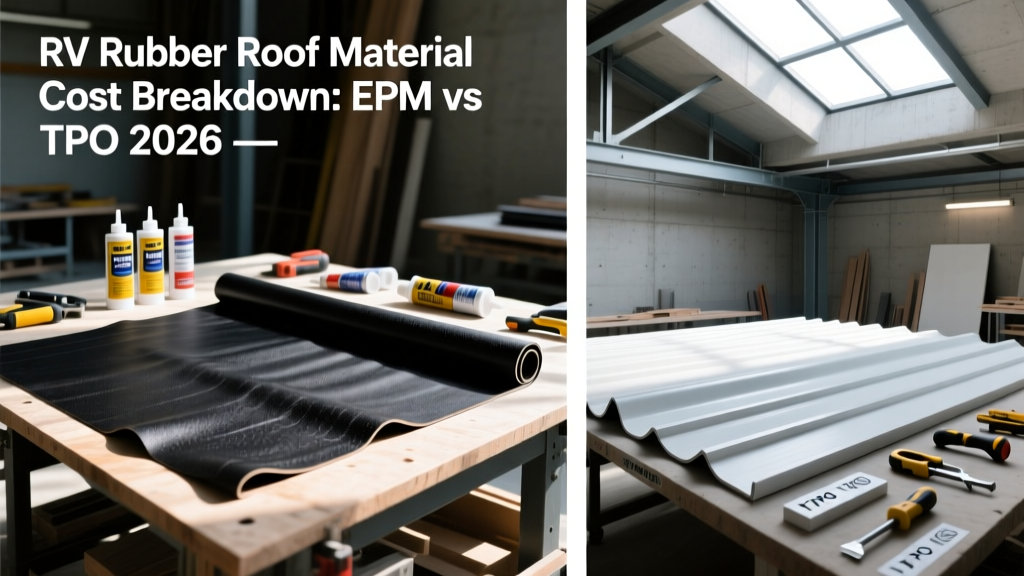
The Shift in RV Rubber Roof Material Economics
The recreational vehicle roofing market has undergone a definitive transition over the last decade. While Ethylene Propylene Diene Monomer (EPDM) historically dominated due to its low upfront cost and DIY-friendly installation, Thermoplastic Polyolefin (TPO) now accounts for the majority of factory-installed RV roofs in 2026. This shift is driven by Energy Star cool roof guidelines and stricter environmental regulations regarding the volatile organic compounds (VOCs) found in EPDM manufacturing and maintenance.
For owners facing a full roof replacement, understanding the true cost of RV rubber roof material requires looking beyond the per-square-foot price of the membrane. A complete financial model must account for membrane thickness, chemical compatibility of adhesives, specialized sealants, and the unpredictable state of the substrate decking. This breakdown provides exact 2026 pricing, material specifications, and labor economics to help you budget accurately.
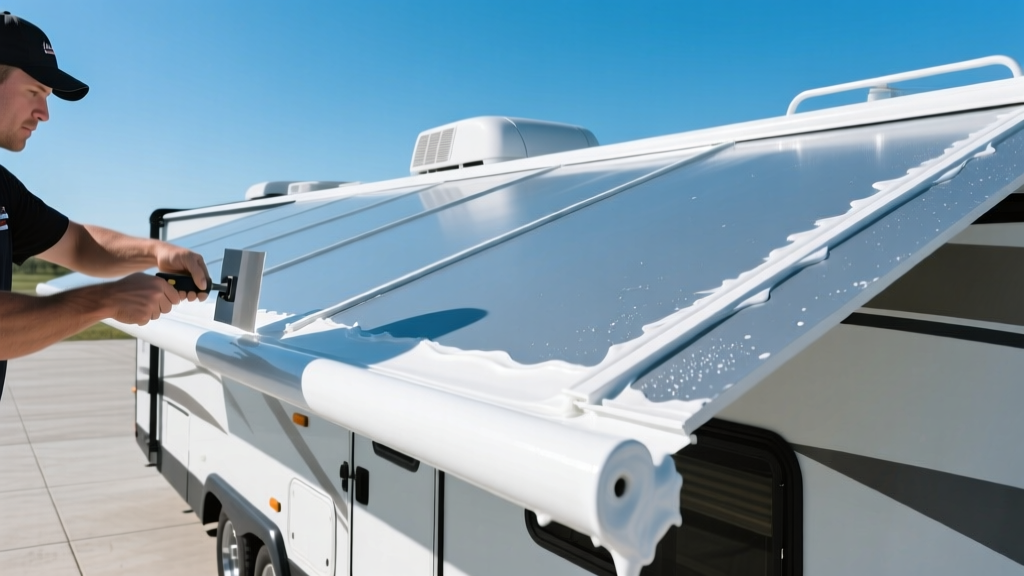
Membrane Cost Matrix: EPDM vs. TPO
Rubber roofing membranes are sold in rolls, typically 8.5 feet wide to accommodate standard RV widths without requiring longitudinal seams. Pricing fluctuates based on thickness (measured in mils) and polymer composition.
| Material Type | Thickness | Cost per Sq. Ft. (Material Only) | UV & Ozone Resistance | Seam Method | Expected Lifespan |
|---|---|---|---|---|---|
| EPDM (Standard) | 40-mil | $1.25 - $1.50 | Moderate (Requires UV Protectant) | Adhesive / Lap Sealant | 10 - 15 Years |
| EPDM (Premium) | 60-mil | $1.60 - $1.90 | Moderate (Requires UV Protectant) | Adhesive / Lap Sealant | 15 - 20 Years |
| TPO (Standard) | 45-mil | $1.55 - $1.85 | High (Inherently Reflective) | Heat Weld / TPO Adhesive | 15 - 20 Years |
| TPO (Premium) | 60-mil | $1.95 - $2.40 | High (Inherently Reflective) | Heat Weld / TPO Adhesive | 20+ Years |
Expert Insight: EPDM oxidizes over time, shedding a chalky residue that requires annual cleaning and the application of UV protectants like 303 Aerospace Protectant. TPO does not oxidize in this manner, effectively eliminating a recurring $80-$120 annual maintenance cost, which offsets its higher initial purchase price over a 15-year ownership cycle.
The Consumables Trap: Adhesives and Sealants
The most common budgeting error in RV roof replacement is underestimating the cost of chemical consumables. You cannot use standard EPDM contact cement on a TPO roof; the chemical composition will fail to bond and may degrade the TPO membrane. According to Dicor Products official sealant specifications, using mismatched sealants is the leading cause of premature RV roof failure.
Adhesive Costs
- Alpha Systems 1016 (For EPDM): ~$45 per gallon. Coverage is approximately 150 square feet per gallon. A 30-foot trailer (approx. 240 sq. ft.) requires 2 gallons ($90 total).
- Alpha Systems 2020 (For TPO): ~$65 per gallon. TPO requires a specialized adhesive or a hot-air welder. If gluing TPO, expect to spend $130 for a standard trailer.
Sealant and Tape Costs
Seams, vents, and perimeter edges require specific sealants. Never use silicone on an RV rubber roof; it creates an un-bondable surface for future repairs.
- Dicor 501LSW-1 (Self-Leveling Lap Sealant): Used for horizontal surfaces. ~$9.50 per 10.3 oz tube. Budget for 6-8 tubes ($57 - $76).
- Dicor 551LSW-1 (Non-Leveling): Used for vertical surfaces and sidewall transitions. ~$9.00 per tube. Budget for 3-4 tubes ($27 - $36).
- Eternabond MicroSealant Tape (4-inch x 50ft): The gold standard for perimeter sealing and covering old screw holes. ~$65 per roll. Two rolls are typically required ($130).
- Membrane Cleaner/Primer: Essential for preparing the substrate and membrane backing. ~$40 per gallon.
Once the old rubber is peeled back, you will expose the roof deck. Most travel trailers use 1/4-inch Luan plywood, while Class A motorhomes often use marine-grade plywood or OSB. If you find water rot, you must replace the decking. Replacing 1/4-inch Luan costs roughly $0.78 per square foot, while 5/8-inch marine plywood costs upwards of $2.03 per square foot. Always add a 20% contingency buffer to your budget for hidden substrate rot.
Labor Economics: DIY vs. Certified Installer
RV roof replacement is highly labor-intensive. The old membrane must be scored, peeled, and scraped clean of old adhesive before the new membrane can be laid. Professional RV service centers typically charge between $4.50 and $8.00 per square foot for labor, depending on the complexity of the roof (e.g., navigating multiple AC units, solar panels, and skylights).
Time and Value Framework
For a 30-foot travel trailer (approx. 240 sq. ft. of roof area):
- Professional Labor Cost: $1,080 to $1,920.
- DIY Time Commitment: 18 to 28 hours for a two-person crew. This includes 4 hours of teardown, 6 hours of scraping/prep, 4 hours of adhesive application and rolling, and 6 hours of sealing and detailing.
If your time is valued at $30/hour, a DIY installation saves roughly $800 to $1,200 in labor. However, TPO heat-welding requires specialized equipment (a Leister hot-air welder costs $400+) and significant practice. For DIYers without welding experience, EPDM with adhesive and Eternabond tape remains the most economically viable and forgiving choice.
Real-World Project Scenarios (2026 Estimates)
To contextualize these numbers, here are two distinct replacement scenarios based on current market pricing and FMCA RV maintenance resources data.
Scenario A: 28-Foot Travel Trailer (DIY, EPDM 40-mil)
Roof Area: 220 sq. ft.
Substrate: Existing Luan in good condition (no replacement needed).
- EPDM 40-mil Membrane (1 roll): $310
- Alpha Systems 1016 Adhesive (2 gal): $90
- Dicor Sealants (Assorted, 8 tubes): $75
- Eternabond Tape (2 rolls): $130
- Cleaner, Primer, and Roller Tools: $65
- Total DIY Cost: $670 (Approx. $3.04 / sq. ft.)
Scenario B: 38-Foot Class A Motorhome (Professional, TPO 60-mil)
Roof Area: 310 sq. ft.
Substrate: 40 sq. ft. of marine plywood replacement required due to AC unit leak.
- TPO 60-mil Membrane: $680
- TPO Adhesive & Primer: $180
- Sealants and Tapes: $210
- Marine Plywood Substrate Repair (Materials): $85
- Professional Labor (Teardown, Carpentry, Install): $2,170 (at $7.00/sq. ft.)
- Total Professional Cost: $3,325 (Approx. $10.72 / sq. ft.)
Sourcing and Purchasing Strategy
Avoid purchasing RV rubber roof material from general big-box hardware stores, as they rarely stock the specialized 8.5-foot wide RV rolls or the specific Alpha Systems adhesives required. Instead, source materials from dedicated RV roofing distributors or direct from manufacturers like Alpha Systems or Carlisle SynTec. Buying a complete 'roof kit' (which includes the membrane, pre-measured adhesive, sealant, and a roller) often yields a 10% to 15% discount compared to sourcing components individually and ensures chemical compatibility across all bonding agents.
Written by
Marcus ChenMarcus Chen is a licensed structural engineer (PE) and building materials analyst with over 12 years of experience across residential, commercial, and industrial construction. He holds a Master of Science in Civil Engineering from UC Berkeley and spent six years at Thornton Tomasetti before transitioning to independent consulting and technical writing. Marcus specializes in material selection for seismic-prone regions, concrete reinforcement strategies, and lifecycle cost analysis. His work has been cited by the American Concrete Institute (ACI) and the Structural Engineers Association of California (SEAOC). When he is not on a job site or at his desk, you will find him hiking the Sierra Nevada or restoring a 1920s craftsman bungalow in Oakland, CA.
More from Marcus Chen
View all
Construction Cost
How Much Did the Eiffel Tower Cost to Build?
How much did the Eiffel Tower cost to build in 1889? We adjust for inflation and compare its budget to modern skyscraper construction.
Aug 4, 2026

Fire Resistance
What Is a Fire Resistant Material? Testing & Certification Guide
Discover what is a fire resistant material through ASTM and UL testing. Learn how fire ratings, certifications, and assemblies work in construction.
Aug 4, 2026

Construction Cost
How Much Did the Burj Khalifa Cost to Build?
How much did the Burj Khalifa cost to build? We break down the $1.5B project and extract 5 money-saving strategies for your next build.
Jul 30, 2026