Crawl Space Waterproofing: Material Taxonomy & Selection Guide
Compare crawl space waterproofing materials with our taxonomy guide. Select 6-mil to 20-mil barriers, drainage mats, and adhesives based on site conditions.
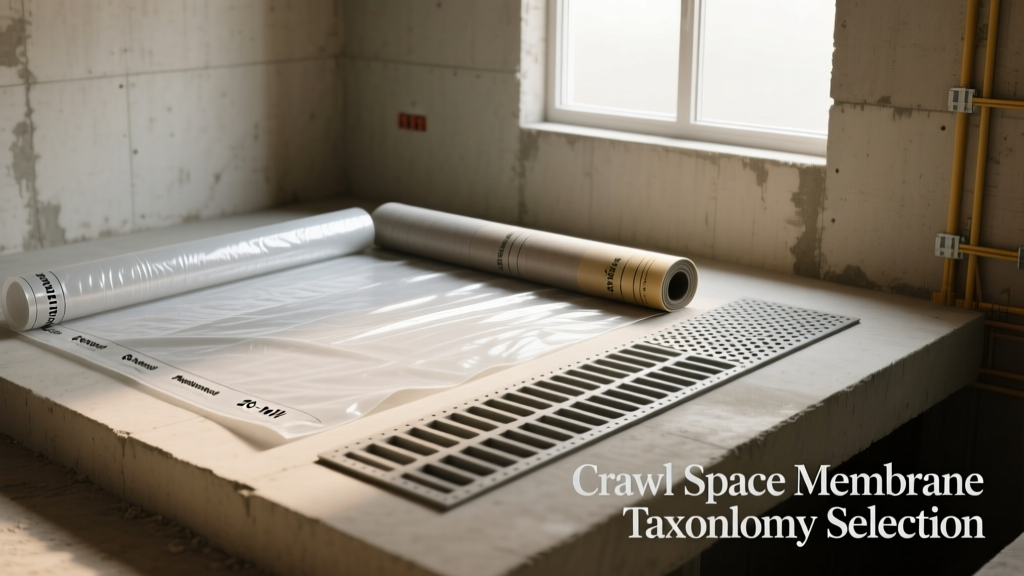
The Material Taxonomy: Classifying Crawl Space Membranes
Selecting the right materials for crawl space waterproofing requires moving beyond generic 'plastic sheeting' and understanding the engineered taxonomy of vapor retarders and drainage systems. According to the U.S. Department of Energy, uncontrolled ground moisture can introduce up to 15 gallons of water vapor per day into a standard 1,500-square-foot crawl space. To combat this, materials are classified by their structural reinforcement, perm ratings, and puncture resistance under ASTM E1745 standards.
Class A: Unreinforced Polyethylene (6-Mil to 10-Mil)
Standard unreinforced polyethylene (PE) film is the most ubiquitous and frequently misapplied material in the industry. While a 6-mil PE sheet technically achieves a perm rating of 0.06 (qualifying it as a vapor barrier), it lacks the tensile strength to survive installation over graded soil. Under ASTM D4833 puncture testing, standard 6-mil poly fails at approximately 0.5 pounds of force. It is highly susceptible to tearing from sharp aggregate, foot traffic during subsequent HVAC or plumbing work, and capillary draw if seams are not perfectly sealed. Use Class A unreinforced PE only as a temporary construction vapor retarder or in sealed, inaccessible, smooth-floored crawl spaces.
Class B: Cross-Laminated & Woven Reinforced (12-Mil to 20-Mil)
For permanent encapsulation, reinforced membranes are the industry standard. These materials feature a high-density polyethylene (HDPE) woven scrim sandwiched between layers of low-density polyethylene (LDPE). A 20-mil cross-laminated membrane, such as Raven Industries ProTotal or VaporGuard, boasts a puncture resistance exceeding 22 pounds and a tensile strength of over 45 lbs/inch per ASTM D882. These membranes achieve perm ratings below 0.03, effectively halting vapor diffusion while providing a durable, walkable surface for maintenance personnel. The 2024 and 2025 International Residential Code (IRC) updates increasingly mandate Class A or B ASTM E1745 compliant materials for new construction in high-moisture climate zones.
Class C: Dimpled Drainage Matting & Active Systems
When a crawl space sits below the local water table or experiences seasonal hydrostatic pressure against the footings, a vapor barrier alone will trap liquid water, leading to pooling and eventual membrane failure. Dimpled drainage matting consists of a high-impact polystyrene (HIPS) or HDPE dimpled core bonded to a non-woven geotextile filter fabric. Products like Tremco TremDrain create a 3/8-inch to 1/2-inch capillary break that channels bulk liquid water to a perimeter French drain or interior sump pit, while the geotextile layer prevents soil fines from clogging the drainage channels.
Many local building codes still reference a minimum '6-mil polyethylene' ground cover. However, the Environmental Protection Agency and advanced building science practitioners strongly advise against relying on 6-mil for full encapsulation. If your goal is a conditioned, unvented crawl space, specify a minimum 12-mil reinforced membrane to ensure long-term integrity and compliance with modern energy codes.
Selection Matrix: Matching Material to Site Conditions
Choosing the correct material requires an assessment of your specific soil composition, water table depth, and intended use of the crawl space. Use the following matrix to align site conditions with the appropriate material class.
| Material Class | Thickness | Perm Rating | Puncture (ASTM D4833) | Best Application | 2026 Cost/Sq Ft |
|---|---|---|---|---|---|
| Unreinforced PE | 6-Mil | 0.06 perms | 0.5 lbs | Vented spaces, smooth soil, temporary use | $0.15 - $0.22 |
| Reinforced Woven | 12-Mil | 0.04 perms | 12.0 lbs | Standard encapsulation, light storage | $0.45 - $0.58 |
| Cross-Laminated | 20-Mil | 0.01 perms | 22.5 lbs | Conditioned spaces, heavy traffic, rocky soil | $0.68 - $0.85 |
| Dimpled Drainage | 24-Mil Core | N/A (Drain) | 85.0 lbs | High water table, bulk water management | $1.35 - $1.70 |
Adhesives and Fasteners: The Hidden Failure Points
The most robust 20-mil membrane will fail if the seam and termination details are compromised. Material selection must include the specific adhesives and mechanical fasteners required for the substrate.
Seam Adhesives: Butyl vs. Acrylic
For overlapping membrane seams (minimum 12-inch overlap required), double-sided butyl rubber tape is the mandatory standard. Butyl tape remains permanently pliable, accommodating the thermal expansion and contraction of the HDPE membrane without losing adhesion. Acrylic mastics and standard duct tapes dry out, become brittle, and fail within 24 to 36 months in the high-humidity environment of a crawl space. Specify a butyl tape with a minimum thickness of 40 mils and a width of 4 inches for primary seams.
Wall Termination Systems
When extending the vapor barrier up the foundation walls (a requirement for full encapsulation), the membrane must be mechanically terminated. Do not rely on adhesive alone to hold the membrane to porous CMU (concrete masonry unit) or poured concrete walls. Use a PVC termination bar or a pressure-treated wood furring strip, anchored with 1/4-inch by 1.5-inch Tapcon masonry screws spaced every 16 inches. Apply a continuous bead of polyurethane construction adhesive (such as Loctite PL Premium) behind the termination bar to create an airtight and watertight gasket against the masonry.
2026 Cost Analysis and Material Lifespan
Budgeting for crawl space waterproofing requires calculating not just the square footage of the floor, but the perimeter wall height, piers, and an additional 15% waste factor for cuts and overlaps. Below is a realistic material-only cost breakdown for a standard 1,500-square-foot crawl space with 3-foot foundation walls and 10 interior piers.
- 6-Mil Unreinforced System: $450 - $600 total material cost. Expected lifespan: 3 to 7 years before tearing requires patching or replacement.
- 12-Mil Reinforced System: $1,100 - $1,400 total material cost (including butyl tape and masonry fasteners). Expected lifespan: 20+ years.
- 20-Mil Premium Encapsulation: $1,800 - $2,300 total material cost. Expected lifespan: Lifetime of the structure (50+ years).
- Perimeter Drainage Matting Add-on: Adds $850 - $1,100 to the material cost, but eliminates the need for a $1,500+ interior sump pump system in moderately wet soils.
The 4-Step Selection Framework
To finalize your material specification, execute this sequential decision framework:
- Assess Bulk Water Intrusion: Dig a 12-inch test pit in the lowest corner of the crawl space after a heavy rain event. If water pools in the pit within 2 hours, you have a hydrostatic pressure issue. You must specify Class C dimpled drainage matting at the perimeter and an interior trench drain before laying any vapor barrier.
- Evaluate Soil Texture: If the native soil contains sharp gravel, shale, or construction debris that cannot be fully graded and removed, bypass 12-mil membranes entirely. The puncture risk dictates a minimum 20-mil cross-laminated specification.
- Calculate Total Surface Area: Measure the floor length and width, then add the perimeter wall area (perimeter x wall height). Add the surface area of all interior piers. Multiply the final number by 1.15 to account for the mandatory 12-inch seam overlaps and cutting waste.
- Determine Conditioning Status: If the crawl space will be unvented and conditioned (insulated walls, supply air registered), the Department of Energy mandates a continuous, sealed vapor barrier. This requires upgrading from standard mechanical termination to a fully taped and masted termination system at the top plate of the foundation wall to prevent stack-effect vapor draw.