Portable Waterproof Bluetooth Speakers: 2026 IP Ratings & Materials
Decode IP68 and IPX7 ratings for portable waterproof bluetooth speakers. Explore the TPU, ePTFE, and conformal coatings driving 2026 performance specs.
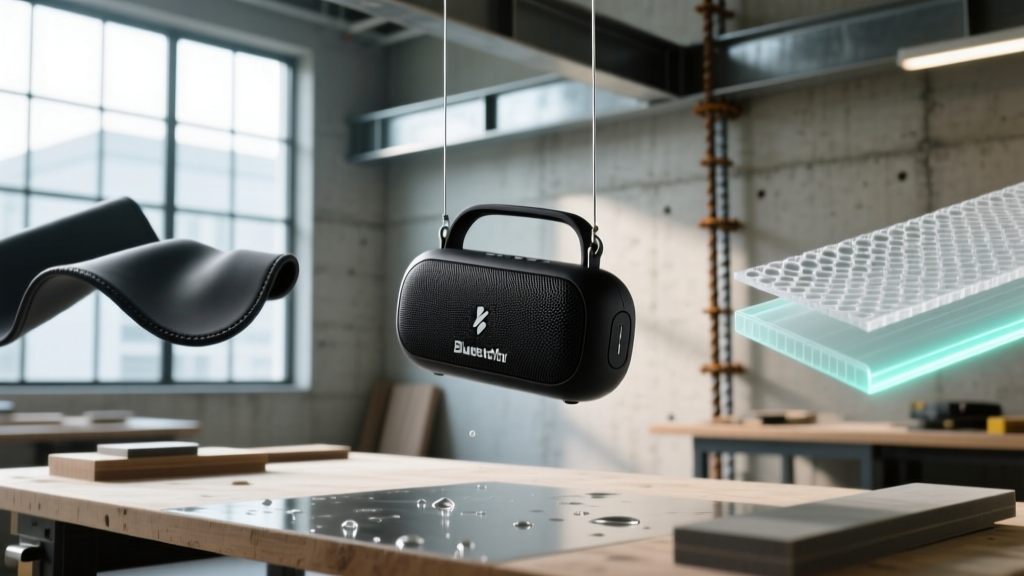
Decoding IEC 60529: IPX7 vs. IP68 in Consumer Audio
The marketing term "waterproof" is technically inaccurate in materials engineering; the correct classification is ingress protection (IP), governed by the IEC 60529 standard. For portable waterproof bluetooth speakers, manufacturers predominantly target IPX7 or IP68 certifications. Understanding the material requirements for each rating is critical for evaluating long-term durability.
According to the Engineering Toolbox IP Rating Guide, IP68 testing parameters are defined by the manufacturer but must exceed the baseline of 1 meter continuous submersion. In 2026, premium portable speakers typically certify IP68 at depths of 1.5 to 3 meters for up to 120 minutes. However, IP ratings do not account for high-pressure water jets (IPX6) or dynamic hydrostatic pressure caused by dropping the speaker into deep water, which can spike localized pressure far beyond the static test limits.
Material Science: What Actually Keeps the Water Out?
Achieving an IP68 rating in a device that must project high-decibel audio requires a complex assembly of specialized polymers and nanocoatings. The waterproofing of a portable bluetooth speaker relies on three distinct material barriers.
1. Enclosure Sealing: TPU Overmolding and Silicone Gaskets
The primary mechanical seal in modern rugged speakers utilizes Thermoplastic Polyurethane (TPU) overmolded onto a rigid Polycarbonate (PC) or ABS chassis. Unlike cheaper Thermoplastic Elastomers (TPE), TPU offers superior hydrolysis resistance and maintains its elasticity across extreme temperature variances (-20°C to 80°C). Engineers specify TPU with a Shore A hardness between 75A and 85A to provide impact absorption without compromising the structural rigidity needed to maintain gasket compression. Internal seams are sealed using platinum-cured silicone O-rings, which resist UV degradation and do not suffer from the compression set that plagues standard EPDM rubber over time.
2. Acoustic Transmission: ePTFE Membranes
The most critical engineering challenge in portable waterproof bluetooth speakers is allowing sound to escape while blocking water. This is solved using expanded Polytetrafluoroethylene (ePTFE) acoustic membranes, as detailed in W.L. Gore & Associates Acoustic Vents. ePTFE is a microporous material with a pore size ranging from 0.1 to 5.0 micrometers. Because a water droplet is approximately 2,000 micrometers, surface tension prevents liquid water from penetrating the membrane. Meanwhile, air and acoustic waves pass through with minimal interference. High-end 2026 speaker models utilize multi-layer ePTFE meshes that limit acoustic insertion loss to less than 1.5 dB at 1kHz, preserving the high-frequency response of the tweeter.
3. Internal PCB Defense: Parylene Conformal Coatings
Mechanical seals eventually fail due to thermal cycling and physical impacts. The final line of defense is the conformal coating applied directly to the printed circuit board (PCB), Class-D amplifiers, and Bluetooth System-on-Chip (SoC). While acrylic and polyurethane coatings are common in budget models, premium waterproof speakers utilize Parylene C. Parylene is applied via Chemical Vapor Deposition (CVD), creating a truly pinhole-free, uniform polymer layer at thicknesses of just 1 to 5 microns. HumiSeal Conformal Coating Specifications note that Parylene provides exceptional dielectric strength and moisture barrier properties without adding the acoustic dampening mass of thicker epoxy potting compounds.
2026 Performance Matrix: Top Speaker Waterproofing Specs
The following matrix outlines the material specifications and performance thresholds expected in premium-tier portable waterproof bluetooth speakers released in 2026.
| Component | Primary Material | Key Specification | Failure Threshold |
|---|---|---|---|
| Exterior Bumper | Polyether-based TPU | Shore 80A, Hydrolysis resistant | Tearing at >400% elongation |
| Acoustic Mesh | ePTFE (Oleophobic coated) | 0.5µm pores, IP68 rated | Puncture at >50 PSI point-load |
| Main PCB Coating | Parylene C | 3.0µm thickness via CVD | Dielectric breakdown >5kV/mm |
| Chassis Seal | Platinum-cured Silicone | 30% compression set limit | Degradation >150°C continuous |
Environmental Failure Modes: When Waterproofing Degrades
Consumers often assume an IP68 rating guarantees lifetime waterproofing. In reality, the materials used in portable waterproof bluetooth speakers are subject to specific environmental failure modes that bypass standard laboratory IP testing.
- Hydrolysis in Budget TPUs: Speakers utilizing cheaper polyester-based TPU will undergo hydrolysis when exposed to high humidity and heat over 12 to 18 months. The polymer chains break down, causing the rubberized exterior to become sticky and brittle, ultimately compromising the mechanical seal. Only polyether-based TPUs resist this degradation.
- Galvanic Corrosion at Charge Ports: Even with waterproof USB-C port flaps, trapped moisture mixed with salt or chlorine creates an electrolyte. This causes galvanic corrosion on the charging pins, shorting the battery management system. To circumvent this, 2026 flagship models are increasingly abandoning physical ports in favor of magnetic induction (Qi) charging pads sealed entirely beneath the TPU overmold.
- Oleophobic Membrane Depletion: ePTFE acoustic meshes are treated with an oleophobic (oil-repelling) coating to prevent sunscreen and sebum from clogging the microscopic pores. Frequent exposure to DEET-based insect repellents or alcohol-based sanitizers strips this coating, causing the membrane to become acoustically opaque and muffle high frequencies.
- Thermal Shock Delamination: Moving a speaker from direct, 95°F sunlight into a 55°F swimming pool induces rapid thermal contraction. If the coefficient of thermal expansion (CTE) between the PC chassis and the TPU overmold is mismatched, the material boundary can micro-fracture, breaking the IP68 seal instantly.
Testing Beyond the IP Rating: MIL-STD-810H
Because IEC 60529 IP ratings only test static submersion and dust ingress, they fail to account for the dynamic realities of outdoor use. Engineering teams validating high-performance portable waterproof bluetooth speakers now supplement IP68 testing with MIL-STD-810H Method 503.7 (Thermal Shock) and Method 516.8 (Shock and Bounce). A speaker that survives 1.5 meters of static water pressure may still fail if dropped onto concrete from 1 meter, as the kinetic shockwave can momentarily unseat the silicone O-rings or crack the rigid internal acoustic chamber. When evaluating specifications, prioritize models that explicitly list both IP68 certification and MIL-STD-810H drop-test compliance to ensure the waterproofing materials are supported by adequate structural engineering.