Vapor Barrier Basement Crawl Space Material Taxonomy and Selection
Compare vapor barrier materials for basement and crawl space encapsulation. Expert taxonomy, cost data, and code-compliant selection frameworks.
The Physics of Moisture Migration in Sub-Grade Environments
Selecting the correct vapor barrier for a basement or crawl space requires navigating a complex taxonomy of polymeric membranes, foil laminates, and fluid-applied systems. Unsealed earth in a crawl space can release up to 12 gallons of water vapor per 1,000 square feet daily. Driven by the stack effect, this moisture migrates upward into living spaces, elevating indoor relative humidity, degrading structural timber, and creating ideal conditions for mold proliferation. According to Building Science Corporation, treating the crawl space as a conditioned, sealed assembly is the only reliable method to halt this moisture drive.
The Environmental Protection Agency (EPA) emphasizes that moisture control relies on continuous, unbroken barriers. In material science terms, a true vapor barrier must achieve a Class I rating, meaning a water vapor permeance of 0.1 perms or less. However, selecting a material based solely on its perm rating ignores the mechanical realities of sub-grade installation: puncture resistance, seam integrity, and long-term alkaline degradation.
Material Taxonomy: Classifying Crawl Space and Basement Vapor Barriers
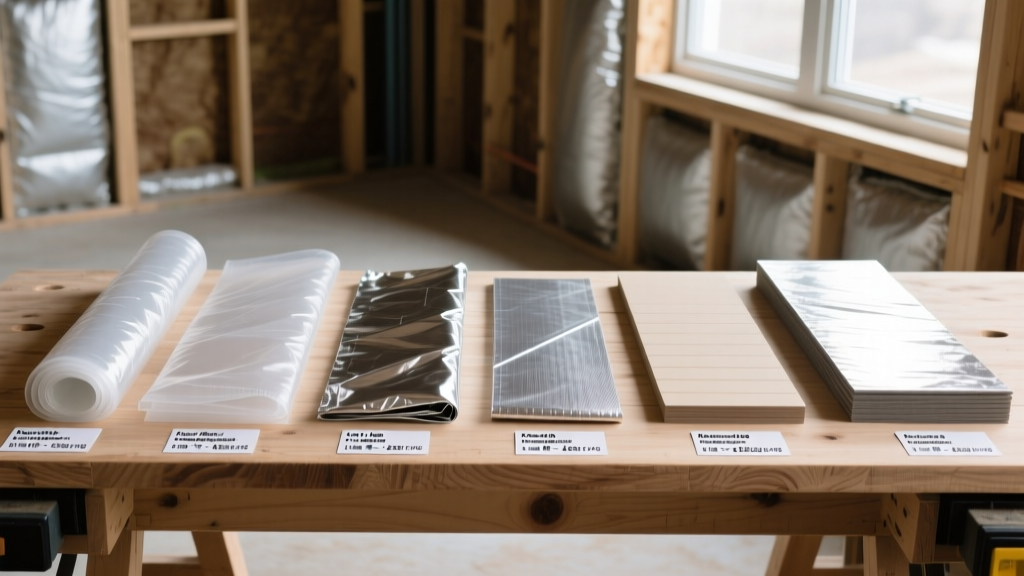
Vapor barriers are not monolithic. They are engineered across distinct material classes, each offering specific mechanical properties suited to different substrate conditions and encapsulation goals.
Class I: Standard Polyethylene (PE) Sheeting (6-mil to 10-mil)
Standard PE sheeting is the most ubiquitous and economical option. Extruded from low-density polyethylene, 6-mil PE meets the minimum 0.1 perm requirement for a Class I vapor retarder. However, its tensile strength is low. It is highly susceptible to tearing from sharp aggregate, foot traffic during HVAC servicing, and degradation from prolonged UV exposure if left unbackfilled. It is strictly recommended for low-traffic, smooth-substrate applications or temporary construction moisture control.
Class II: Cross-Laminated and String-Reinforced Membranes (12-mil to 20-mil)
Engineered for full encapsulation, these membranes fuse multiple layers of polyethylene with a high-tensile polyester or fiberglass scrim. Products like Raven Industries VaporGuard (12-mil) or Stego Wrap (15-mil) dominate this category. The cross-lamination process ensures that if the outer layer is punctured, the tear cannot propagate through the reinforcing scrim. These membranes routinely pass ASTM D1004 (Graves Tear Resistance) and ASTM E1745 Class A puncture testing, making them the standard for dirt-floor crawl spaces with rocky or uneven substrates.
Class III: Foil-Faced and Metallized Radiant Barriers
These systems laminate a micro-thin layer of aluminum foil to a PE or kraft backing. While they offer an exceptional perm rating (often 0.02 perms or lower) and provide radiant heat reflectivity, the foil layer is highly vulnerable to alkaline degradation. Concrete and masonry foundations have a high pH; when foil-faced barriers are placed in direct, prolonged contact with damp concrete or mortar, the aluminum oxidizes and disintegrates. They must be isolated from alkaline substrates using a separation layer or applied only to suspended floor joists.
Class IV: Fluid-Applied and Spray-On Membranes
For complex basement geometries, pipe penetrations, and irregular rubble foundations, fluid-applied elastomeric coatings (such as polyurea or asphalt-modified polyurethane) provide a seamless vapor barrier. Sprayed at 40 to 60 mils thick, they cure into a monolithic, fully adhered membrane. While highly effective for basement walls and concrete slabs, they are rarely used on dirt crawl space floors due to the inability of fluid coatings to bridge loose, shifting soil substrates.
Decision Matrix: Matching Material to Substrate and Climate
Use the following framework to specify the correct material class based on site-specific variables.
| Substrate / Condition | Recommended Material Class | Minimum Thickness / Spec | Seaming Method |
|---|---|---|---|
| Smooth, clean dirt floor (low traffic) | Standard Polyethylene | 6-mil to 10-mil PE | Acrylic mastic tape + mechanical fasteners |
| Rocky, uneven dirt floor (service traffic) | Cross-Laminated / Scrim-Reinforced | 12-mil to 20-mil (ASTM E1745 Class A) | Butyl rubber tape + termination bars |
| Poured concrete basement slab | Fluid-Applied or Standard PE | 40-mil spray / 10-mil under-slab | Monolithic cure / Lapped seams |
| Suspended floor joists (vented crawl) | Foil-Faced Radiant Barrier | Foil-laminated PE (0.05 perm) | Foil-backed HVAC tape |
Critical Failure Modes and Edge Cases
The most common failure in crawl space encapsulation is not the membrane itself, but the seams. Standard cloth-backed duct tape degrades rapidly in high-humidity, sub-grade environments. Seams must be sealed using double-sided butyl rubber tape or manufacturer-specific acrylic mastic tape. Furthermore, IRC Section R408.3 dictates that the vapor barrier must extend up the foundation wall by a minimum of 6 inches. Stopping the membrane flush with the dirt floor allows capillary moisture to bypass the barrier entirely.
A vapor barrier manages water vapor, not liquid water. If a crawl space experiences seasonal liquid water pooling, a 20-mil vapor barrier will trap the water, creating a hidden reservoir that breeds anaerobic bacteria. In these edge cases, a sub-membrane drainage system (dimpled drainage matting tied to a sump pump) must be installed beneath the vapor barrier before encapsulation.
Cost Breakdown and ROI by Material Class
Pricing reflects 2026 material costs for residential and light-commercial projects. Labor for installation typically adds $1.50 to $3.00 per square foot, depending on crawl space clearance and pier complexity.
| Material Class | Material Cost (per sq. ft.) | Expected Lifespan | Puncture Resistance |
|---|---|---|---|
| 6-mil Standard PE | $0.12 - $0.18 | 2 - 5 Years | Low (Fails ASTM E1745 Class A) |
| 12-mil Cross-Laminated | $0.35 - $0.45 | 15 - 20 Years | High (Passes ASTM E1745 Class B) |
| 20-mil Scrim-Reinforced | $0.55 - $0.75 | 25+ Years | Very High (Passes ASTM E1745 Class A) |
| Foil-Faced PE | $0.60 - $0.90 | 10 - 15 Years | Low (Foil layer easily compromised) |
Installation Specifications for Code Compliance
To ensure compliance with the International Residential Code (IRC) and local building authorities, encapsulation projects must adhere to strict material and installation standards:
- Material Certification: The membrane must carry a manufacturer's certification of compliance with ASTM E1745 (Standard Specification for Plastic Water Vapor Retarders Used in Contact with Soil or Granular Fill). For residential crawl spaces, Class A or Class B is typically required.
- Overlap Requirements: All field seams must overlap by a minimum of 6 inches. For high-wind or active depressurization environments (such as homes with radon mitigation systems), 12-inch overlaps sealed with continuous mastic are recommended to prevent air-transported moisture.
- Pier and Penetration Sealing: Membranes wrapping around structural piers must be cut precisely and sealed to the pier using compatible mastic sealant and secured with mechanical termination rings or heavy-duty zip ties. Gaps around piers account for over 30% of residual moisture intrusion in poorly executed encapsulations.
- Conditioning Requirements: Under IRC R408.3, once a crawl space is fully sealed with a Class I vapor barrier, it must be conditioned. This is achieved either by introducing conditioned air from the main living space via a register, installing a dedicated continuous exhaust system, or providing a dedicated heat source.
By matching the specific mechanical properties of the membrane to the physical realities of the substrate, builders and homeowners can eliminate moisture migration, protect structural assets, and ensure long-term indoor air quality.