Building Material Thrift: 2026 Sourcing and Compliance Trends
Discover how building material thrift is reshaping 2026 construction. Explore sourcing frameworks, code compliance for reclaimed materials, and cost data.

The Economics of Reuse: Why Building Material Thrift is Surging
The secondary construction market has evolved from a niche salvage operation into a $14.2 billion supply chain pillar. Driven by volatile lumber futures, embodied carbon mandates, and municipal deconstruction ordinances, building material thrift is no longer just an aesthetic choice for high-end renovations—it is a core procurement strategy for commercial and residential builders. According to the Environmental Protection Agency (EPA), over 600 million tons of construction and demolition (C&D) debris were generated in the United States in a recent annual cycle, with more than half ending up in landfills. The shift toward thrift and salvage directly intercepts this waste stream while providing materials with a fraction of the carbon footprint of newly manufactured equivalents.
While traditional demolition costs average $4 to $8 per square foot, systematic deconstruction costs $10 to $15 per square foot due to higher labor requirements. However, the recovered building material thrift inventory offsets these costs through direct resale, tax-deductible donations (often yielding 30% to 40% of the appraised material value in tax savings), and avoided landfill tipping fees, which now average $55 per ton nationally.
Material Viability Matrix: High-Value Salvage vs. High-Risk Thrift
Not all salvaged inventory is suitable for reuse. Procurement managers must filter thrifted materials through a strict viability matrix that weighs structural integrity, code compliance, and refurbishment labor against the cost of new alternatives.
| Material Category | Thrift Viability | Primary Risk / Failure Mode | Best 2026 Application |
|---|---|---|---|
| Old-Growth Dimensional Lumber | High (Structural & Finish) | Hidden metal fasteners; moisture content variance | Exposed beam ceilings, custom millwork |
| Clay Brick & Masonry | Very High | Mortar adhesion loss; spalling from freeze-thaw | Exterior veneers, interior accent walls |
| Architectural Hardware | High | Worn internal mechanisms; non-standard backsets | Cabinet pulls, decorative hinges, door levers |
| Vinyl Windows & IGUs | Low (Avoid) | Seal failure (argon gas leak); UV degradation | Non-conditioned spaces (sheds, garages) |
| Electrical Panels & Breakers | Critical Risk (Avoid) | Obsolete bus bars (e.g., FPE, Zinsco); arc faults | Scrap metal recycling only |
Navigating Code Compliance for Reclaimed Structural Elements
The most significant barrier to scaling building material thrift in structural applications is the International Residential Code (IRC) and International Building Code (IBC). Under IRC Section R104.11 (Alternative materials, design and methods of construction), building officials have the authority to approve reused materials, provided they meet the same performance standards as new materials. However, the burden of proof falls on the contractor or structural engineer.
Grading Reclaimed Timber for Structural Use
You cannot simply pull a 2x10 from a demolished 1920s warehouse and use it as a load-bearing floor joist without verification. To use thrifted lumber structurally, it must be visually or mechanically graded by a certified professional. The Whole Building Design Guide (WBDG) recommends adhering to ASTM D245 (Standard Practice for Establishing Structural Grades and Related Allowable Properties for Visually Graded Lumber).
- De-nailing and Milling: Thrifted beams must pass through a metal detector and be re-sawn to remove nail holes and surface checking, which alters the nominal dimensions. A salvaged 2x8 may need to be milled down to a true 1.5" x 7" to ensure a uniform cross-section for engineering calculations.
- Moisture Equilibration: Reclaimed timber stored in unconditioned salvage yards can have a moisture content (MC) exceeding 18%. It must be kiln-dried or acclimated to below 12% MC before installation to prevent warping and shrinkage after the building envelope is sealed.
- Stamping: Once graded, a licensed lumber grader or structural engineer must stamp the material or provide a sealed letter of certification to satisfy the local building inspector.
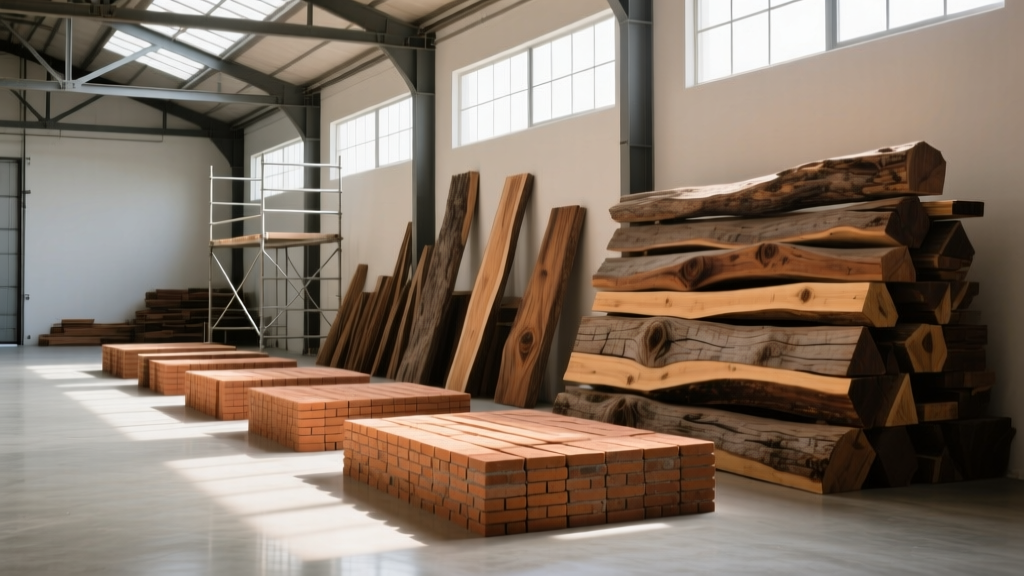
2026 Sourcing Channels: Beyond the Local ReStore
While Habitat for Humanity ReStores remain a staple for DIY thrift, commercial contractors and high-volume builders are utilizing specialized digital marketplaces and municipal deconstruction hubs to secure consistent inventory.
"The days of driving around to three different salvage yards to find matching heart pine are over. In 2026, we use AI-driven inventory aggregators that scan regional deconstruction sites for specific SKUs, board-foot yields, and species before the building even comes down."
— Procurement Director, Mid-Atlantic Sustainable Builders Coalition
- Municipal Building Material Hubs: Cities with strict deconstruction ordinances (such as Portland, OR, and San Antonio, TX) have established centralized sorting facilities. These hubs process C&D waste into graded, clean thrift inventory, often selling directly to contractors at 20% below market rate to incentivize local reuse.
- B2B Digital Salvage Marketplaces: Platforms like Rheaply and specialized architectural salvage exchanges allow contractors to purchase bulk lots of surplus materials—such as over-ordered acoustic ceiling tiles, unused insulation batts, and surplus structural steel—directly from corporate real estate portfolios and liquidated job sites.
- Pre-Demolition Audits: Forward-thinking general contractors are now writing "pre-demolition salvage audits" into their subcontracts. This allows the GC to catalog and extract high-value thrift materials (like solid core doors, terrazzo tiles, and cast-iron plumbing fixtures) before the demolition crew begins wrecking the interior.
True Cost Analysis: New vs. Thrifted Materials
Building material thrift is often mistakenly assumed to be universally cheaper. While the raw acquisition cost is lower, the preparation labor (de-nailing, cleaning, milling, and testing) can invert the savings. Below is a comparative cost breakdown for a 2,500 sq. ft. residential build utilizing thrifted vs. new materials in 2026.
| Material Scope | New Material Cost | Thrifted Acquisition | Prep & Milling Labor | Total Installed Cost |
|---|---|---|---|---|
| Flooring (Oak Hardwood, 1,500 sq ft) | $12,750 | $3,000 | $4,500 | $7,500 (41% Savings) |
| Exterior Veneer (Clay Brick, 1,000 sq ft) | $9,500 | $2,500 | $3,200 (Mortar cleaning) | $5,700 (40% Savings) |
| Structural Beams (Glulam vs. Salvaged Timber) | $8,200 | $4,000 | $5,500 (Grading & Milling) | $9,500 (15% Premium) |
The Hidden Cost of Dimensional Variance
When utilizing thrifted framing lumber or masonry, contractors must account for dimensional variance. New 2x4s are uniformly 1.5" x 3.5". Salvaged framing from the mid-20th century may be true-dimension (2" x 4") or vary by an eighth of an inch due to historical milling standards. This variance requires additional labor during the drywall and sheathing phases to shim and plane surfaces, ensuring flat walls. Failing to budget for this 10% to 15% labor premium in framing and finishing is the most common reason thrifted structural projects exceed their initial budgets.
Strategic Integration for Modern Builders
Successfully integrating building material thrift into a construction pipeline requires a shift in project scheduling. Unlike ordering new materials from a big-box distributor with a 48-hour lead time, sourcing salvaged inventory requires front-loading the procurement phase. Builders must secure and store thrifted materials during the site-preparation and foundation stages. By treating deconstruction sites as upstream suppliers rather than waste generators, contractors can lock in material costs, hedge against supply chain disruptions, and deliver structures with verifiable, drastically reduced embodied carbon profiles.
Written by
Sarah WhitfieldSarah Whitfield is a chartered quantity surveyor (MRICS) and construction cost analyst with 15 years of experience in material pricing, procurement strategy, and project budgeting. She earned her degree in Construction Management from the University of Reading (UK) and has worked on projects ranging from $2M custom homes to $180M mixed-use developments across North America and Europe. Sarah currently leads cost estimating for BuildMat Insight, maintaining a proprietary database of 4,000+ material price points updated quarterly. She is a frequent contributor to RSMeans cost data panels and has presented at the International Cost Engineering Council (ICEC) congress. Based in Denver, CO, Sarah is an avid trail runner and volunteer mentor for Women in Construction.
More from Sarah Whitfield
View all
Wood & Lumber
What Are the Different Types of Wood? A Builder's Guide
Compare structural softwoods, finish hardwoods, and engineered lumber. Analyze Janka ratings, MOE values, and 2026 pricing for construction.
Aug 4, 2026

Walls & Panels
Steel Framing vs Wood Framing: Corrosion and Moisture Defense
Compare steel framing vs wood framing for moisture resistance. Learn about galvanized coatings, condensation risks, and corrosion protection strategies.
Jul 21, 2026

Stone & Masonry
How to Cut Stone Veneer: Wet Saw vs Grinder Comparison
Compare the best tools for cutting stone veneer. We review wet saws, angle grinders, and chop saws to help you achieve clean, chip-free cuts.
Jul 21, 2026