Understanding the Durability of Building Materials: A Complete Guide
Explore the durability of building materials with our comprehensive guide. Compare lifespans, failure modes, and advanced treatments for lasting structures.
Beyond Compressive Strength: Defining True Material Longevity
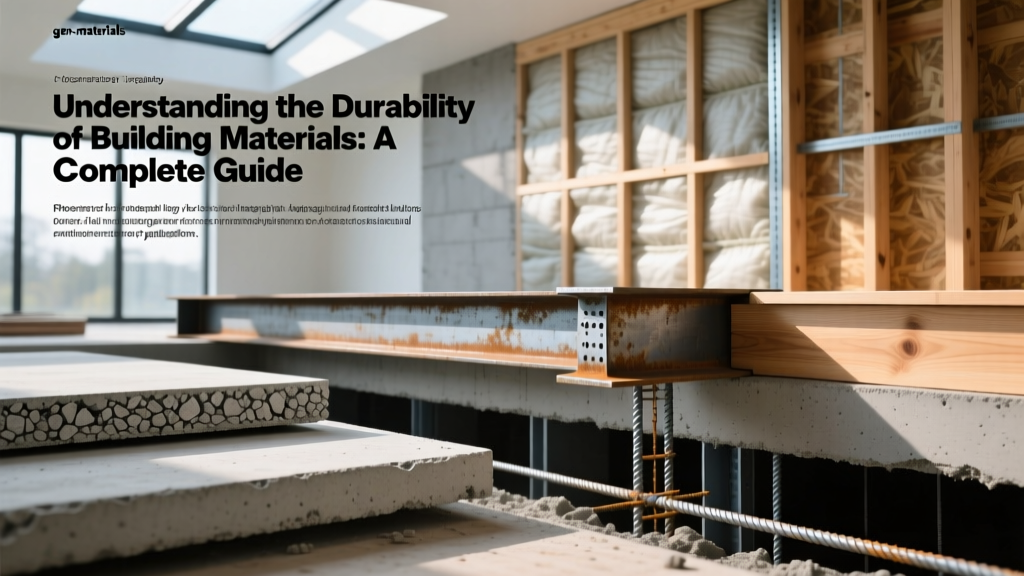
When specifying components for commercial and residential projects, architects and engineers frequently conflate structural strength with environmental resilience. However, the durability of building materials is an entirely distinct metric. While compressive strength measures a material's capacity to bear axial loads before fracturing, durability dictates its ability to resist chemical, thermal, and biological degradation over a 50- to 100-year design life. A concrete mix might achieve 5,000 psi at 28 days, yet fail catastrophically in a decade due to chloride-induced rebar corrosion if the water-cement ratio and air-entrainment parameters are poorly calibrated.
Evaluating longevity requires a rigorous understanding of material science, environmental stressors, and predictive life-cycle modeling. This guide dissects the specific failure modes of primary structural and envelope materials, providing actionable specifications to maximize service life and minimize long-term maintenance expenditures.
Lifespan Comparison Matrix: Structural vs. Envelope Materials
The following matrix outlines the expected service life, primary degradation vectors, and required mitigation strategies for common building materials under standard North American environmental conditions. These estimates assume proper installation and adherence to manufacturer maintenance protocols.
| Material Class | Expected Lifespan | Primary Failure Mode | Specification & Mitigation Strategy |
|---|---|---|---|
| Cast-in-Place Concrete | 75 - 100+ years | Chloride ingress, freeze-thaw spalling, carbonation | Limit w/c ratio to <0.40; specify 4-8% air entrainment (ASTM C260); use epoxy-coated or GFRP rebar. |
| Fiber Cement Siding | 40 - 50 years | Moisture wicking at unsealed joints, freeze-thaw delamination | Mandate factory-applied acrylic finishes; maintain 1/4-inch expansion gaps; seal all field cuts. |
| Acetylated Wood (e.g., Accoya) | 50 years (above ground) | Fungal decay, dimensional swelling/shrinking | Acetylation modifies cell walls, reducing moisture uptake by 80%. Use stainless steel fasteners to prevent tannin staining. |
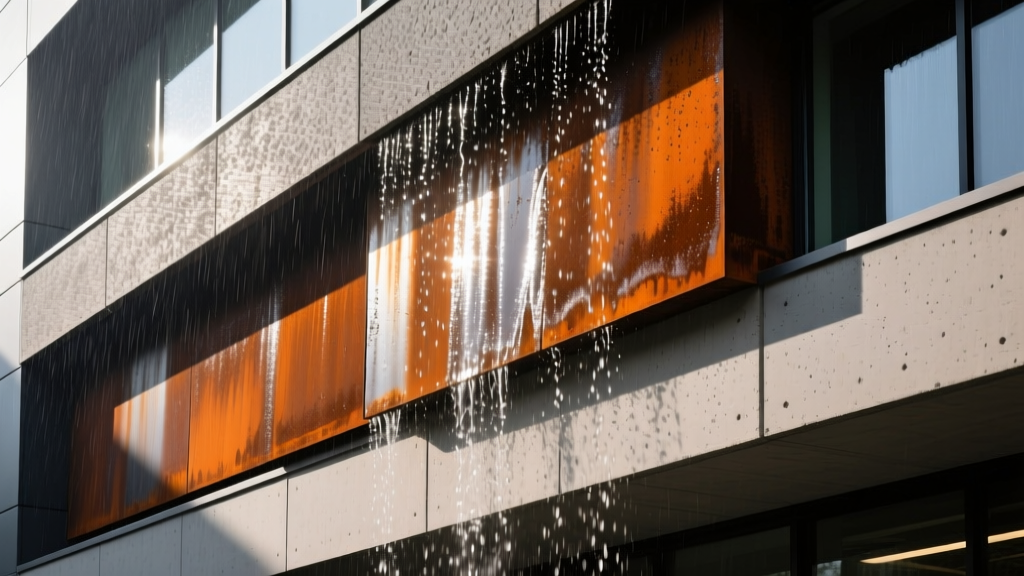
| Weathering Steel (ASTM A588) | 60+ years | Excessive runoff staining, pitting in salt traps | Design for continuous drainage; avoid horizontal ledges; do not use in highly saline coastal zones without sealants. |
Environmental Stressors and Material Degradation Pathways
Material degradation is rarely the result of a single factor; it is typically a synergistic process where multiple environmental stressors accelerate chemical and physical breakdown. Understanding these pathways is essential for selecting the correct protective treatments.
Moisture and Freeze-Thaw Cycles
Water is the universal solvent and the primary catalyst for building material failure. When water trapped in the capillary pores of masonry or concrete freezes, it expands by approximately 9%. This expansion generates internal hydraulic pressures that exceed the tensile strength of the matrix, causing micro-cracking and eventual spalling. To mitigate this in concrete, air-entraining admixtures are used to create a microscopic network of disconnected voids (typically 4% to 8% by volume). These voids act as pressure relief valves during the freezing process, a mechanism rigorously tested under ASTM C666 standards.
For porous masonry and natural stone, the application of silane or siloxane penetrating sealers is critical. Unlike film-forming coatings (like acrylics or urethanes) that trap moisture inside the wall assembly and cause spalling when heated by the sun, silane molecules are small enough to penetrate 1/4 to 1/2 inch into the substrate. They react chemically with the silica in the masonry to create a hydrophobic barrier that repels liquid water while allowing water vapor to escape.
UV Radiation and Thermal Expansion
Ultraviolet radiation breaks down the polymer chains in organic building materials, leading to chalking, embrittlement, and color fading. According to research published by the USDA Forest Products Laboratory, unprotected wood surfaces can degrade at a rate of 1/4 inch per century solely due to UV and weathering, compromising the adhesion of subsequent paint layers. For exterior polymers, PVC, and composite claddings, specifying formulations with high concentrations of titanium dioxide (TiO2) and hindered amine light stabilizers (HALS) is mandatory to pass accelerated weathering tests like ASTM G154.
Galvanic and Crevice Corrosion in Metals
When two dissimilar metals are in electrical contact in the presence of an electrolyte (such as rainwater or coastal humidity), galvanic corrosion occurs. The less noble metal (anode) corrodes rapidly to protect the more noble metal (cathode). For instance, using untreated carbon steel fasteners to secure aluminum or copper flashing will result in the fasteners dissolving within a few seasons. Always isolate dissimilar metals using dielectric unions, neoprene gaskets, or heavy-duty polymer coatings.
Advanced Material Treatments and Upgrades
Baseline materials often require chemical or metallurgical upgrades to meet the demands of aggressive environments. Budgeting for these treatments during the design phase yields exponential returns in reduced lifecycle costs.
- Hot-Dip Galvanizing (ASTM A123): Submerging fabricated steel in molten zinc (approx. 840°F) creates a metallurgical bond. For structural members over 3/8 inch thick, specify a minimum coating thickness of 3.5 mils. This provides both a physical barrier and cathodic protection, where the zinc sacrifices itself if the coating is scratched.
- Acetylation of Timber: The acetylation process reacts wood cell walls with acetic anhydride, replacing hydroxyl groups with acetyl groups. This drastically reduces the wood's equilibrium moisture content, rendering it indigestible to decay fungi and highly dimensionally stable. Products like Accoya carry a 50-year above-ground warranty, bridging the gap between natural timber and synthetic composites.
- Slag and Fly Ash Supplementation: Replacing 30% to 50% of Portland cement in a concrete mix with supplementary cementitious materials (SCMs) like ground granulated blast-furnace slag (GGBFS) or Class F fly ash significantly reduces the permeability of the hardened paste. This densification blocks chloride ion penetration, extending the time-to-corrosion for embedded steel rebar by decades.
Life Cycle Cost Analysis (LCCA) Framework
Selecting materials based solely on initial capital expenditure is a fundamental error in construction economics. The National Institute of Standards and Technology (NIST) promotes the use of the Building for Environmental and Economic Sustainability (BEES) software and standard LCCA frameworks to evaluate true costs. An LCCA calculates the present value of all costs associated with a material over its study period, including initial purchase, installation, scheduled maintenance, unscheduled repairs, and end-of-life disposal.
For example, a commercial roofing project might compare a standard EPDM membrane (initial cost: $6.50/sq ft, lifespan: 20 years) against a TPO membrane with reinforced scrim (initial cost: $9.00/sq ft, lifespan: 30+ years). While the TPO system requires a 38% higher upfront investment, the elimination of a full tear-off and replacement cycle at year 20, combined with higher solar reflectance reducing HVAC loads, typically results in a net present value (NPV) savings of 15% to 22% over a 40-year building horizon.
Frequently Asked Questions on Material Lifespans
How does the water-cement ratio affect concrete durability?
The water-cement (w/c) ratio is the single most critical factor in concrete durability. A lower w/c ratio (ideally 0.40 or below) results in a denser, less permeable cement paste. High w/c ratios leave behind a network of capillary pores as excess water evaporates, creating pathways for aggressive chemicals, chlorides, and freeze-thaw moisture to penetrate the matrix and attack the reinforcing steel.
Can pressure-treated wood match the durability of tropical hardwoods?
Modern micronized copper azole (MCA) and alkaline copper quaternary (ACQ) pressure treatments force preservatives deep into the sapwood, offering excellent resistance to rot and termites for ground-contact applications. However, they do not improve dimensional stability. Tropical hardwoods like Ipe or Cumaru possess high natural densities and oils that resist both decay and severe warping, making them superior for high-traffic exterior decking where surface checking and splintering are concerns.
What is the most durable cladding for coastal environments?
In highly corrosive marine environments (within 1,500 feet of the surf line), fiber cement boards, marine-grade anodized aluminum (Class I anodic coating), and naturally durable masonry perform best. Avoid standard galvanized steel, untreated wood, and vinyl, which becomes brittle under intense UV and salt spray exposure. All metal fasteners and flashings in these zones must be specified as 316 stainless steel to prevent rapid pitting corrosion.
Written by
Elena RodriguezElena Rodriguez is a civil engineer and technical writer specializing in concrete technology, masonry systems, and ASTM/ACI compliance. She earned her B.S. in Civil Engineering from Texas A&M University and spent a decade at a materials testing laboratory, performing over 2,000 concrete compressive strength tests and masonry prism evaluations. Elena is an ACI-certified Field Testing Technician (Grade I) and a member of ASTM Committee C12 on Natural Building Stone. She currently consults on forensic engineering cases involving concrete failures and moisture intrusion. Based in San Antonio, TX, Elena is a proud member of the Society of Women Engineers (SWE) and coaches her daughter's FIRST Robotics team.
More from Elena Rodriguez
View all
Walls & Panels
Cost Analysis: Light Gauge Steel Framing Advantages and Disadvantages
Evaluate light gauge steel framing advantages and disadvantages through a strict cost analysis lens, comparing material, labor, and lifecycle expenses.
Aug 4, 2026

Walls & Panels
Gypsum Board Types: Exact Specifications, Thickness & Dimensions
Compare standard, Type X, and moisture-resistant gypsum board types. Get exact specifications, thicknesses, dimensions, and ASTM standards for your project.
Aug 4, 2026

Fire Resistance
Best Fire-Resistant Outdoor Decking Materials: 2026 Buyer Guide
Discover the best fire-resistant outdoor decking materials for 2026. Compare Class A PVC, aluminum, and hardwood options for WUI compliance and safety.
Aug 4, 2026