Ceiling Insulation R-Value Specs: Performance Ratings & Top Materials
Compare ceiling insulation performance ratings, R-value specs, and STC data for fiberglass, spray foam, and mineral wool to meet modern building codes.
Decoding Ceiling Insulation Performance Metrics
Selecting the right ceiling insulation requires moving beyond basic thickness measurements and evaluating strict performance specifications. The thermal and acoustic efficiency of a ceiling assembly is governed by three primary metrics: R-value (thermal resistance), U-factor (thermal transmittance), and STC (Sound Transmission Class). While the U.S. Department of Energy defines R-value as the material's resistance to conductive heat flow, real-world performance is heavily dictated by installation tolerances, density, and air permeability.
R-value measures resistance to heat flow (higher is better). U-factor measures the rate of heat transfer (lower is better). They are mathematical inverses (U = 1/R). A ceiling assembly with an R-value of 40 has a U-factor of 0.025. Building codes increasingly reference U-factor for whole-assembly performance because it accounts for thermal bridging through the ceiling joists, which R-value alone ignores.
2026 Building Code Minimums by Climate Zone
The International Energy Conservation Code (IECC) mandates minimum ceiling insulation levels based on climate zones. As of the latest code adoption cycles, the focus has shifted toward continuous insulation and airtightness to mitigate thermal bridging. According to the Pacific Northwest National Laboratory's Building America Solution Center, achieving these targets in vented attics requires precise baffle placement and soffit ventilation management.
| IECC Climate Zone | Minimum Ceiling R-Value | Recommended Assembly Target | Typical US Regions |
|---|---|---|---|
| Zone 1 & 2 | R-38 | R-45 | South FL, Southern TX, HI |
| Zone 3 & 4 | R-49 | R-60 | Pacific Coast, Southeast, Mid-Atlantic |
| Zone 5 & 6 | R-49 to R-60 | R-60+ | Midwest, Northeast, Pacific NW |
| Zone 7 & 8 | R-60 | R-80 | Northern MN, AK, High Altitude CO |
Material Specification Matrix: Top Performers
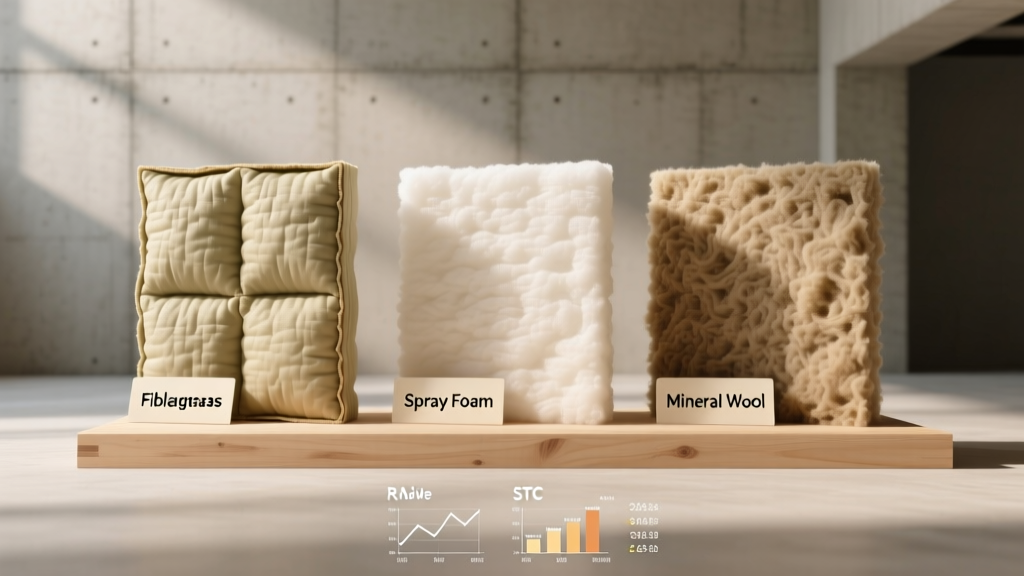
Not all insulation with the same nominal R-value performs identically under dynamic thermal loads. Below is a breakdown of the top-performing materials for ceiling cavities, evaluating density, acoustic ratings, and moisture permeability.
1. High-Density Fiberglass Batts
Reference Product: Owens Corning Pink Next Gen R-49 (15-inch thickness)
Thermal Spec: R-3.27 per inch
Density: 0.8 lbs/ft³
Permeability: High (Requires separate Class I or II vapor retarder in cold climates)
STC Rating: 39 (Standard 2x6 framing with 5/8" drywall)
Fiberglass remains the baseline for ceiling insulation due to its low cost and non-combustible nature. However, its high air permeability makes it highly susceptible to convective heat loss (wind washing) in vented attics. Installation requires meticulous air sealing at the ceiling plane prior to batt placement.
2. Mineral Wool (Stone Wool)
Reference Product: Rockwool Comfortbatt R-42 (12-inch thickness)
Thermal Spec: R-4.22 per inch
Density: 2.5 lbs/ft³
Permeability: Medium-High (Vapor semi-permeable)
STC Rating: 52 (Excellent acoustic dampening)
Mineral wool provides superior dimensional stability. It friction-fits into joist cavities without sagging and maintains its R-value even if slightly compressed. Its dense, fibrous structure excels at blocking low-frequency noise (like HVAC rumble or footfalls from a floor above), making it the premier choice for multi-family residential ceilings or home theaters.
3. Closed-Cell Spray Polyurethane Foam (ccSPF)
Reference Product: Icynene ProSeal
Thermal Spec: R-7.0 per inch
Density: 2.0 lbs/ft³
Permeability: Class II Vapor Retarder at 1.5 inches; Class I at 3+ inches
STC Rating: 44
Closed-cell foam applied directly to the underside of the roof deck (unvented attic assembly) eliminates thermal bridging and provides a monolithic air barrier. At 5 inches thick, it yields R-35 while simultaneously acting as a vapor barrier. The primary drawback is cost and the requirement for professional installation with strict off-gassing curing times.
Real-World Failure Modes & Installation Tolerances
The Federal Trade Commission's R-Value Rule mandates that manufacturers test insulation under ideal laboratory conditions. In the field, ceiling insulation frequently underperforms due to three specific installation failures:
- Compression Derating: Stuffing a 15-inch R-49 fiberglass batt into a 10-inch joist cavity does not yield R-49. The compression increases thermal conductivity, dropping the effective R-value to approximately R-35. Always match batt thickness to cavity depth or use raised heel trusses.
- Wind Washing: In vented attics, air entering through soffit vents can strip heat from the top layer of permeable insulation (like fiberglass). Without rigid foam baffles extending from the soffit past the exterior wall top plate, the effective R-value near the eaves can drop by up to 40%.
- Thermal Bridging: Wood framing accounts for 15% to 20% of a ceiling's surface area. Wood has an R-value of roughly 1.25 per inch. A 2x10 joist acts as a thermal bridge, lowering the whole-assembly U-factor. To mitigate this, install 1 to 2 inches of continuous rigid polyiso insulation below the joists before hanging drywall.
Cost vs. Performance ROI Analysis
When budgeting for ceiling insulation, contractors must weigh the upfront material and labor costs against long-term energy savings and acoustic benefits. The following matrix reflects current national averages for professional installation.
| Material Type | Installed Cost (per sq ft) | Target R-Value Assembly | Estimated Energy Payback |
|---|---|---|---|
| Blown-in Cellulose | $1.80 - $2.40 | R-49 (14 inches) | 3 - 5 Years |
| Fiberglass Batts | $2.10 - $2.80 | R-49 (15 inches) | 4 - 6 Years |
| Mineral Wool Batts | $3.20 - $4.10 | R-42 (12 inches) | 5 - 7 Years |
| Closed-Cell SPF | $4.50 - $6.50 | R-35 (5 inches) | 7 - 10 Years |
Frequently Asked Questions
Can I layer R-38 batts over existing ceiling insulation?
Yes, but you must remove any kraft-faced (paper-backed) vapor retarders from the top layer. Trapping a vapor barrier between two layers of insulation creates an interstitial condensation plane, leading to mold and structural rot. Use unfaced batts or blown-in cellulose for the overlay layer.
Does ceiling insulation require a separate vapor barrier?
In IECC Climate Zones 5 and higher, a Class I or II vapor retarder is required on the warm-in-winter side of the ceiling (typically below the drywall). Paint with a high perm-rating (latex) is often insufficient; use a dedicated polyethylene sheet or a vapor-retarding primer like Sherwin-Williams Sher-Loxane, which achieves a Class II rating.
How do I insulate a ceiling with shallow 2x4 joists?
Standard 2x4 cavities only allow for R-13 to R-15, which fails modern code minimums. To achieve R-38+, you must either furr out the ceiling by adding 2x4s perpendicular to the existing joists (creating a deeper cavity for cross-layering mineral wool) or apply 3 inches of closed-cell spray foam directly to the cavity, supplemented by rigid polyiso board below the joists.