Closed Cell Spray Foam Installation: Pro Procedures and Pitfalls
Master closed cell spray foam installation with pro procedures, exact temperature parameters, pass thickness limits, and critical safety protocols.
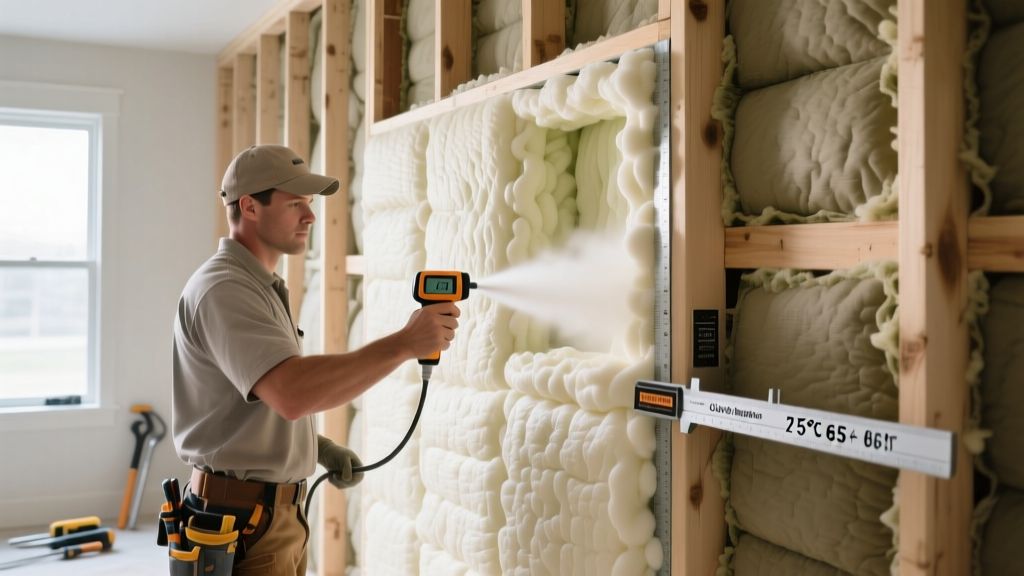
Pre-Application: Substrate and Environmental Parameters
Closed-cell spray polyurethane foam (ccSPF) is a rigid, 2 lb/cu ft density insulation that simultaneously functions as a thermal barrier, air sealant, and Class II vapor retarder. Unlike open-cell variants, the closed-cell structure relies on a highly exothermic chemical reaction between an isocyanate (A-side) and a polyol resin blend (B-side) blown with an HFO or hydrocarbon blowing agent. Proper installation requires strict adherence to environmental thresholds to ensure optimal cell structure and adhesion.
Ambient temperature dictates the chemical reactivity. Standard ccSPF formulations require substrate temperatures between 60°F and 80°F. Winter-grade formulations can be applied at substrate temperatures as low as 15°F, but the B-side resin must be pre-heated to maintain proper viscosity and ensure a complete cross-linking reaction.
Equipment Calibration: Proportioner and Hose Dynamics
The proportioner is the heart of the ccSPF application. For high-volume commercial and residential roof decks, a plural-component proportioner like the Graco Reactor E-30 or AP is standard. The machine must heat the chemicals and maintain precise volumetric ratios to achieve the targeted R-6.5 to R-7.2 per inch performance.
Target Machine Parameters
- Chemical Temperature: 140°F to 160°F (60°C to 71°C) at the proportioner heaters. This reduces viscosity, ensuring optimal impingement mixing at the spray gun.
- Dynamic Pressure: 1,000 to 1,200 psi at the mixing chamber. Pressure drop across a 200-foot hose whip should not exceed 200 psi. If dynamic pressure drops below 800 psi during trigger pull, the impingement mix will fail, resulting in sticky, unreacted foam.
- Volumetric Ratio: Strictly 1:1. Any deviation caused by blocked screens, worn piston seals, or unequal hose heating will yield off-ratio foam that compromises the vapor retarder properties.
Hose management is critical. Use a heated hose bundle with independent temperature zones. If the ambient temperature drops below 50°F, increase the hose heat zone by 5°F to 10°F to compensate for thermal loss over the 200-foot run to the scaffold or attic space.
Application Technique: Managing Exothermic Reaction and Pass Limits
Applying ccSPF is not merely about filling a cavity; it is about managing heat. The reaction between the A and B sides generates significant exothermic heat. Applying too much material in a single pass will cause the core temperature to exceed 400°F, leading to thermal degradation, charring, and potential auto-ignition in extreme cases.
Step-by-Step Spraying Protocol
- The Tack Pass: Apply a thin, 0.5-inch initial pass to the substrate. This creates a mechanical bond and allows the substrate to acclimate to the exothermic heat.
- The First Build Pass: Wait 30 to 60 seconds for the tack pass to cure and off-gas. Apply a second pass up to the maximum thickness limit dictated by the ambient temperature.
- Subsequent Passes: For deeper cavities (e.g., 2x6 roof decks requiring 5.5 inches), allow 2 to 5 minutes between passes to let the foam core dissipate heat. Use an infrared thermometer to monitor surface temperature; do not spray over a surface exceeding 150°F.
| Ambient Temperature | Substrate Temperature | Max Single Pass Thickness | Required Cool-Down Time |
|---|---|---|---|
| Below 40°F (Winter Grade) | 15°F - 40°F | 2.0 inches | 5 - 8 minutes |
| 60°F - 80°F (Standard) | 60°F - 80°F | 3.5 - 4.0 inches | 2 - 3 minutes |
| Above 90°F (Hot Weather) | > 90°F | 2.5 inches | 4 - 6 minutes |
Troubleshooting Matrix: Identifying and Correcting Foam Defects
Even with calibrated equipment, environmental variables can cause defects. Recognizing the visual and tactile signs of failing foam allows for immediate correction before a cavity is completely filled.
| Defect Symptom | Root Cause | Corrective Action |
|---|---|---|
| Shrinkage / Pulling away from studs | Substrate too cold; foam cured too rapidly before expanding fully, or excessive exothermic heat causing post-cure shrinkage. | Increase chemical and hose temperatures by 5°F. Reduce pass thickness. Ensure substrate is above 40°F. |
| Spongy or Sticky Texture | Off-ratio mix (usually B-side rich); low dynamic pressure; inadequate impingement mixing at the gun. | Check proportioner stroke counters. Clean gun impingement port. Verify dynamic pressure is above 1,000 psi. |
| Dark Brown / Charred Core | Thermal degradation from applying passes too thick or failing to allow cool-down time between layers. | Stop application. Remove charred foam (it lacks structural integrity). Resume with thinner passes and longer cool-down intervals. |
| Friable, Crumbly Surface | A-side rich mix; moisture contamination on substrate reacting with isocyanate. | Verify substrate moisture content. Check A-side heater temperature and pump seals. |
Respiratory Protection and MDI Exposure Limits
The A-side isocyanate (typically MDI - methylene diphenyl diisocyanate) is a potent respiratory sensitizer. Standard N95 or half-face cartridge respirators are entirely insufficient for the aerosolized isocyanate mists generated during high-pressure airless spraying.
- Supplied Air Respirators (SAR): For interior applications, confined spaces, or high-volume roof deck spraying, a Type CE supplied-air respirator is the industry gold standard. This provides positive pressure clean air from an external compressor.
- Powered Air-Purifying Respirators (PAPR): For well-ventilated exterior applications or retrofit jobs where SAR hoses are impractical, a PAPR with an Assigned Protection Factor (APF) of 25 or greater and organic vapor/acid gas cartridges is required. Cartridges must be changed every 4 hours or immediately if breakthrough odor is detected.
- Skin and Eye Protection: Uncured isocyanates readily absorb through the skin. Installers must wear chemical-resistant suits (e.g., Tyvek with taped seams), nitrile gloves, and full-face shields.
According to guidelines published by the Spray Polyurethane Foam Alliance (SPFA), re-entry times for unprotected occupants and workers without PPE typically range from 24 to 72 hours post-application, depending on the specific product formulation and HVAC ventilation rates.
Post-Application: Code-Compliant Ignition and Thermal Barriers
Once the ccSPF has fully cured (typically within 24 hours), the installation is not complete until code-mandated fire protection is addressed. According to the U.S. Department of Energy and International Residential Code (IRC) Section R316, exposed spray foam in living spaces or unvented attics requires a thermal or ignition barrier.
While ccSPF has a Class I flame spread rating (ASTM E84), it will melt and release toxic gases when exposed to sustained structural fire temperatures.
Approved Barrier Solutions
- Prescriptive Thermal Barriers: 1/2-inch gypsum wallboard (drywall) is the standard prescriptive thermal barrier. This provides the required 15-minute fire resistance rating.
- Intumescent Coatings (Ignition Barriers): For exposed applications like cathedral ceilings or metal buildings, apply a code-listed intumescent paint such as DC315 or Flame Seal. These products must be sprayed to the exact wet-mil thickness specified in their ICC-ES evaluation report (typically 15 to 22 wet mils). Use a wet-mil gauge to verify thickness during application.
- Specialty Assemblies: Certain high-density ccSPF products have passed specific NFPA 285 wall assembly tests, allowing them to be used without additional barriers in specific multi-family or commercial framed assemblies.
As noted by Building Science Corporation, the durability of the air barrier relies heavily on the initial adhesion and the structural rigidity of the ccSPF. Because closed-cell foam adds significant racking strength to wood-framed walls (increasing shear wall capacity by up to 300%), ensuring proper adhesion via the initial tack pass and strict moisture control is not just an energy code requirement, but a structural one.
Mastering closed cell spray foam installation requires treating the chemical reaction as a dynamic industrial process rather than a simple construction task. By strictly monitoring proportioner pressures, respecting exothermic pass limits, and executing code-compliant fire protection, contractors ensure the foam delivers its promised R-value performance and structural longevity.