Rockwool Mineral Fiber Insulation Cost Calculator & 2026 Guide
Calculate your rockwool mineral fiber insulation costs with our 2026 pricing guide. Get exact material, labor, and quantity estimates for your project.
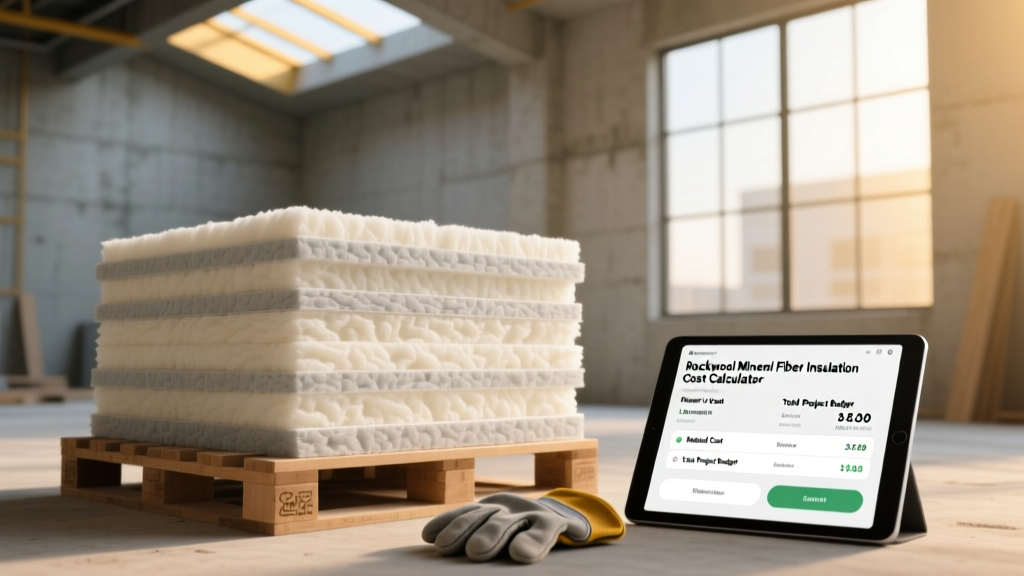
The True Cost of Rockwool Mineral Fiber Insulation in 2026
Estimating the budget for rockwool mineral fiber insulation requires moving beyond basic square-footage multipliers. Unlike standard kraft-faced fiberglass, stone wool commands a 35% to 55% premium in material costs, but it delivers non-combustible fire resistance (withstanding temperatures up to 2,150°F), superior acoustic dampening, and complete moisture resilience. According to the North American Insulation Manufacturers Association (NAIMA), mineral wool's density provides an R-value of roughly 4.2 to 5.0 per inch, making it a staple for high-performance building envelopes.
Material Cost Breakdown by Product Line
To build an accurate calculator framework, you must segment your estimate by specific product lines. ROCKWOOL dominates the North American market with three primary residential and light-commercial SKUs. Below is the 2026 pricing matrix based on national average retail and pro-desk pricing.
| Product Line | Primary Use Case | R-Value / Thickness | 2026 Est. Cost (per sq. ft.) |
|---|---|---|---|
| Comfortbatt | Exterior walls, attics, thermal | R-15 (3.5") / R-23 (5.5") | $0.95 - $1.35 |
| Safe'n'Sound | Interior partitions, soundproofing | STC 45-52 (3" / 2.5") | $0.85 - $1.10 |
| Comfortboard 80 | Exterior continuous insulation | R-6 to R-12 (1.5" - 3") | $1.75 - $2.20 |
Step-by-Step Quantity Calculator Framework
The most common error in mineral wool estimation is applying a blanket 10% waste factor without accounting for stud spacing and cavity geometry. Rockwool mineral fiber insulation is manufactured with a friction-fit design, meaning it must be cut slightly larger than the cavity to compress and hold itself in place without sagging.
- Calculate Gross Wall Area: Multiply total exterior wall length by ceiling height (e.g., 120 linear feet × 9 feet = 1,080 sq. ft.).
- Subtract Openings: Deduct the exact square footage of all windows, doors, and major penetrations. (Assume 15% of gross area for standard residential builds = 162 sq. ft. Net Cavity Area = 918 sq. ft.).
- Determine Stud Spacing Multiplier: For 16-inch on-center (O.C.) framing, order 15-inch wide batts. For 24-inch O.C. framing, order 23-inch wide batts. Do not attempt to rip 23-inch batts to fit 16-inch cavities; the resulting waste will destroy your budget.
- Apply the Geometry Waste Factor: Use the matrix below to adjust your net cavity area before dividing by the bag coverage.
The Waste Factor Matrix
| Wall Geometry Type | Characteristics | Recommended Waste Factor |
|---|---|---|
| Simple Rectilinear | Long, unbroken walls, standard 8-9ft heights | 5% - 7% |
| Moderate Complexity | Multiple windows, standard doors, some corners | 10% - 12% |
| High Complexity | Dormers, vaulted ceilings, bay windows, heavy HVAC runs | 15% - 18% |
Calculation Example: For 918 sq. ft. of net cavity area in a moderately complex home, multiply by 1.12 (12% waste) = 1,028 sq. ft. total required. If one bag of ROCKWOOL Comfortbatt R-15 covers 59.7 sq. ft., you will need exactly 17.2 bags. Round up to 18 bags.
Labor Costs: Professional Installation vs. DIY
Mineral wool is significantly denser than fiberglass. While it does not require the same level of PPE (it is less prone to airborne micro-glass shards), its rigidity makes it physically demanding to cut and maneuver into tight joist bays. The U.S. Department of Energy emphasizes that proper installation without compression or gaps is critical to achieving the rated R-value.
- DIY Installation: $0.00 labor, but factor in $45-$60 for specialized tools (a dedicated mineral wool serrated knife, heavy-duty shears, and an N95 respirator for dust). Expect to install roughly 150-200 sq. ft. per hour if working alone.
- Professional Installation: Insulation contractors typically charge between $1.40 and $2.25 per square foot for labor on mineral wool projects. This premium over fiberglass labor ($1.00-$1.50) accounts for the increased time required to score and snap the dense batts and the physical toll of friction-fitting heavy material overhead in ceilings.
Hidden Costs and Edge Cases
When running your final cost estimate, ensure you have line items for the following ancillary materials required for a code-compliant mineral wool assembly:
- Acoustic Sealant: When using Safe'n'Sound for soundproofing, perimeter gaps must be sealed with an acoustic sealant (e.g., OSI SC-175 or Tremco Acoustical Sealant). Budget $8-$12 per 28oz tube, estimating 1 tube per 150 linear feet of partition framing.
- Vapor Retarders: Rockwool mineral fiber insulation is vapor-permeable. In Climate Zones 5 and higher, you will need to budget for a Class I or II vapor retarder (like 6-mil polyethylene or a smart membrane like Intello) on the interior warm-in-winter side. Expect $0.15 to $0.45 per sq. ft. for membrane materials and specialized tape.
- Thermal Bridging Mitigation: If you are using Comfortbatt in 2x6 framing, wood studs still account for roughly 20% of the wall area, creating thermal bridges. High-performance builds often pair cavity batts with 1.5 inches of Comfortboard 80 on the exterior sheathing. This doubles your material cost but is increasingly mandated by 2024/2026 IECC energy codes in northern climates.
According to the ROCKWOOL Official Product Directory, combining cavity insulation with continuous exterior mineral wool boards not only eliminates thermal bridging but also provides a superior drainage plane and fire-resistant exterior barrier that foam plastics cannot match.
Frequently Asked Questions
Can I use rockwool mineral fiber insulation in direct contact with recessed lighting?
Yes. Unlike some foam insulations or faced fiberglass, mineral wool is non-combustible and can be installed in direct contact with IC-rated (Insulation Contact) recessed lighting cans without creating a fire hazard. However, you must still ensure the lighting fixture is officially rated for insulation contact to prevent the fixture's internal thermal switch from tripping due to trapped ambient heat.
Does mineral wool require a separate air barrier?
Yes. Mineral fiber insulation is highly air-permeable. It provides thermal and acoustic resistance, but it will not stop convective heat loss (drafts). You must pair it with a dedicated air barrier system, such as taped exterior ZIP sheathing, an interior airtight drywall approach (ADA), or a dedicated house wrap, to meet modern blower-door testing standards (typically 3.0 ACH50 or lower).
How do I cut rockwool mineral fiber insulation cleanly?
Do not use a standard utility knife; it will drag and tear the dense fibers. Use a long, serrated bread knife or a specialized mineral wool blade (such as the Wal-Board Co. mineral wool knife). Cut the batt on a flat surface, compressing it slightly with a straight edge, and allow for a 0.5-inch overage on the width to ensure a tight friction fit inside the stud bay.