Brick or Mortar: Selection Guide for Masonry Durability
Learn the golden rule of masonry with our brick or mortar selection guide. Match ASTM mortar types to brick hardness for lasting structural durability.
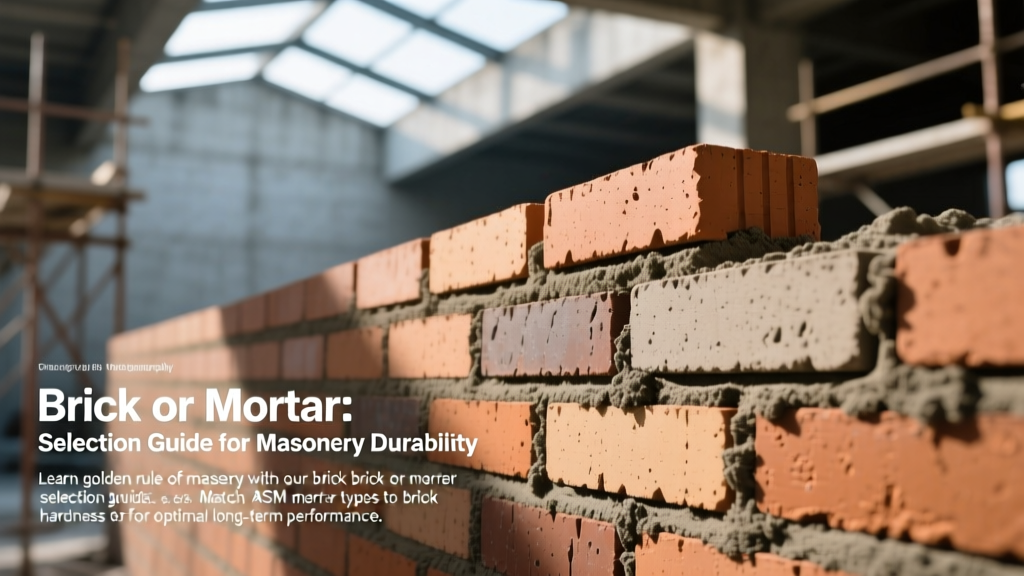
The Golden Rule: Mortar Must Be the Sacrificial Layer
When evaluating a failing masonry wall or specifying materials for a new build, the most critical structural decision is how to balance the brick or mortar to ensure the system breathes, flexes, and sheds water. The foundational principle of masonry engineering is that the mortar joint must always be softer, weaker, and more permeable than the brick unit it binds. Mortar acts as a sacrificial layer; it is far less expensive and significantly easier to repoint a deteriorating mortar joint than it is to replace spalled, cracked, or shattered brick units.
If the mortar possesses a higher compressive strength than the brick, thermal expansion, moisture ingress, and structural settling will force the wall to relieve stress by fracturing the brick itself. This is particularly devastating in freeze-thaw climates, where trapped moisture freezes and expands. A hard, impermeable Portland-cement-heavy mortar traps water inside the brick unit, leading to catastrophic face spalling within just a few winter cycles. According to the Brick Industry Association Technical Notes, selecting the correct mortar type based on the brick's weathering index and compressive strength is the single most important factor in achieving a 100-year masonry lifespan.
ASTM C270 Mortar Selection Matrix
The ASTM C270 standard classifies mortar into five primary types based on compressive strength and material ratios. Selecting the correct type requires matching the mortar's psi to the brick's hardness and the wall's exposure conditions.
| Mortar Type | Compressive Strength (psi) | Volume Ratio (Cement : Lime : Sand) | Best Application | Brick Compatibility |
|---|---|---|---|---|
| Type M | 2,500 | 3 : 1 : 12 | Below-grade foundations, retaining walls, heavy load-bearing | High-strength modern extruded brick only |
| Type S | 1,800 | 1 : 0.5 : 4.5 | At-grade exterior walls, high wind/seismic zones | Modern Severe Weathering (SW) brick |
| Type N | 750 | 1 : 1 : 6 | General exterior above-grade walls, parapets, chimneys | Standard modern brick, soft-burned brick |
| Type O | 350 | 1 : 2 : 9 | Interior non-load-bearing, historic repointing (post-1900) | Historic soft brick, moderate weathering |
| Type K | 75 | 1 : 3 : 12 | Historic preservation, pre-1900 soft lime brick | Extremely soft, low-fire historic brick |
Evaluating Brick Hardness and Weathering Grades
To properly select your mortar, you must first identify the brick's ASTM grade. Modern facing bricks (ASTM C216) and building bricks (ASTM C62) are categorized by their resistance to freeze-thaw cycles:
- Severe Weathering (SW): Designed for direct ground contact and harsh freezing climates. Compressive strength typically exceeds 3,000 psi. Can safely accept Type N or Type S mortar.
- Moderate Weathering (MW): Suitable for exterior walls in milder climates or protected areas. Compressive strength ranges from 2,500 to 3,000 psi. Requires Type N or Type O mortar.
- Negligible Weathering (NW): Interior use only or fully protected veneers. Highly porous and soft. Requires Type O or Type K mortar if used in restoration.
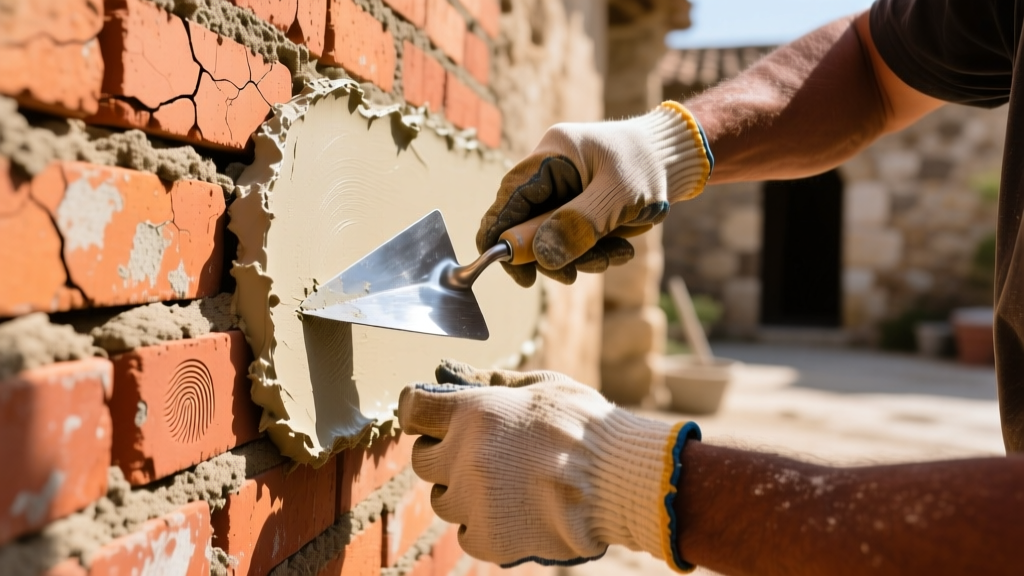
Diagnostic Flowchart: When Brick or Mortar Fails First
Diagnosing an existing wall reveals whether the original brick or mortar selection was flawed. Use this diagnostic framework to identify the root cause of masonry failure before attempting repairs.
Symptom 1: Brick Face Spalling and Shattering
Cause: The mortar is too hard and impermeable (usually a modern Type M or S Portland cement mix applied to older, softer brick). The mortar refuses to yield to thermal movement and traps moisture inside the brick unit.
Fix: Remove the hard mortar using hand tools (never use rotary grinders, which damage the brick arris). Repoint with a breathable, high-lime Type O or Type K mortar to allow the wall to transpire moisture.
Symptom 2: Deep Mortar Joint Erosion (Honeycombing)
Cause: The mortar is too soft for the exposure environment, or the sand-to-binder ratio was improperly mixed on-site. It can also indicate chronic water runoff from missing gutters.
Fix: Address the water management issue first. If the brick is hard (SW grade) and the joint is eroding, repoint with a stronger Type N or Type S mortar, ensuring strict adherence to ASTM C144 sand gradation standards.
Symptom 3: Step Cracking Along Mortar Joints
Cause: Differential foundation settlement or lack of expansion joints in long brick runs. The mortar is actually doing its job by cracking instead of the brick.
Fix: Stabilize the foundation or install retrofit expansion joints. Repoint the step cracks with a flexible, elastomeric masonry sealant or a standard Type N mortar if movement has fully ceased.
Repointing Specifications and 2026 Cost Data
Budgeting for masonry restoration requires understanding the cost delta between standard modern repointing and historic lime-mortar restoration. As of 2026, specialized materials and skilled labor command a premium.
- Standard Type N/S Repointing (Modern Brick): $12 to $18 per square foot. This includes raking joints to a depth of 2 to 2.5 times the joint width, washing, and applying pre-bagged Portland-lime mortar.
- Historic Type O/K Repointing (Pre-1930s Brick): $22 to $35 per square foot. The higher cost reflects the meticulous hand-raking required to avoid damaging soft brick, the use of specialized natural hydraulic lime (NHL 3.5 or 5) or lime putty, and extended curing times requiring wet burlap wrapping.
- Material Costs: Standard Type N pre-mixed bags cost approximately $8 to $12 per 80lb bag (yielding ~1.5 cubic feet). High-purity hydrated lime or imported NHL putty can cost $35 to $60 per equivalent yield, significantly driving up material expenses for historic projects.
The National Park Service Preservation Brief 2 explicitly warns against the use of power tools for raking historic joints and mandates that replacement mortar match the historic mix in both physical properties and visual profile. Ignoring these guidelines to save on labor costs inevitably results in accelerated brick destruction, turning a $15,000 repointing job into a $100,000 brick replacement project within a decade.
Sourcing and Mixing Best Practices
For new construction and major restorations, avoid 'masonry cement' bags that rely on undisclosed proprietary air-entrainment chemicals if you require precise structural control. Instead, specify proportion-specification mixing using individual ingredients:
- Portland Cement (ASTM C150): Type I or II for standard applications. Use Type III only if early freeze protection is required, though this increases shrinkage cracking risks.
- Hydrated Lime (ASTM C207): Type S (Special) hydrated lime is mandatory for masonry. It provides the crucial workability, water retention, and autogenous healing properties that pure Portland cement lacks.
- Masonry Sand (ASTM C144): The sand must be sharp, washed, and properly graded. Avoid overly fine 'brick sand' which requires excess water to achieve workability, leading to severe shrinkage and joint cracking upon curing.
When deciding between prioritizing the brick or mortar in your specification budget, always allocate funds toward testing and matching the mortar. A premium, custom-tinted historic brick will be destroyed in five years by a $5 bag of gray Portland cement, while a common utility brick will last a century if bound in a properly engineered, breathable lime matrix.
Written by
Marcus ChenMarcus Chen is a licensed structural engineer (PE) and building materials analyst with over 12 years of experience across residential, commercial, and industrial construction. He holds a Master of Science in Civil Engineering from UC Berkeley and spent six years at Thornton Tomasetti before transitioning to independent consulting and technical writing. Marcus specializes in material selection for seismic-prone regions, concrete reinforcement strategies, and lifecycle cost analysis. His work has been cited by the American Concrete Institute (ACI) and the Structural Engineers Association of California (SEAOC). When he is not on a job site or at his desk, you will find him hiking the Sierra Nevada or restoring a 1920s craftsman bungalow in Oakland, CA.
More from Marcus Chen
View all
Construction Cost
How Much Did the Eiffel Tower Cost to Build?
How much did the Eiffel Tower cost to build in 1889? We adjust for inflation and compare its budget to modern skyscraper construction.
Aug 4, 2026

Fire Resistance
What Is a Fire Resistant Material? Testing & Certification Guide
Discover what is a fire resistant material through ASTM and UL testing. Learn how fire ratings, certifications, and assemblies work in construction.
Aug 4, 2026

Construction Cost
How Much Did the Burj Khalifa Cost to Build?
How much did the Burj Khalifa cost to build? We break down the $1.5B project and extract 5 money-saving strategies for your next build.
Jul 30, 2026