German Schmear Brick Cost Calculator & 2026 Pricing Guide
Calculate your german schmear brick project costs with our 2026 estimator. Discover exact mortar quantities, labor rates, and material pricing per square foot.
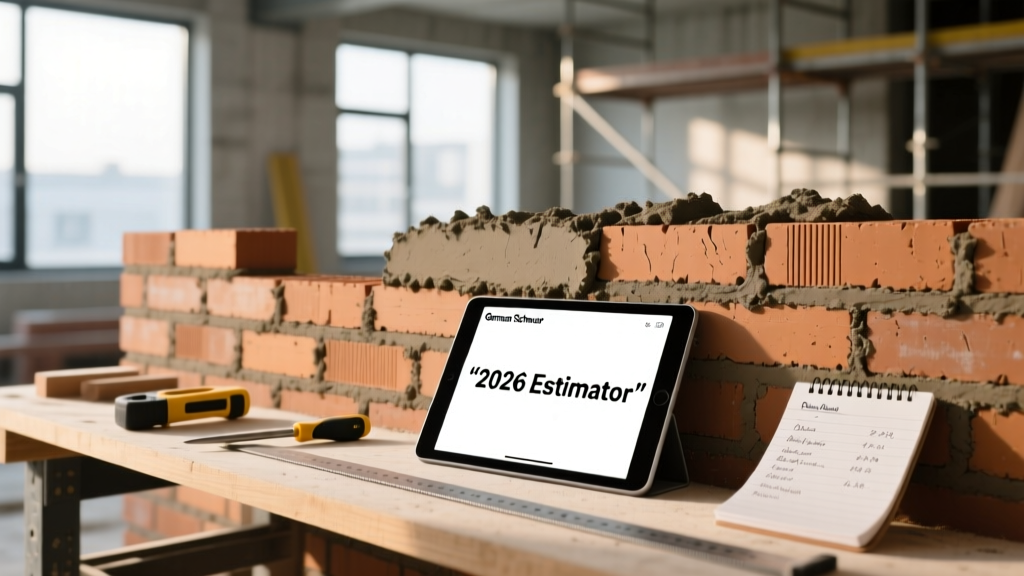
The True Cost of German Schmear Brick in 2026
German schmear brick is a centuries-old masonry technique experiencing a massive resurgence in modern interior and exterior design. Unlike whitewashing (which uses diluted paint) or limewashing (which uses slaked lime and water), a true German schmear relies on a Portland cement and lime-based mortar that is aggressively troweled onto the brick and immediately distressed with a damp sponge. This leaves a textured, translucent, and highly durable finish that penetrates the brick pores rather than sitting on the surface.
Because the technique bridges masonry and decorative finishing, estimating costs requires understanding both material yield math and specialized labor rates. In 2026, the national average for a professional German schmear application ranges from $6.50 to $14.00 per square foot, while a DIY approach costs between $0.85 and $1.60 per square foot in materials. Below, we break down the exact quantity calculations, material selections, and hidden substrate costs required to budget this project accurately.
Quick 2026 Cost Summary (Per Square Foot)
- DIY Material Cost: $0.85 - $1.60 / sq ft
- Professional Labor + Materials: $6.50 - $14.00 / sq ft
- Substrate Prep & Cleaning: $0.40 - $1.20 / sq ft
- Average Fireplace Surround (35 sq ft): $225 - $490 (Pro)
- Average Exterior Accent Wall (250 sq ft): $1,625 - $3,500 (Pro)
Material Quantity Calculator: Mortar Yield Math
The most common estimation error in German schmear projects is miscalculating mortar coverage. Standard masonry calculators assume a 3/8-inch mortar joint, but a schmear is a surface application with a variable thickness of 1/16-inch to 1/4-inch, heavily wiped during the distressing phase.
An 80 lb bag of standard Type N mortar mix (such as Quikrete Type N Mortar Mix SKU 110280) yields approximately 0.85 cubic feet of mixed material. Mathematically, 0.85 cubic feet equals 1,468 cubic inches. If applied at a strict 1/8-inch thickness, one bag would theoretically cover 81 square feet. However, real-world application involves significant loss: the porous brick absorbs moisture, and the sponge-wiping process removes 20% to 30% of the material onto drop cloths.
Real-World Coverage Rates
| Application Style | Target Thickness | Real-World Coverage (per 80lb bag) | Estimated Cost per Sq Ft (Material) |
|---|---|---|---|
| Light / Translucent Wash | 1/16" to 1/8" | 65 - 75 sq ft | $0.08 - $0.10 |
| Standard German Schmear | 1/8" to 3/16" | 50 - 60 sq ft | $0.11 - $0.14 |
| Heavy / Opaque Parge | 1/4"+ | 30 - 40 sq ft | $0.16 - $0.22 |
Calculator Rule of Thumb: Take your total square footage, divide by 55 (for a standard finish), and add a 15% waste factor to determine the number of 80 lb bags required.
Critical Substrate Prep & Hidden Costs
Mortar will not adhere to sealed, painted, or heavily soiled brick. Skipping substrate preparation is the leading cause of delamination and premature failure in schmear applications. Budget for the following preparatory steps:
1. The Water Drop Test (Crucial Diagnostic)
Splash a cup of clean water onto the brick. If the water beads up or runs off without darkening the clay within 60 seconds, the brick has been previously sealed or painted. You must budget for chemical stripping or mechanical abrasion (sandblasting), which adds $2.50 to $4.00 per square foot to your project cost. If the water absorbs immediately, the brick is ready for cleaning.
2. Deep Cleaning and Efflorescence Removal
Use a heavy-duty degreaser and masonry cleaner like Krud Kutter or a TSP (Trisodium Phosphate) solution. If white, powdery efflorescence (soluble salts) is present, it must be removed with a diluted muriatic acid wash or a specialized efflorescence remover like Prosoco Sure Klean Vana Trol. Budget $0.40 per square foot for cleaning chemicals and stiff-bristle nylon brushes.
Mortar Selection: Avoiding Catastrophic Spalling
Not all mortar is created equal, and choosing the wrong mix can destroy your brickwork. This is especially critical for exterior applications or historic homes built before 1920.
Never use Type S or Type M mortar on historic, soft-clay brick. These modern mortars have high Portland cement content and compressive strengths exceeding 3,600 PSI. If applied to soft historic brick (which often has a compressive strength of only 1,500 PSI), the rigid mortar will trap moisture inside the brick. During freeze-thaw cycles, the trapped water expands, and because the mortar is harder than the brick, the brick face will literally pop off (spall). For pre-1920s masonry, you must use a soft Type O mortar or a custom lime putty mix. For detailed guidance on matching mortar hardness to historic masonry, refer to the National Park Service Preservation Brief 22 on Repointing Mortar Joints.
2026 Mortar Recommendations by Substrate
- Standard Modern Brick (Interior): Quikrete Type N Mortar Mix (SKU 110280). Excellent balance of workability and adhesion. Cost: ~$6.50 / 80lb bag.
- Exterior Brick (Freeze-Thaw Climates): Type N with a liquid acrylic polymer fortifier (e.g., Quikrete Concrete Acrylic Fortifier) mixed into the water to increase flexural strength and reduce cracking. Adds $0.15 / sq ft.
- Historic / Soft Clay Brick: Custom Type O mix (1 part Portland cement, 2 parts hydrated lime, 9 parts sand) or pre-mixed NHL (Natural Hydraulic Lime) 3.5 mortar. Cost: ~$18.00 / 50lb bag.
Step-by-Step Application & Labor Rates
Professional masonry finishers charge a premium for German schmear because it is an artistic, time-sensitive, two-person process. One mason applies the mortar while a second follows closely behind to wipe and distress it before the Portland cement begins its initial set (usually within 20-30 minutes).
- Pre-Wetting (Crucial): Mist the brick wall with a garden sprayer. Dry brick will suck the moisture out of the mortar instantly, causing it to cure prematurely and crack. Labor impact: 15 mins per 100 sq ft.
- Batching the Mortar: Mix the mortar to a "peanut butter" consistency. It must be wet enough to spread easily but dry enough not to run down the wall. Labor impact: 20 mins per batch.
- The Hawk and Trowel Application: Using a wide margin trowel or a drywall hawk, smear the mortar aggressively over the brick, forcing it into the joints and the porous clay surface. Do not worry about neatness at this stage.
- The Distressing Phase: Within 5 to 15 minutes of application (depending on ambient humidity and temperature), take a large, damp cellulose sponge and wipe the high points of the brick. Leave the mortar deep in the joints and the low-texture areas of the clay.
- Curing and Sealing: Allow 28 days for a full cure. For interior fireplaces, sealing is optional. For exterior walls or high-splash areas (like a kitchen backsplash), apply a breathable, penetrating silane/siloxane sealer like Prosoco Siloxa-Tek 8500. This prevents water intrusion without trapping vapor, adding roughly $0.55 per square foot to the material cost.
Frequently Asked Questions
Can I apply German schmear over painted brick?
No. Mortar requires a porous, mineral substrate to achieve a mechanical bond. If your brick is painted, the mortar will adhere only to the paint film, which will eventually peel away from the brick under the weight and moisture of the cementitious layer. You must chemically strip or sandblast the paint first, or opt for a high-adhesion masonry paint product instead of a true mortar schmear.
How does the cost of German schmear compare to Limewash?
Limewash is generally cheaper in materials ($0.30 to $0.60 per square foot) because slaked lime is less expensive than Portland cement mixes. However, limewash requires multiple coats and a rigorous carbonation curing process. German schmear requires only one thick coat, making the labor time comparable. Ultimately, schmear offers a much thicker, more textured, and durable physical layer, while limewash provides a flat, chalky, and more delicate patina.
Will a German schmear finish turn yellow or dingy over time?
Unlike whitewash (which uses titanium dioxide paint pigments that can yellow when exposed to UV light or nicotine), a true German schmear uses the natural gray/white color of the cement and lime. It will not yellow. However, on exterior applications, it can accumulate dirt and organic growth in the textured pores. This is why applying a breathable, hydrophobic siloxane sealer is highly recommended for exterior projects to maintain the bright, rustic aesthetic.