How to Clean and Seal Every Stone Veneer Texture Type
Learn how to clean, seal, and maintain different stone veneer texture profiles, from split-face to honed, with exact PSI limits and sealer chemistries.
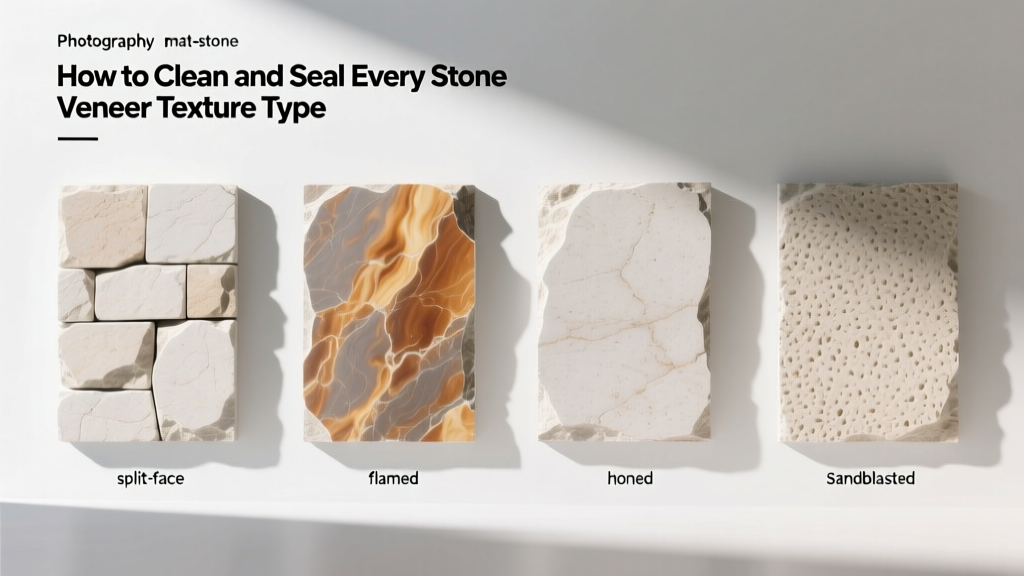
The Hidden Maintenance Trap of Stone Veneer Textures
When selecting stone veneer, the stone veneer texture is usually chosen for its aesthetic appeal—whether it is the rugged depth of split-face, the rustic charm of tumbled cobble, or the sleek finish of honed slate. However, from a maintenance perspective, texture is actually a topographical map that dictates water runoff, dirt accumulation, and biological growth. A deeply clefted surface traps windblown soil and organic matter, while a smooth surface highlights water spots and acid etching.
Applying a single, blanket maintenance approach to all stone veneer textures is a primary cause of premature degradation, efflorescence, and spalling. To preserve the structural integrity and visual depth of your installation, your cleaning tools, pressure washing limits, and sealer chemistries must be precisely matched to the specific texture profile of your veneer.
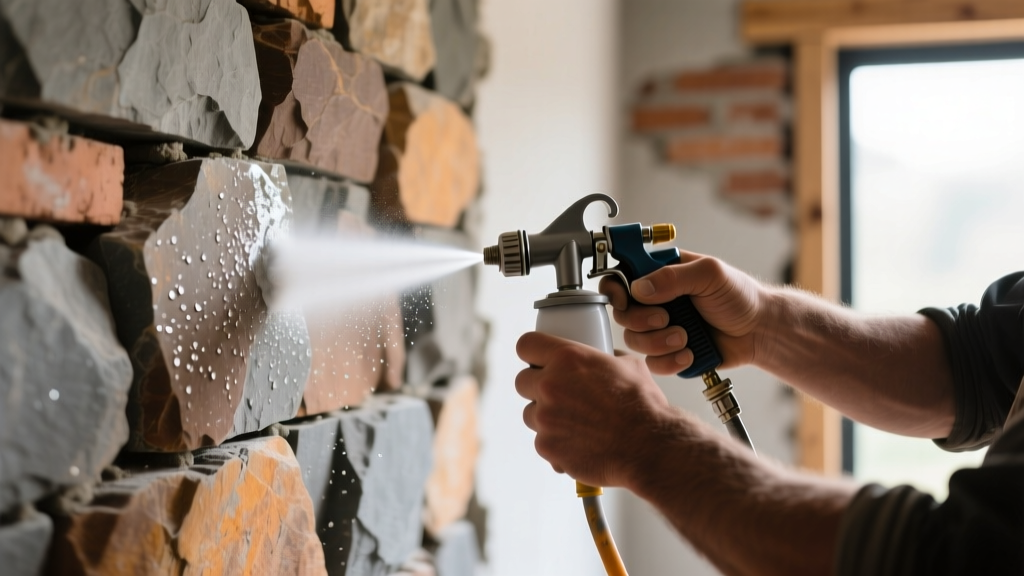
Texture-to-Maintenance Matrix: Know Your Profile
Before mixing a single cleaning solution, identify your veneer's texture profile. The following matrix outlines the mechanical and chemical limits for the four most common stone veneer textures.
| Texture Profile | Cleft Depth | Max Pressure (PSI) | Recommended Brush | Primary Vulnerability |
|---|---|---|---|---|
| Split-Face / Ledge | 1.0 - 3.0 inches | 1,500 PSI (40° tip) | Tampico fiber | Mortar smears in deep crevices; trapped moisture |
| Dry-Stack (Ledgestone) | 0.5 - 1.0 inches | 1,000 PSI (40° tip) | Soft nylon | Dust trapping on horizontal ledges; joint erosion |
| Tumbled / Cobble | 0.25 - 0.5 inches | 1,200 PSI (25° tip) | Medium bristle | Algae rooting in rounded, porous joints |
| Honed / Smooth | 0 inches (Flat) | 800 PSI (Fan tip) | Microfiber cloth | Water spotting, acid etching, and surface scratching |
Cleaning Protocols by Texture Depth
Deep-Cleft and Split-Face Textures
Split-face and heavily textured dry-stack veneers possess deep horizontal shelves that catch airborne pollutants, pollen, and exhaust residue. The most common mistake homeowners make is using high-pressure water to blast these crevices clean. According to guidelines outlined in NPS Preservation Brief 1 on masonry cleaning, excessive pressure forces water past the veneer's mortar joints and into the weather-resistive barrier (WRB) behind the wall, leading to hidden wood rot and mold.
The Oxygen Bleach Method: For deep textures, avoid chlorine bleach entirely. Chlorine leaves behind salt residues that trigger severe efflorescence (white, powdery mineral deposits). Instead, use a powdered oxygen bleach (sodium percarbonate). Mix 1/2 cup of oxygen bleach per gallon of warm water. Apply using a garden pump sprayer, allow it to dwell for 10 to 15 minutes to lift organic stains from the deep clefts, and gently agitate with a Tampico fiber brush before rinsing with a low-pressure garden hose.
Smooth and Honed Textures
Honed slate, marble, or smooth-cut manufactured veneers require an entirely different approach. Because there are no crevices to hide imperfections, water spots and mineral deposits are highly visible. Do not use stiff bristle brushes or abrasive scrubbing pads, which will leave permanent micro-scratches in the honed finish. Clean these surfaces using a pH-neutral stone cleaner (such as Prosoco DailyKlean) applied with a microfiber mop or cloth. Rinse immediately with distilled or deionized water if possible, to prevent hard water minerals from drying on the flat surface.
Selecting the Right Sealer for Your Texture
The stone veneer texture directly dictates which sealer chemistry will perform correctly. Sealers generally fall into two categories: penetrating (below-surface) and film-forming (surface). Applying the wrong type will ruin the texture's appearance and trap destructive moisture.
- Silane/Siloxane Penetrating Sealers: These are the gold standard for split-face and dry-stack textures. The small molecular structure of silane penetrates up to 1/4 inch into the stone's pores, while siloxane seals the mid-level capillaries. They do not alter the natural matte look or tactile feel of the rough texture. Products like Foundation Armor SX5000 or Prosoco SureKlean Weather Seal Siloxane PD allow the deep-textured stone to breathe, letting trapped vapor escape while blocking liquid water ingress.
- Acrylic and Urethane Film-Forming Sealers: These create a physical plastic-like shell on the surface. They are strictly recommended for honed or smooth textures where a 'wet look' or enhanced color is desired. Applying a film-forming sealer to a deep split-face texture is a critical error; it bridges the deep crevices, creates a cloudy white film in the shadows, and traps moisture inside the stone, leading to catastrophic freeze-thaw spalling in colder climates.
- Color-Enhancing Penetrating Sealers: Ideal for tumbled and cobble textures. These use specialized resins that penetrate the stone and permanently darken the material, mimicking the 'wet' look without leaving a surface film. They highlight the natural variances and rounded edges of tumbled stone without filling the deep grout lines with glossy residue.
Biological Growth Removal on High-Profile Textures
Algae, moss, and lichen thrive in the shaded, moisture-retaining microclimates created by deep stone veneer textures. When biological growth roots into the pores of manufactured or natural stone, power washing will only remove the surface layer, leaving the root structure intact to rapidly regrow.
Expert Insight: To permanently eradicate biological growth in deep-cleft textures, apply a quaternary ammonium-based biocide (such as Concrobium Mold Control or a dedicated exterior soft-wash solution). Spray the solution onto the dry stone and allow it to remain without rinsing. The biocide will continue to work at the microscopic level, killing the root structure within the stone's pores over the next 48 to 72 hours. The dead organic matter will naturally weather away with subsequent rainfalls.
Frequently Asked Questions
Can I use muriatic acid to clean mortar off textured manufactured stone?
No. Muriatic acid (hydrochloric acid) is highly corrosive and will chemically burn the Portland cement binder used in manufactured stone veneer. On deep textures like split-face, the acid pools in the lower clefts, eating away the cement and exposing the lightweight aggregates, permanently destroying the stone veneer texture. Always use a specialized, non-acidic masonry cleaner (like Prosoco SureKlean Vana Trol) and a wooden scraping tool to gently chip away mortar smears without scarring the surrounding texture.
How often should deep-texture veneer be resealed?
Penetrating siloxane sealers on exterior split-face or dry-stack veneers typically last 5 to 7 years. However, because deep textures trap more UV-reflecting heat and hold moisture longer than flat surfaces, the sealer on the horizontal ledges may degrade faster than on the vertical faces. Perform the 'splash test' annually: splash a cup of water onto the lowest, most shaded section of the veneer. If the water beads and rolls off, the sealer is intact. If the stone darkens and absorbs the water within 60 seconds, it is time to reapply a fresh coat of penetrating sealer.
Does texture affect the cost of professional sealing?
Yes, significantly. Professional masonry contractors typically charge by the square foot of flat wall area, but deep textures like split-face require up to 40% more sealer material and double the labor time to ensure the chemical is sprayed into every crevice from multiple angles. Expect to pay between $2.50 and $4.00 per square foot for sealing smooth veneer, compared to $4.50 to $7.00 per square foot for heavily textured split-face or ledgestone profiles, according to current 2026 masonry restoration pricing indices. For further technical specifications on manufactured stone installation and care, consult the National Concrete Masonry Association (NCMA) TEK notes.
Written by
Marcus ChenMarcus Chen is a licensed structural engineer (PE) and building materials analyst with over 12 years of experience across residential, commercial, and industrial construction. He holds a Master of Science in Civil Engineering from UC Berkeley and spent six years at Thornton Tomasetti before transitioning to independent consulting and technical writing. Marcus specializes in material selection for seismic-prone regions, concrete reinforcement strategies, and lifecycle cost analysis. His work has been cited by the American Concrete Institute (ACI) and the Structural Engineers Association of California (SEAOC). When he is not on a job site or at his desk, you will find him hiking the Sierra Nevada or restoring a 1920s craftsman bungalow in Oakland, CA.
More from Marcus Chen
View all
Construction Cost
How Much Did the Eiffel Tower Cost to Build?
How much did the Eiffel Tower cost to build in 1889? We adjust for inflation and compare its budget to modern skyscraper construction.
Aug 4, 2026

Fire Resistance
What Is a Fire Resistant Material? Testing & Certification Guide
Discover what is a fire resistant material through ASTM and UL testing. Learn how fire ratings, certifications, and assemblies work in construction.
Aug 4, 2026

Construction Cost
How Much Did the Burj Khalifa Cost to Build?
How much did the Burj Khalifa cost to build? We break down the $1.5B project and extract 5 money-saving strategies for your next build.
Jul 30, 2026