Faux Stone Veneer Exterior Maintenance: Cleaning and Sealing Guide
Learn expert maintenance techniques for your faux stone veneer exterior. Discover safe cleaning methods, sealing schedules, and repair tips to prevent damage.
The Material Science of Faux Stone Vulnerabilities
Architectural Manufactured Stone Veneer (AMSV), commonly referred to as faux stone, is not a solid geological material. It is a composite of Portland cement, lightweight natural aggregates (like pumice or expanded shale), and iron oxide pigments cast in polyurethane molds. While this manufacturing process yields a product with a compressive strength typically ranging from 2,000 to 3,500 psi, it lacks the dense, non-porous crystalline structure of natural granite or quartzite.
Because the color is achieved through surface-applied iron oxide slurries during the casting process, the outer 1/8-inch of a faux stone veneer exterior is highly vulnerable to chemical etching, UV degradation, and abrasive wear. Furthermore, the cementitious matrix is inherently alkaline and porous, making it prone to moisture absorption. When trapped moisture undergoes freeze-thaw cycling, the resulting hydraulic expansion causes spalling—the flaking and peeling of the stone's colored face. Understanding these material limitations is the first step in executing a proper maintenance protocol.
Safe Cleaning Protocols for Manufactured Veneer
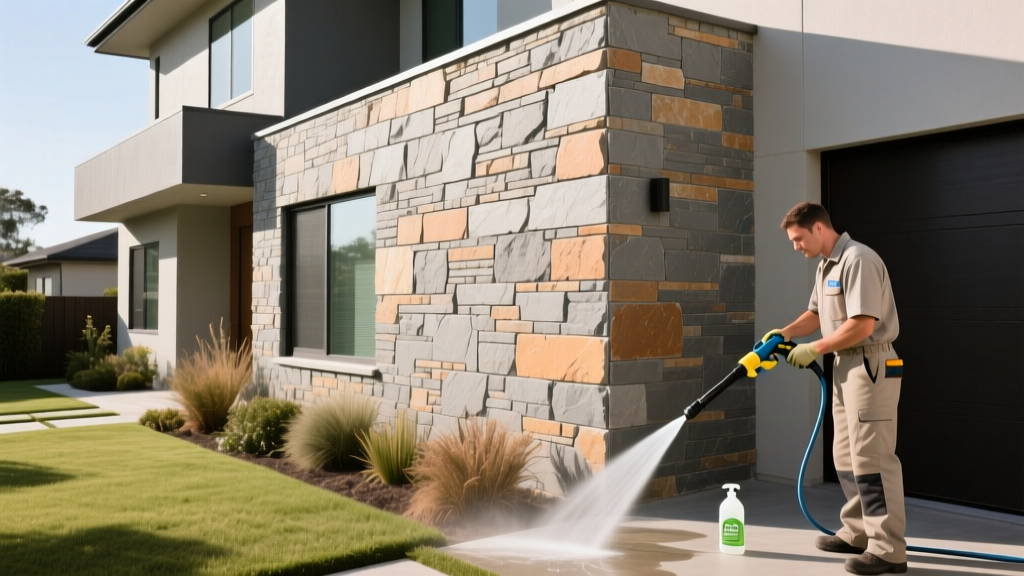
Routine cleaning of a faux stone veneer exterior should occur every 12 to 18 months to remove biological growth (algae, mildew, moss) and atmospheric pollutants. The primary objective is to lift contaminants without stripping the iron oxide pigments or driving water behind the weather-resistant barrier (WRB).
Never use a pressure washer exceeding 1,200 PSI on manufactured stone. High-pressure streams will instantly blast away the colored surface layer, exposing the gray concrete core. Additionally, never use muriatic acid, hydrochloric acid, or unbuffered phosphoric acid cleaners. These acids react violently with the Portland cement, dissolving the binder and permanently bleaching the iron oxide pigments.
Step-by-Step Low-Impact Cleaning Process
- Pre-Wet the Surface: Use a standard garden hose to thoroughly saturate the stone and mortar joints. Pre-wetting prevents the porous concrete from rapidly absorbing the cleaning solution, which could lead to uneven staining.
- Apply Non-Ionic Detergent: Mix a pH-neutral, non-ionic masonry cleaner (such as Prosoco Sure Klean Restoration Cleaner or a diluted solution of Simple Green Oxy Dog) according to manufacturer dilution rates, typically 1:10 with water.
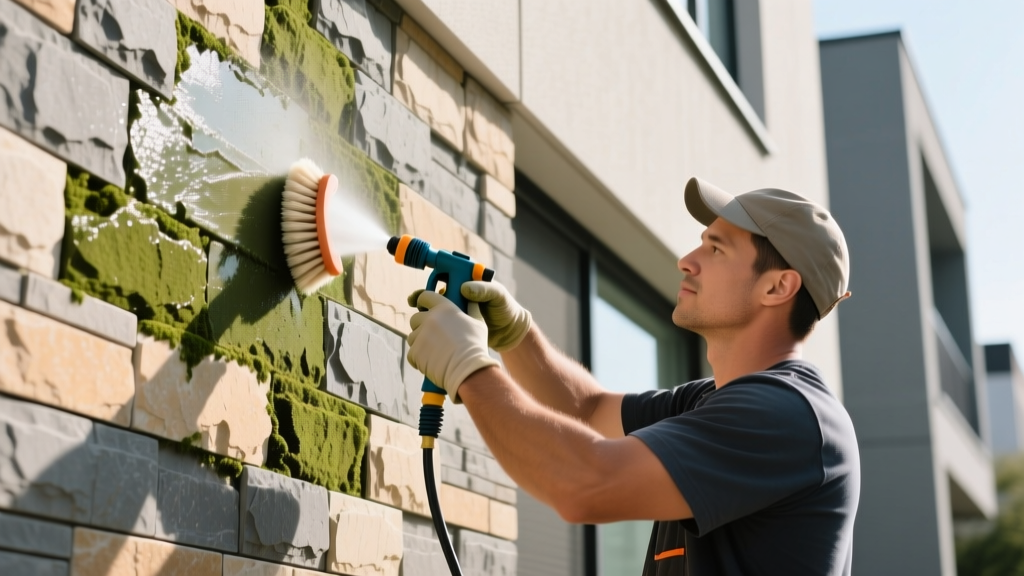
- Agitate with Natural Bristles: Using a natural Tampico bristle brush or a soft nylon brush, agitate the surface in a circular motion. Avoid wire brushes or stiff synthetic bristles, which will leave micro-scratches that trap future dirt.
- Dwell Time: Allow the solution to dwell for 5 to 7 minutes. Do not let the cleaner dry on the surface; mist with water if necessary.
- Low-Pressure Rinse: Rinse using a pressure washer set to a maximum of 1,000 PSI equipped with a 40-degree white fan tip. Maintain a minimum distance of 18 inches from the stone face, spraying at a downward 45-degree angle to prevent water intrusion behind the veneer.
Penetrating Sealers: Protecting Against Freeze-Thaw Spalling
Applying a water-repellent sealer to a faux stone veneer exterior is highly recommended in climates that experience freezing temperatures. However, selecting the wrong chemical formulation will trap moisture inside the wall assembly, accelerating deterioration. According to guidelines from the Masonry Veneer Manufacturers Association (MVMA), only breathable, penetrating sealers should be used on AMSV.
| Sealer Chemistry | Breathability | UV Resistance | Recommendation for AMSV |
|---|---|---|---|
| Acrylic (Film-Forming) | Very Low | Moderate | REJECT: Traps moisture, causes spalling, creates artificial gloss. |
| Polyurethane | Low | High | REJECT: Too rigid for thermal expansion, peels over time. |
| Silane / Siloxane | Very High | Excellent | APPROVED: Penetrates pores, lines capillaries, allows vapor transmission. |
Silane and siloxane sealers react chemically with the alkalis in the Portland cement to form a hydrophobic resin within the pore structure. This prevents liquid water from entering while allowing water vapor from inside the wall cavity to escape. Apply two coats of a high-quality siloxane sealer (such as SX5000 or LastiSeal) using a low-pressure pump sprayer, ensuring the stone is completely dry and ambient temperatures are above 50°F (10°C). Reapplication is typically required every 5 to 7 years.
Troubleshooting Efflorescence and Mortar Degradation
Even with meticulous cleaning, faux stone exteriors can develop structural and aesthetic anomalies. Identifying the root cause is critical before attempting repairs.
Managing Efflorescence
Efflorescence presents as a white, powdery crystalline deposit on the stone face or mortar joints. It occurs when water-soluble salts (calcium hydroxide) within the cement migrate to the surface and react with atmospheric carbon dioxide.
Expert Insight: Do not wash fresh efflorescence with water. Water simply dissolves the salts and drives them back into the pores, guaranteeing the problem will return. Instead, allow the stone to dry completely, then remove the deposits using a stiff, dry nylon brush. For stubborn deposits, use a specialized efflorescence remover formulated with buffered sulfamic acid, followed by an immediate fresh-water rinse.
Mortar Joint Deterioration
The mortar used in faux stone veneer exterior applications must accommodate the thermal expansion and contraction of the lightweight aggregates. If the original installer used a high-strength Type S mortar (common in structural bricklaying), the rigid joints will crack as the veneer moves. Repairs should be executed using a Type N mortar mix, which offers higher flexibility and lower compressive strength, aligning with ASTM C270 standards for non-load-bearing veneer. Rake out cracked joints to a depth of 1/2 inch using a joint raking tool, vacuum the dust, mist with water, and repoint using a grout bag to avoid smearing mortar on the stone face.
Annual Inspection and Seasonal Care Matrix
To maximize the lifespan of your faux stone veneer exterior, implement this seasonal maintenance checklist. Consistent monitoring prevents minor moisture intrusions from escalating into catastrophic wall assembly failures.
- Spring (Post-Thaw): Inspect the bottom 12 inches of the veneer (the weep screed area). Ensure soil, mulch, and landscaping are graded at least 4 inches below the weep screed to prevent ground moisture from wicking into the stone. Clear any debris blocking the weep holes.
- Summer (Peak UV): Check south- and west-facing elevations for UV fading or chalking of the iron oxide pigments. This is the optimal time to perform the low-pressure cleaning and apply siloxane sealers, as the stone requires 48 hours of dry, warm weather to cure properly.
- Fall (Pre-Winterization): Inspect all penetrations (windows, doors, exterior outlets) adjacent to the stone veneer. Recaulk any failing polyurethane sealant at the transition joints between the faux stone and dissimilar materials (like wood trim or vinyl siding) to prevent wind-driven rain from entering the cavity.
- Winter (Freeze-Thaw): Avoid using chemical de-icers (like calcium chloride or rock salt) on adjacent walkways. Salt-laden snow kicked up onto the lower veneer courses will cause rapid chemical degradation and severe spalling. Use clean sand for traction near stone-clad foundations.
Proper maintenance of architectural manufactured stone relies on respecting its composite nature. By avoiding abrasive cleaning, utilizing breathable penetrating sealers, and managing moisture at the weep screed, homeowners can preserve the aesthetic integrity and structural performance of their faux stone veneer exterior for decades.
Written by
David NakamuraDavid Nakamura is a licensed architect (AIA) and construction technology writer focused on sustainable building methods, mass timber engineering, and high-performance building envelopes. He holds a Master of Architecture from the University of Washington and is a certified Passive House Consultant (CPHC). David spent eight years at the Seattle firm Mithun, where he led the design of three LEED Platinum projects, before founding his own practice specializing in net-zero residential design. He serves on the editorial advisory board of GreenBuilder Magazine and has authored peer-reviewed papers on cross-laminated timber (CLT) connections for the Journal of Structural Engineering. In his spare time, David teaches woodworking at Pratt Fine Arts Center and kayaks the Puget Sound.
More from David Nakamura
View all
Construction Cost
Labor Cost to Build a Deck Per Sq Ft: 2026 Installation Guide
Discover the exact labor cost to build a deck per sq ft in 2026. This installation guide breaks down contractor rates, complexity factors, and hidden fees.
Aug 4, 2026

Construction Cost
How Much Does It Cost to Build a 3 Bedroom House? Financing Guide
Learn exactly how much it costs to build a 3 bedroom house and explore 2026 financing options, construction loan types, and budget frameworks for your build.
Aug 4, 2026

Construction Cost
Cost to Build a Tennis Court: 2026 Guide
How much does it cost to build a tennis court in 2026? Breakdowns for asphalt, concrete, and synthetic surfaces plus fencing and lighting.
Jul 30, 2026