Granite Countertop Sealer Taxonomy & Selection Guide
Master granite countertop sealer selection with our material taxonomy guide. Compare fluoropolymers, siloxanes, and enhancers for your specific stone.
The Mineral Taxonomy of Granite and Absorption Rates
Selecting the correct granite countertop sealer begins with understanding that commercial "granite" is a broad geological catch-all. True geological granite consists primarily of quartz and feldspar, but commercial slabs sold as granite frequently include gneiss, granulite, and anorthosite. This mineralogical variance directly dictates the stone's porosity, measured as the water absorption coefficient by weight (CWW).
The Natural Stone Institute categorizes stone porosity to guide maintenance protocols. Dense, dark stones like Zimbabwe Absolute Black possess a CWW of less than 0.05%, meaning their microscopic capillary networks are virtually non-existent. Conversely, lighter, highly feldspathic stones like Kashmir White or Santa Cecilia can exhibit CWW rates exceeding 0.40%. Applying a heavy, oil-based fluoropolymer to ultra-dense black granite will result in surface pooling and hazing, while applying a lightweight, water-based siloxane to highly porous white granite will result in inadequate oil repellency.
Chemical Classification of Granite Countertop Sealers
The market is saturated with marketing jargon, but professional stone fabricators classify sealers strictly by their active resin chemistry and carrier solvent. Understanding this taxonomy is critical for matching the sealer to the stone's specific density.
Siloxane and Silane Impregnators
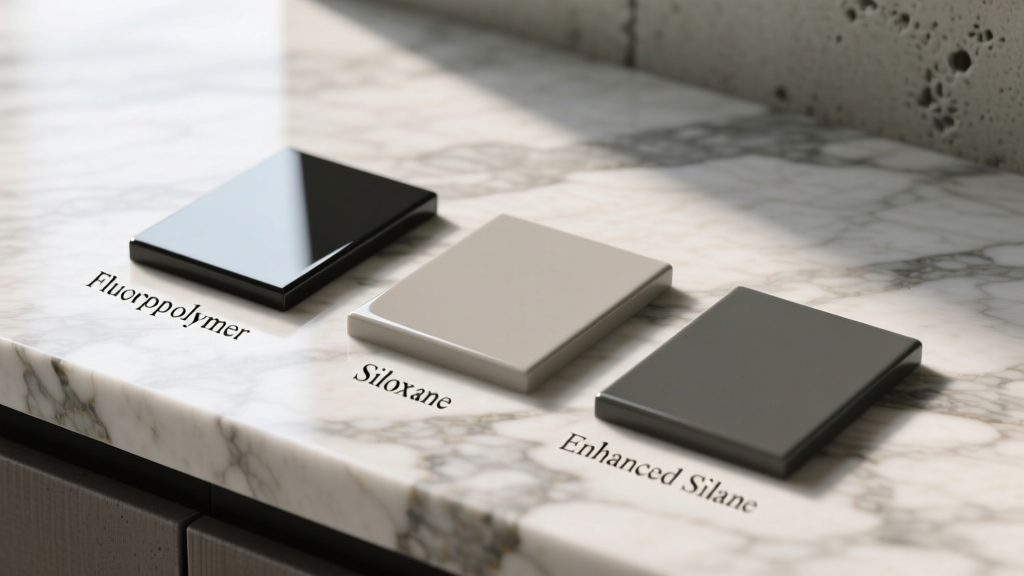
Siloxanes are silicon-based polymers with relatively small molecular structures. Because of their small size, they penetrate deeply into the microscopic pores of dense granites. They are typically carried in water or light petroleum distillates. While they excel at repelling water (hydrophobic), standard siloxanes struggle to repel oil-based stains (lipophobic) unless heavily modified.
Fluoropolymer Impregnators
Fluoropolymers contain fluorine atoms, which alter the surface tension of the stone at a molecular level, making them both hydrophobic and lipophobic (oil-repelling). These molecules are larger and require stronger carrier solvents (like acetone or heavy petroleum distillates) to penetrate the stone. They are the mandatory choice for high-porosity, light-colored granites that are susceptible to cooking oil and grease stains.
Topical Acrylics and Polyurethanes
Topical sealers sit on the surface of the stone, forming a physical plastic film. In modern commercial and residential kitchen applications, topical sealers are universally rejected by stone professionals. They trap moisture beneath the surface, alter the natural slip resistance, scratch easily, and create an unnatural, high-gloss "wet look" that degrades unevenly.
Sealer Chemistry vs. Granite Porosity Matrix
| Granite Classification | Visual Examples | Absorption Rate (CWW) | Recommended Sealer Chemistry | Carrier Solvent |
|---|---|---|---|---|
| Ultra-Dense (Gabbro/Basalt) | Absolute Black, Nero Marquina | < 0.05% | Water-based Siloxane or None | Water |
| Medium Density (True Granite) | Ubatuba, Baltic Brown | 0.10% - 0.25% | Siloxane/Silane Blend | Water / Light Solvent |
| High Porosity (Anorthosite/Gneiss) | Kashmir White, Santa Cecilia | > 0.30% | Fluoropolymer | Petroleum Distillate / Acetone |
| Resin-Filled / Fissured | Blue Bahia, exotic movement | Variable | Enhancing Fluoropolymer | Heavy Solvent |
The 15-Minute Water Absorption Decision Framework
Before purchasing a sealer, perform this standardized field test to determine the exact absorption rate of your installed slab. This eliminates guesswork and prevents chemical incompatibility.
- Preparation: Clean a 12x12 inch area of the countertop with a pH-neutral stone cleaner and allow it to dry completely (minimum 2 hours).
- Application: Pour exactly 2 tablespoons of distilled water onto the surface, forming a puddle approximately 3 inches in diameter.
- Observation (5-Minute Mark): If the water darkens the stone immediately and the puddle shrinks, the stone is highly porous. You require a solvent-based fluoropolymer.
- Observation (10-Minute Mark): If the stone begins to darken slightly at the edges of the puddle, it is medium density. A premium siloxane blend is appropriate.
- Observation (15-Minute Mark): If the water beads perfectly and the stone color remains completely unchanged after 15 minutes, the stone is ultra-dense. It may not require sealing at all, or will only accept a highly volatile, water-based siloxane.
Top Commercial Formulations and Coverage Economics
Professional fabricators rely on specific, proven formulations rather than consumer-grade hardware store brands. Below is an analysis of the industry standards for 2026, including coverage economics.
- StoneTech BulletProof Sealer: A premium, water-based fluoropolymer microemulsion. It offers exceptional oil repellency without the harsh VOCs of solvent-based carriers. Cost: ~$48 per quart. Coverage: 100-150 sq. ft. per quart on medium-porosity stone. Ideal for high-traffic kitchen islands.
- Miracle Sealants 511 Impregnator: A siloxane-based penetrating sealer carried in petroleum distillates. It is the workhorse of the industry for medium-density granites. Cost: ~$32 per quart. Coverage: 150-200 sq. ft. per quart. Excellent water repellency, moderate oil resistance.
- Tenax Ager: An enhancing, solvent-based sealer designed specifically for honed, flamed, or highly fissured exotic granites. It permanently darkens the stone to mimic a "wet" look while providing protection. Cost: ~$65 per liter. Coverage: 80-100 sq. ft. per liter.
Warning: The "Lifetime Warranty" Marketing Myth
Many retail sealers advertise a "lifetime guarantee." In chemical reality, no penetrating sealer lasts forever. Fluoropolymers degrade under UV exposure and alkaline cleaning agents. A realistic lifespan for a premium impregnator in a busy kitchen is 3 to 5 years. Warranties typically cover the cost of the sealer itself, not the labor to strip and reapply it, rendering them practically useless.
Application Physics: Solvent Trapping and Curing Constraints
The most common failure mode in DIY and amateur sealer application is "solvent trapping." This occurs when the surface of the sealer cures and forms a skin before the carrier solvent deep within the stone pores has evaporated. The trapped solvent reflects light, creating a permanent, cloudy white haze that can only be removed by stripping the stone with methylene chloride.
To prevent solvent trapping, adhere to these strict environmental parameters:
- Surface Temperature: Must be between 65°F and 80°F (18°C - 26°C). Cold stone delays solvent evaporation; hot stone causes flash-curing.
- Relative Humidity (RH): Must be below 70%. High ambient moisture prevents water-based carriers from evaporating into the air, forcing them back into the stone matrix.
- Dwell Time: Never allow the sealer to dry on the surface. The standard protocol is to apply, allow 10-15 minutes of dwell time for penetration, and aggressively buff the surface completely dry with microfiber towels before a skin can form.
Food Safety and Regulatory Compliance
Because kitchen countertops are primary food-preparation surfaces, the chemical safety of the cured sealer is paramount. Once fully cured (typically 24 to 72 hours), penetrating sealers are generally considered safe. However, professionals verify compliance with specific regulatory frameworks. According to the FDA's Code of Federal Regulations Title 21 Part 175.300, any resinous or polymeric coating used on food-contact surfaces must meet specific extraction limitations and be composed of approved synthetic resins. When selecting a sealer for commercial kitchens or residential islands, always verify that the manufacturer's Safety Data Sheet (SDS) explicitly states compliance with FDA 21 CFR 175.300 for indirect food additives.
Frequently Asked Questions
Can I use a granite sealer on marble or quartzite?
While fluoropolymers work well on quartzite (which shares a similar density profile to granite), marble is calcium carbonate and highly reactive to acids. Sealers do not prevent acid etching on marble. For marble, an impregnator will stop oil stains, but you must rely on physical barriers (cutting boards, trivets) to prevent acidic etching from citrus or wine.
Why does my sealed granite still darken when water sits on it?
Penetrating sealers are designed to be breathable. They repel oils and slow down water absorption, but they do not create a 100% impermeable plastic barrier. If water is left to pool for an extended period (over 30 minutes), it will eventually bypass the hydrophobic molecular layer and temporarily darken the stone. This is known as "false staining" and will evaporate without leaving a permanent mark.
How do I strip an old, failing topical sealer before applying an impregnator?
You must completely remove the topical film, or the new penetrating sealer will be blocked from entering the pores. Use a dedicated stone stripper containing N-Methyl-2-pyrrolidone (NMP) or a heavy-duty alkaline stripper. Apply, agitate with a white nylon scrub pad (never steel wool, which leaves iron particles that cause rust stains), and extract with a wet vacuum before neutralizing the surface.