Luxury Stone Wood Veneer vs. Exotic Timber: 2026 Comparison Review
Compare luxury stone wood veneer, petrified stone, and exotic timber for 2026 interiors. Explore costs, durability, and installation for feature walls.
The Rise of Luxury Stone Wood Veneer in High-End Design
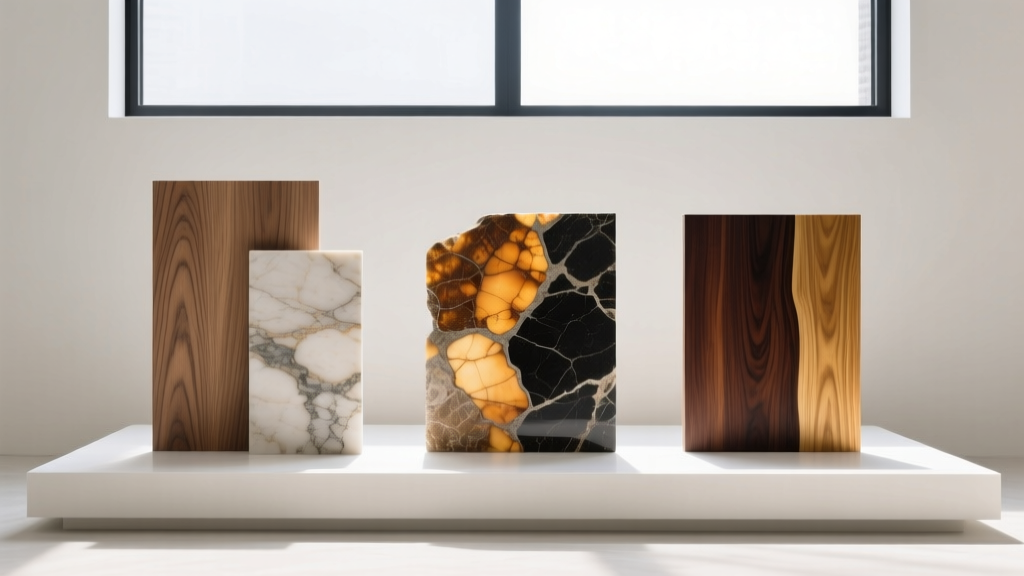
When architects and interior designers specify a luxury stone wood veneer, they are navigating a highly specialized intersection of material science and aesthetics. This category does not refer to a single product, but rather a niche class of architectural finishes that either mimic the organic grain of timber through lithic formations (such as wood-grain quartzite) or utilize actual fossilized timber (petrified wood veneer). In 2026, the demand for these materials has surged in commercial lobbies, luxury hospitality, and high-end residential projects where the warmth of wood is desired, but the fire-rating, moisture resistance, and permanence of stone are strictly required.
This comparison review evaluates the three primary materials that dominate this space: genuine petrified wood stone veneer, wood-grain natural stone, and traditional exotic hardwood veneer. We will analyze their structural properties, 2026 market pricing, installation requirements, and long-term performance to help you make an exact specification for your next project.
Material Breakdown: Stone vs. Timber
1. Petrified Wood Stone Veneer (The True Hybrid)
Petrified wood veneer is created by slicing fossilized timber logs—typically sourced from Indonesia or Madagascar—into ultra-thin sheets using diamond-wire saws. Because the organic material has been entirely replaced by silica and quartz over millions of years, the resulting product is legally and structurally classified as a natural stone. To make it viable for vertical wall applications, the 2mm to 5mm stone slices are epoxy-backed with a fiberglass mesh.
- Weight: 2.5 to 4.0 lbs per square foot (significantly lighter than standard stone slabs).
- Dimensions: Typically sold in modular tiles (e.g., 12" x 24") or custom book-matched panels up to 48" x 96".
- Best Application: High-impact corporate reception desks, elevator cab surrounds, and luxury retail feature walls where unique, one-of-a-kind patterning is paramount.
2. Wood-Grain Quartzite and Sandstone
Certain natural stones exhibit striking linear veining that closely resembles wood grain. Brazilian quartzites (such as Silver Fox or Montauk Black) and specific Indian sandstones are frequently cut into thin veneer panels to replicate the look of reclaimed timber or bark. According to the Natural Stone Institute, quartzite offers exceptional hardness (7 on the Mohs scale), making it highly resistant to scratching and etching compared to marble or limestone.
- Weight: 8.0 to 12.0 lbs per square foot (for 1cm to 2cm thick veneer panels).
- Consistency: Higher visual consistency across large batches compared to petrified wood, allowing for seamless continuous grain across expansive walls.
- Best Application: Large-scale commercial lobbies, exterior cladding in freeze-thaw climates (if properly sealed), and wet-area accent walls.
3. Exotic Hardwood Veneer (The Traditional Benchmark)
Traditional luxury wood veneers, such as Macassar Ebony, Ziricote, or Burl Walnut, remain the benchmark for organic warmth. These are sliced from raw timber to thicknesses of 1/42" or 1/16" and backed with paper or phenolic resin. While they offer unmatched tactile warmth and acoustic dampening, they are bound by strict environmental and physical limitations. The Architectural Woodwork Institute (AWI) mandates strict humidity controls for these materials to prevent delamination and checking.
- Weight: 0.5 to 1.5 lbs per square foot.
- Vulnerabilities: Susceptible to UV fading, moisture swelling, and fire code restrictions in commercial egress paths.
- Best Application: Executive boardrooms, luxury residential libraries, and interior spaces with strict climate control.
Head-to-Head Comparison Matrix
| Feature | Petrified Wood Veneer | Wood-Grain Quartzite | Exotic Hardwood Veneer |
|---|---|---|---|
| Material Class | Natural Stone (Silica) | Natural Stone (Metamorphic) | Organic Timber |
| Fire Rating | Class A (Non-combustible) | Class A (Non-combustible) | Class C (Requires FR treatment) |
| Moisture Tolerance | Excellent (Impervious) | Excellent (Low absorption) | Poor (Prone to warping) |
| UV Resistance | High (No fading) | High (No fading) | Low (Darkens/bleaches over time) |
| Pattern Uniqueness | 100% Unique (Fossilized) | High Variation | Moderate (Book-matched) |
2026 Cost Analysis and Market Pricing
Pricing for luxury architectural finishes varies wildly based on sourcing, fabrication complexity, and substrate preparation. The figures below reflect 2026 North American market averages for material, fabrication, and professional installation.
Petrified Wood Veneer
Material: $150 – $350 / sq. ft.
Installed: $250 – $500 / sq. ft.
Cost Driver: Sourcing fossilized logs and the high breakage rate during diamond-wire slicing. Book-matching large panels requires custom fabrication, pushing costs to the upper limit.
Wood-Grain Quartzite
Material: $60 – $120 / sq. ft.
Installed: $110 – $190 / sq. ft.
Cost Driver: Block extraction from Brazilian quarries and CNC waterjet cutting for precise vein-matching across multiple panels.
Exotic Hardwood Veneer
Material: $25 – $85 / sq. ft.
Installed: $65 – $140 / sq. ft.
Cost Driver: CITES regulations on endangered species (like Ebony) and the labor-intensive process of applying phenolic backings and pressing onto MDF substrates.
Installation & Substrate Requirements
The most common point of failure in luxury veneer installations is improper substrate preparation. Stone and wood react entirely differently to environmental shifts, dictating their installation protocols.
Stone Veneer Installation (Petrified & Quartzite)
Because stone is dimensionally stable but heavy, the substrate must be rigid and free of deflection. For interior vertical applications, 1/2" cement backer board (such as Durock or HardieBacker) is mandatory. Standard drywall is insufficient for wood-grain quartzite due to its weight.
- Adhesive: Use a premium, polymer-modified thin-set mortar meeting ANSI A118.4 or ANSI A118.15 standards. For petrified wood veneer (which is mesh-backed and lighter), a high-strength, non-sag epoxy adhesive is often preferred to prevent bleed-through and ensure immediate grab on vertical surfaces.
- Grouting: Most luxury stone wood veneers are installed with a tight, butt-jested seam (zero grout line) to maintain the illusion of continuous wood grain. Edges must be precisely mitered at 45-degree angles for outside corners.
Wood Veneer Installation
Wood veneer requires a perfectly smooth, porous substrate, typically 3/4" MDF or furniture-grade plywood. The environment must be strictly climate-controlled.
- Adhesive: PVA (polyvinyl acetate) wood glue applied via a mechanical press, or solvent-based contact cement for site-applied architectural millwork.
- Climate Acclimation: Per AWI standards, the wood veneer and substrate must acclimate in the installation space for a minimum of 72 hours at a relative humidity (RH) of 35% to 55% and a temperature of 70°F. Failure to acclimate will result in telegraphing (where the substrate grain shows through the veneer) or edge lifting.
Decision Framework: Which Material Fits Your Project?
Selecting the right luxury stone wood veneer or alternative depends entirely on the environmental and regulatory constraints of your specific build.
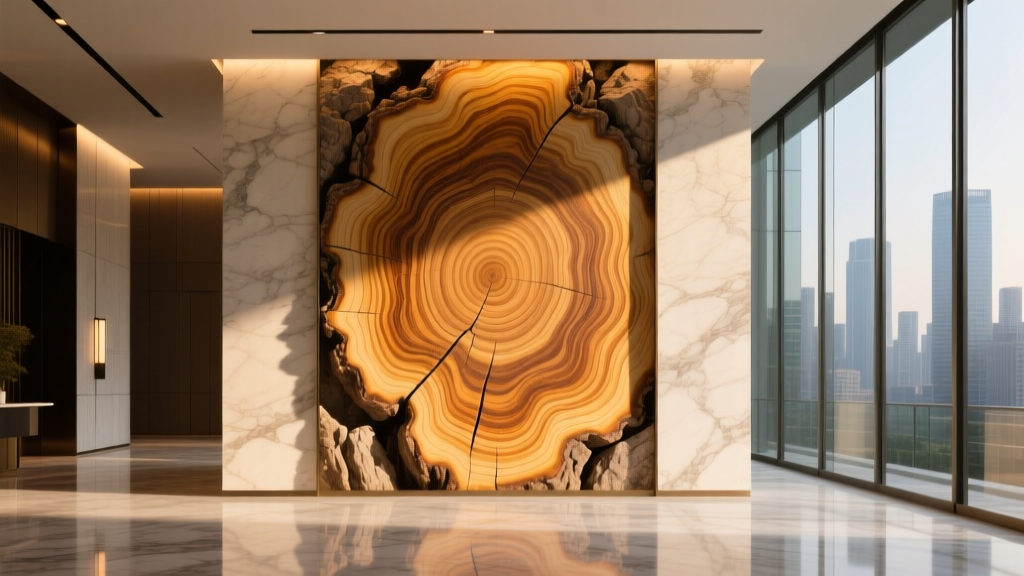
- Choose Petrified Wood Veneer if: You are designing a luxury hospitality space or corporate lobby where budget is secondary to visual impact. It is ideal for curved walls (the mesh backing allows for slight flexing) and spaces requiring a Class A fire rating without sacrificing the exact visual of timber rings and grain.
- Choose Wood-Grain Quartzite if: The application involves high moisture, exterior cladding, or heavy public traffic. Quartzite provides the linear, directional aesthetic of reclaimed wood but can withstand pressure washing, freeze-thaw cycles, and direct UV exposure without degrading.
- Choose Exotic Hardwood Veneer if: The project is a residential interior, executive boardroom, or acoustic-sensitive space. Wood offers natural sound dampening and tactile warmth that stone simply cannot replicate, provided the space has dedicated HVAC humidity control.
Frequently Asked Questions
Can petrified wood veneer be used in wet areas like showers?
Yes. Because petrified wood is essentially solid quartz and silica, it is impervious to water. However, the epoxy and fiberglass mesh backing must be rated for continuous moisture exposure, and the installation must utilize a waterproof membrane (like Schluter-Kerdi) behind the cement board to protect the wall cavity.
How do I maintain the seal on wood-grain quartzite?
Quartzite is highly dense, but the linear veining can sometimes contain microscopic fissures. Apply a high-quality, impregnating silane/siloxane sealer annually. Avoid topical sealers, which can build up and create a plastic-like sheen that ruins the natural, matte appearance of the "wood" grain.
Is luxury stone wood veneer sustainable?
Petrified wood is a finite, mined resource, though it utilizes fossilized material that is millions of years old and does not contribute to modern deforestation. Wood-grain quartzite is also mined. If LEED certification or FSC (Forest Stewardship Council) compliance is a strict project requirement, traditional FSC-certified hardwood veneers or high-end porcelain wood-look alternatives may score better on specific environmental product declarations (EPDs).
Written by
Elena RodriguezElena Rodriguez is a civil engineer and technical writer specializing in concrete technology, masonry systems, and ASTM/ACI compliance. She earned her B.S. in Civil Engineering from Texas A&M University and spent a decade at a materials testing laboratory, performing over 2,000 concrete compressive strength tests and masonry prism evaluations. Elena is an ACI-certified Field Testing Technician (Grade I) and a member of ASTM Committee C12 on Natural Building Stone. She currently consults on forensic engineering cases involving concrete failures and moisture intrusion. Based in San Antonio, TX, Elena is a proud member of the Society of Women Engineers (SWE) and coaches her daughter's FIRST Robotics team.
More from Elena Rodriguez
View all
Walls & Panels
Cost Analysis: Light Gauge Steel Framing Advantages and Disadvantages
Evaluate light gauge steel framing advantages and disadvantages through a strict cost analysis lens, comparing material, labor, and lifecycle expenses.
Aug 4, 2026

Walls & Panels
Gypsum Board Types: Exact Specifications, Thickness & Dimensions
Compare standard, Type X, and moisture-resistant gypsum board types. Get exact specifications, thicknesses, dimensions, and ASTM standards for your project.
Aug 4, 2026

Fire Resistance
Best Fire-Resistant Outdoor Decking Materials: 2026 Buyer Guide
Discover the best fire-resistant outdoor decking materials for 2026. Compare Class A PVC, aluminum, and hardwood options for WUI compliance and safety.
Aug 4, 2026