Marble Floor Flooring Cost Estimator & Calculator 2026
Calculate exact marble floor flooring costs for 2026. Includes material grades, installation labor, waste factors, and hidden subfloor prep expenses.
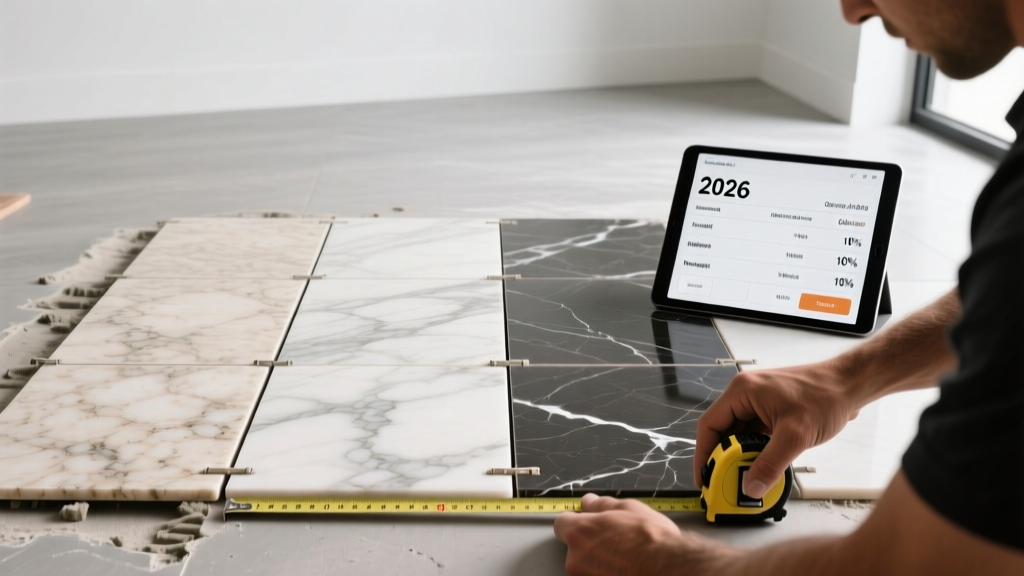
The True Cost of Marble Floor Flooring in 2026
Estimating the budget for natural stone requires moving beyond basic square-footage multiplication. Marble floor flooring represents a premium investment, and the final invoice is heavily influenced by quarry origin, slab grading, structural subfloor requirements, and complex waste factors. In 2026, global supply chain shifts and increased quarrying regulations in Italy and Greece have pushed the baseline cost of premium marble up by approximately 8% compared to previous years. This guide provides a precise, data-driven framework to calculate your exact material and labor expenses, ensuring your project avoids the hidden costs that frequently derail luxury flooring budgets.
Material Cost Matrix: Grade, Origin, and Finish
The price of marble is dictated by its rarity, veining consistency, and structural integrity. Commercial-grade tiles often contain resin fills and mesh backings, while premium grades are solid, unblemished stone. Below is the current 2026 pricing matrix for the most specified marble varieties in residential and commercial construction.
| Marble Variety | Origin | Grade | Cost Per Sq. Ft. (Material Only) | Best Application |
|---|---|---|---|---|
| Carrara White (CD) | Italy | Commercial/Standard | $12 - $22 | High-traffic bathrooms, mudrooms |
| Calacatta Gold | Italy | Premium/First Choice | $150 - $280 | Grand foyers, luxury master suites |
| Statuario Venato | Italy | Premium | $90 - $160 | Feature walls, formal dining rooms |
| Emperador Dark | Spain/Turkey | Standard | $18 - $35 | Library floors, executive offices |
| Crema Marfil | Spain | Commercial/Standard | $14 - $28 | Whole-home open concepts |
Finish Modifiers: Polished finishes are standard and typically carry no upcharge. Honed (matte) finishes usually add $2 to $4 per square foot due to the secondary grinding process. Tumbled or brushed finishes, which require specialized edge distressing, can add $5 to $8 per square foot.
The Quantity Calculator: Factoring in Waste and Cuts
The most common error in stone estimation is ordering exactly the square footage of the room. Marble is a brittle, naturally fissured material. Breakage during transit, cutting around HVAC registers, and the necessity of discarding tiles with undesirable veining or structural weak points require a strict waste factor multiplier.
Waste Factor Calculation Rules
- Standard Grid Layout (Straight Set): Add 10% to total square footage.
- Diagonal Layout (45-degree angle): Add 15% to total square footage due to extensive perimeter cutting.
- Large Format Tiles (24x48 or larger): Add 15% minimum. Large tiles are highly susceptible to snapping on the wet saw.
- Bookmatching / Vein-Matching: Add 25% to 40%. Achieving continuous veining across seams requires purchasing entire bundles and discarding non-matching sections.
Calculator Example: For a 500 sq. ft. foyer using 24x24 Statuario marble in a diagonal layout with vein-matching requirements, the calculation is: 500 sq. ft. + 15% (diagonal) + 20% (vein-matching buffer) = 675 sq. ft. total order quantity. Always order from the same quarry lot number to prevent drastic color variations between batches.
Labor and Installation Estimates
Installing marble floor flooring demands specialized masonry skills. Unlike porcelain, marble requires specific thin-set mortars (typically white, polymer-modified, ANSI A118.4 or A118.15) to prevent staining and shadowing through the stone. Dark marbles like Emperador require gray mortar, while white and light marbles strictly require bright white mortar to avoid darkening the stone's appearance.
Expect to pay between $18 and $35 per square foot for professional installation labor in 2026. This baseline assumes a standard thin-set application over a perfectly prepared substrate. Complex patterns like herringbone or Versailles will push labor costs to the $40–$55 per square foot range due to the increased cutting time and layout precision required.
Hidden Subfloor Preparation Costs
Marble is heavy and highly intolerant of structural deflection. According to the Tile Council of North America (TCNA), natural stone installations require a maximum subfloor deflection rating of L/720, which is twice as rigid as the L/360 standard for ceramic tile. If your floor joists bounce, the marble will crack along the veining.
- Joist Sistering / Reinforcement: $4 to $8 per sq. ft. to stiffen existing floor joists to meet L/720.
- Uncoupling Membranes: Installing a product like Schluter-DITRA adds $2.50 to $4.00 per sq. ft. (material and labor). This membrane absorbs lateral movement and prevents cracks from telegraphing through the marble.
- Self-Leveling Compound: Marble requires a perfectly flat substrate (no more than 1/8-inch variance in 10 feet). Floor leveling adds $3 to $6 per sq. ft.
Maintenance, Sealing, and Long-Term Upkeep
Marble is a calcareous stone, meaning it is highly reactive to acids. Spills of wine, citrus, or vinegar will etch the surface, leaving dull spots that cannot be cleaned away—they must be mechanically polished out. The Natural Stone Institute strongly recommends applying a high-quality impregnating sealer immediately after installation and reapplying every 12 to 18 months in high-traffic zones.
Impregnating sealers do not make marble stain-proof; they make it stain-resistant by buying you time to wipe up spills. They do not prevent etching from acidic substances. For areas prone to acid exposure, specify a honed finish, as etching is far less visible on a matte surface than on a high-gloss polished surface.
Budget an additional $0.75 to $1.50 per square foot for professional sealing post-installation. DIY sealing using products like Miracle Sealants 511 Impregnator costs roughly $0.25 per square foot but requires meticulous application to avoid hazy residue.
Step-by-Step Estimation Workflow
To finalize your budget, follow this sequential estimation workflow:
- Measure Gross Area: Calculate the exact length x width of the space in square feet.
- Apply Waste Multiplier: Multiply the gross area by your layout-specific waste factor (1.10 to 1.40).
- Calculate Material Cost: Multiply the total adjusted square footage by the per-sq. ft. cost of your selected marble grade.
- Add Setting Materials: Budget $2.50 per sq. ft. for white polymer-modified thin-set, unsanded grout (for joints under 1/8-inch), and membrane if required.
- Calculate Labor: Multiply the gross area (not the waste-adjusted area) by the local installation rate ($18 - $35).
- Include Subfloor Prep: Add structural reinforcement and leveling costs based on a contractor's joist inspection.
- Factor in Sealing & Trim: Add professional sealing costs and linear-foot pricing for marble bullnose or Schluter metal edge profiles for exposed transitions.
By systematically addressing the structural prerequisites, precise waste factors, and chemical vulnerabilities of natural stone, you can accurately forecast the true cost of marble floor flooring and ensure a flawless, enduring installation.