Natural vs Manufactured Stone Veneer Around Pool: 2026 Comparison
Compare natural vs manufactured stone veneer around pool decks and coping. Discover 2026 costs, freeze-thaw durability, and installation best practices.
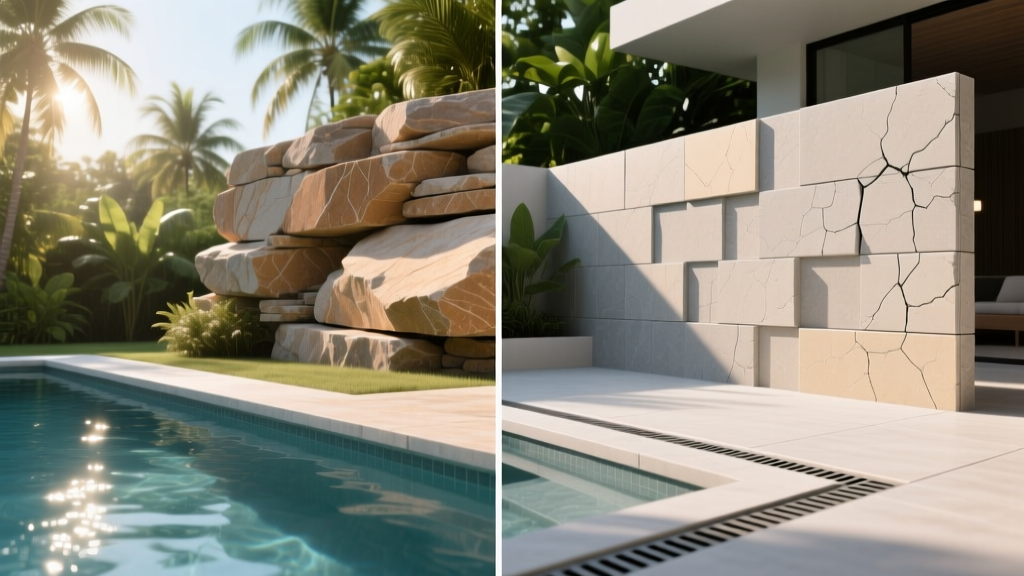
The Poolside Microclimate: Why Standard Masonry Fails
Installing stone veneer around pool environments subjects masonry to a brutal microclimate that standard exterior walls never face. The combination of constant moisture cycling, chemical exposure from chlorinated or saltwater splashing, UV radiation, and freeze-thaw dynamics creates a high-failure zone for improperly specified materials. When evaluating stone veneer around pool coping, waterfalls, and raised bond beams, the primary enemy is not just water, but waterborne chemistry.
Standard Portland cement-based mortars and high-absorption stones will rapidly deteriorate in these conditions. Chlorine gas off-gassing from the pool surface attacks the calcium hydroxide in standard mortars, while saltwater pools introduce chloride ions that corrode underlying steel reinforcements if moisture penetrates the veneer system. To ensure longevity, contractors and homeowners must choose materials based on ASTM absorption standards and pair them with specialized polymer-modified setting materials.
Head-to-Head Matrix: Natural vs. Manufactured Stone
Before selecting a specific stone profile, it is critical to understand the macro-differences between natural stone and Manufactured Stone Veneer (MSV) when applied to poolscapes. The following matrix breaks down the core performance metrics for 2026.
| Metric | Natural Stone (Quartzite/Basalt) | High-Density MSV (ASTM C1670) |
|---|---|---|
| Average Weight | 10 - 15 lbs per sq. ft. | 6 - 9 lbs per sq. ft. |
| Water Absorption Rate | 0.5% - 3.0% (Highly variable) | < 5.0% (Engineered consistency) |
| Chemical Resistance | Excellent (Siliceous stones only) | Good (Requires chemical-resistant sealer) |
| Structural Load on Bond Beam | High (May require structural engineering) | Low (Standard bond beams suffice) |
| Material Cost (2026) | $12.00 - $28.00 / sq. ft. | $7.50 - $14.00 / sq. ft. |
Natural Stone Veneer: The Siliceous Requirement
When specifying natural stone veneer around pool decks and raised walls, the mineral composition of the stone dictates its survival. You must strictly differentiate between siliceous and calcareous stones.
Never install limestone, marble, or standard travertine as vertical veneer in splash zones. These are calcareous stones composed primarily of calcium carbonate. Pool maintenance chemicals (muriatic acid, chlorine tablets) and acidic rain will chemically etch the stone, causing rapid pitting, surface dissolution, and structural weakening.
Top Natural Stone Picks for Pool Environments
- Quartzite: Composed almost entirely of quartz, this stone offers near-zero water absorption (often under 1%) and exceptional resistance to pool chemicals. Its high density makes it virtually impervious to freeze-thaw spalling.
- Basalt: An igneous rock with excellent compressive strength and a modern, dark aesthetic. Basalt handles constant moisture without degrading, though it requires a penetrating silane/siloxane sealer to prevent mineral staining from hard water.
- Dense Slate: While some slates are prone to delamination, high-grade, unfading slate (such as those quarried in Vermont or specific Brazilian deposits) performs exceptionally well when installed with a waterproof membrane backing.
Manufactured Stone Veneer (MSV): The Engineered Alternative
Manufactured Stone Veneer has evolved significantly. Modern MSV is governed by ASTM C1670, which dictates strict requirements for compressive strength, flexural load, and freeze-thaw durability. For pool applications, high-density MSV offers a distinct advantage: weight reduction.
Pool coping and raised spa walls are often built on concrete bond beams that are subject to differential settlement and thermal expansion. The lighter weight of MSV (up to 40% lighter than natural stone) reduces the shear stress on the substrate and the mortar bond, significantly lowering the risk of cracking in seismic zones or expansive soil regions.
Pros and Cons of MSV in Splash Zones
Advantages
- Consistent thickness reduces mortar bed variations.
- Lighter weight eases structural requirements on retaining walls.
- Uniform coloring prevents the 'patchwork' look of natural cleft stone.
- Cost-effective for large perimeter retaining walls.
Disadvantages
- Surface pigmentation can fade under intense, direct UV + chlorine exposure over 10+ years.
- Requires high-quality sealing to prevent efflorescence.
- Lower-end MSV lacks the density to survive northern freeze-thaw cycles.
Installation & Mortar Systems: Where Projects Fail
The most common cause of stone veneer failure around pools is not the stone itself, but the use of traditional Type N or Type S masonry mortar. Standard mortars are highly porous and lack the chemical resistance required for pool environments. When chlorinated water wicks into standard mortar, it expands during freezing or crystallizes as salts, blowing the stone off the wall.
The Modern Poolside Setting Standard
According to technical guidelines from the Pool & Hot Tub Alliance (PHTA), submerged and splash-zone masonry requires specialized setting materials. For vertical stone veneer in pool zones, the industry standard has shifted to polymer-modified thin-set mortars or specialized latex-Portland cement mortars.
- Substrate Preparation: The concrete block or poured wall must be cured, clean, and free of form-release agents. Apply a liquid-applied waterproofing membrane (such as LATICRETE Hydro Ban) to the substrate before installing any metal lath. This prevents water that penetrates the veneer from reaching the structural wall.
- Lath and Scratch Coat: Use a minimum 2.5 lb self-furring galvanized or stainless-steel metal lath. Stainless steel is mandatory within 10 feet of saltwater pools to prevent rust bleeding through the stone joints.
- Adhesive Selection: Use an ANSI A118.15 (Improved Modified Dry-Set Cement Mortar) compliant adhesive for adhering the stone, or a high-performance polymer-modified masonry mortar. Brands like LATICRETE and MAPEI formulate specific mortars that resist chloride ion penetration and constant moisture immersion.
- Jointing and Weeping: Tool all mortar joints to a concave profile to shed water. Crucially, install weep holes at the base of the veneer (just above the pool decking grade) to allow any trapped moisture behind the stone to escape.
2026 Cost Breakdown: Material and Labor
Budgeting for stone veneer around pool projects requires accounting for both the premium materials needed for wet environments and the specialized labor required to install them correctly. Below is the 2026 national average pricing for pool-grade installations.
| Cost Category | Natural Stone (Quartzite/Basalt) | Premium MSV (Pool-Rated) |
|---|---|---|
| Material (Stone Only) | $14.00 - $26.00 / sq. ft. | $8.00 - $15.00 / sq. ft. |
| Setting Materials & Membrane | $3.50 - $5.00 / sq. ft. | $3.50 - $5.00 / sq. ft. |
| Labor (Specialized Masonry) | $18.00 - $30.00 / sq. ft. | $14.00 - $22.00 / sq. ft. |
| Total Installed Cost | $35.50 - $61.00 / sq. ft. | $25.50 - $42.00 / sq. ft. |
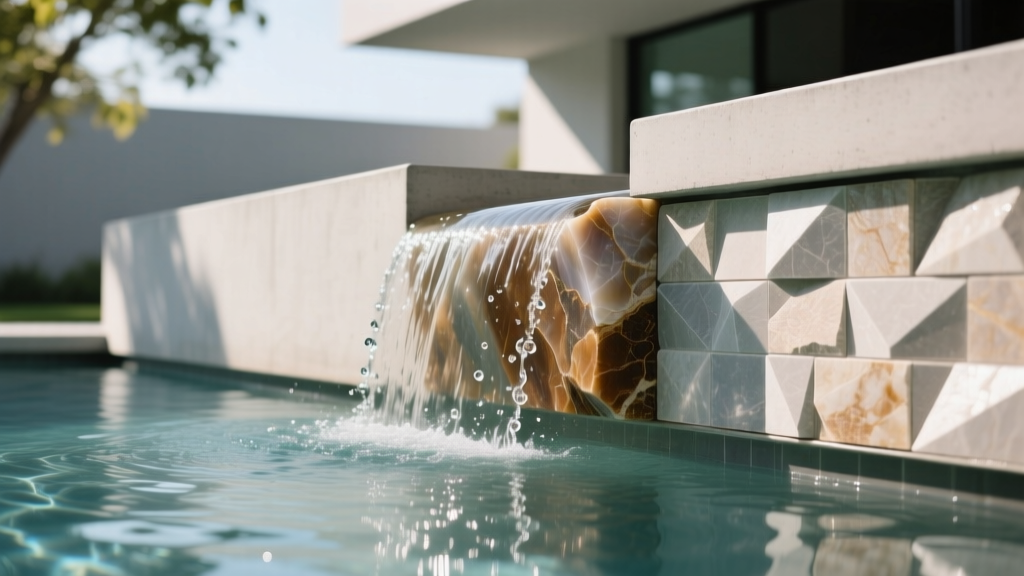
Decision Framework: Which Should You Choose?
Use this practical framework to finalize your material specification based on your specific pool design and environmental factors.
- Choose Natural Quartzite or Basalt if: You are building a saltwater pool, designing a naturalistic waterfall feature where stone will be continuously submerged or heavily splashed, or if the project is located in a region with extreme freeze-thaw cycles (USDA Zones 3-5) where absolute minimum water absorption is critical.
- Choose High-Density MSV if: You are cladding a large perimeter retaining wall or raised spa bond beam where structural weight limits are a concern, if you are working with a tighter budget but still require a high-end aesthetic, or if the veneer is located outside the direct 'splash zone' (more than 4 feet from the water's edge).
Ultimately, the success of stone veneer around pool environments relies less on the visual profile of the stone and more on the rigorous specification of the waterproofing membrane, the chemical resistance of the mortar, and the absorption rate of the masonry unit. Prioritizing these technical metrics over pure aesthetics will ensure the installation survives the harsh poolside microclimate for decades.
Written by
Marcus ChenMarcus Chen is a licensed structural engineer (PE) and building materials analyst with over 12 years of experience across residential, commercial, and industrial construction. He holds a Master of Science in Civil Engineering from UC Berkeley and spent six years at Thornton Tomasetti before transitioning to independent consulting and technical writing. Marcus specializes in material selection for seismic-prone regions, concrete reinforcement strategies, and lifecycle cost analysis. His work has been cited by the American Concrete Institute (ACI) and the Structural Engineers Association of California (SEAOC). When he is not on a job site or at his desk, you will find him hiking the Sierra Nevada or restoring a 1920s craftsman bungalow in Oakland, CA.
More from Marcus Chen
View all
Construction Cost
How Much Did the Eiffel Tower Cost to Build?
How much did the Eiffel Tower cost to build in 1889? We adjust for inflation and compare its budget to modern skyscraper construction.
Aug 4, 2026

Fire Resistance
What Is a Fire Resistant Material? Testing & Certification Guide
Discover what is a fire resistant material through ASTM and UL testing. Learn how fire ratings, certifications, and assemblies work in construction.
Aug 4, 2026

Construction Cost
How Much Did the Burj Khalifa Cost to Build?
How much did the Burj Khalifa cost to build? We break down the $1.5B project and extract 5 money-saving strategies for your next build.
Jul 30, 2026