How Stone Specifications Dictate the Cost of Granite Counters Installed
Analyze how ASTM stone specifications, thickness tolerances, and edge profiles directly impact the total cost of granite counters installed.
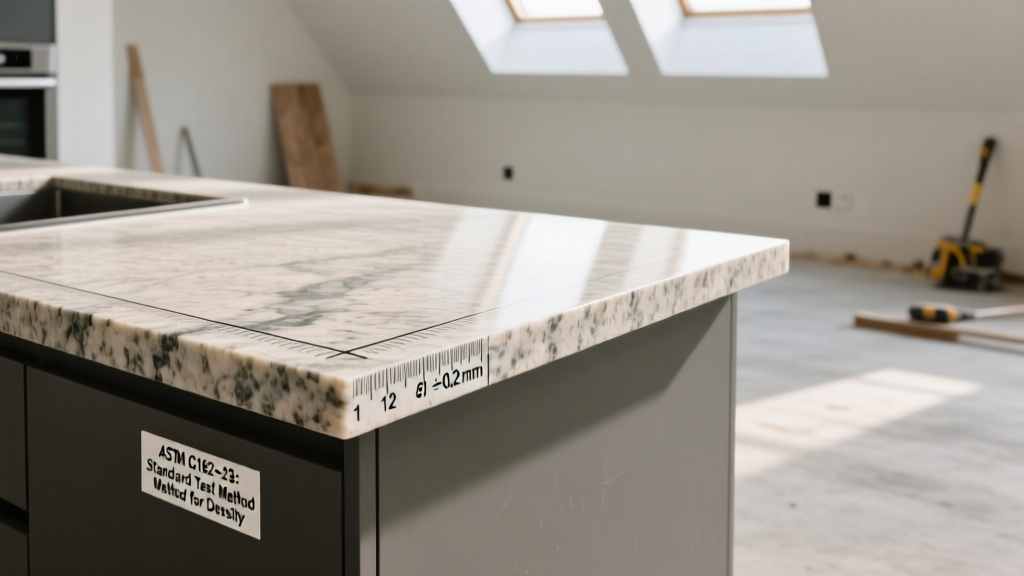
The Intersection of Geological Specs and Final Pricing
When homeowners research the cost of granite counters installed, they typically encounter superficial price ranges based on color or origin. However, from a fabrication and architectural perspective, the final invoice is driven by strict material performance specifications. The mineral composition, dimensional tolerances, and absorption rates of a specific granite slab dictate the machinery wear, labor hours, and specialized adhesives required for installation. Understanding these technical variables is essential for accurately forecasting project budgets and avoiding unexpected change orders during fabrication.
Physical Properties and Fabrication Wear
Granite is an igneous rock primarily composed of quartz, feldspar, and mica. The exact ratio of these minerals determines the stone's Mohs hardness scale rating, which directly impacts fabrication costs. CNC (Computer Numerical Control) routing and diamond-blade cutting are priced not just by linear footage, but by the estimated wear on diamond tooling.
High-Quartz vs. High-Mica Compositions
Quartz rates a 7 on the Mohs scale, while mica rates between 2.5 and 3. Granites with high quartz content (such as Absolute Black or Uba Tuba) are significantly harder to cut and polish. Fabricators must slow down CNC feed rates and replace diamond polishing pads more frequently. This mechanical wear is passed on to the consumer, adding a 10% to 15% fabrication surcharge to high-quartz materials compared to softer, feldspar-heavy stones.
Water Absorption and ASTM C97 Compliance
According to the ASTM C97 standard test method for absorption and bulk specific gravity, high-quality granite should exhibit a water absorption rate of less than 0.4%. Stones that test higher than 0.4% require intensive chemical impregnation prior to installation. If a specified granite fails to meet low-absorption thresholds, fabricators must apply multiple coats of solvent-based sealers in a climate-controlled environment, adding $4 to $8 per square foot in chemical and labor costs to the final installed price.
Dimensional Tolerances: 2cm vs. 3cm Thickness
The nominal thickness of the slab is one of the most critical specifications affecting the cost of granite counters installed. While 2cm (3/4 inch) and 3cm (1 1/4 inch) are the industry standards, their installation methodologies differ drastically.
| Specification | Substrate Requirement | Weight per Sq. Ft. | Impact on Installed Cost |
|---|---|---|---|
| 2cm Thickness | Requires 3/4' plywood sub-deck and built-up edges | ~12.5 lbs | Lower material cost, but +$15-$25/sq ft in carpentry and edge-lamination labor. |
| 3cm Thickness | Can be installed directly on reinforced cabinet frames | ~19.0 lbs | Higher material cost, but eliminates sub-deck carpentry. Requires specialized suction lifters for heavy rigging. |
For 3cm material, the increased weight (nearly 19 lbs per square foot) means a standard 50-square-foot kitchen island top weighs almost 1,000 lbs. This necessitates a three-person installation crew and specialized vacuum lifting equipment, increasing the labor portion of the installation quote by approximately 18% compared to lighter engineered quartz or 2cm natural stone.
Edge Profile Complexity and CNC Machining
The edge profile specification is where material costs transition into heavy machinery costs. A straight polished edge (eased edge) requires minimal CNC passes. Conversely, profiles that require deep undercutting or multi-axis routing exponentially increase machine time.
- Eased / Pencil Edge: $0 - $5 per linear foot upcharge. Requires basic 3-axis polishing.
- Half Bullnose / Bevel: $10 - $15 per linear foot upcharge. Requires continuous water-fed routing to prevent thermal shock to the stone.
- Ogee / Dupont: $25 - $35 per linear foot upcharge. Demands 5-axis CNC machining and manual hand-polishing for the concave curves.
- Mitered Apron (Drop Edge): $45 - $75 per linear foot upcharge. Requires precision 45-degree cutting, structural epoxy bonding, and invisible seam polishing to create the illusion of a 5cm or thicker slab.
Seaming Specifications and Adhesive Chemistry
When a kitchen layout exceeds the maximum slab size (typically 110 x 65 inches), seams are unavoidable. The specification of the adhesive used for these seams heavily influences both the immediate cost and long-term performance.
Many budget installers use standard polyester resin (styrene-based) for seaming. While cheaper, polyester shrinks as it cures and is highly susceptible to UV yellowing, especially on light-colored granites like Kashmir White. Specifying a high-grade, UV-stable methyl methacrylate or pure epoxy adhesive (such as Tenax or Akemi brands) adds $150 to $300 per seam to the installation cost but guarantees structural integrity and color stability for decades.
Cutout Radius and Structural Reinforcement
The Natural Stone Institute recommends specific reinforcement protocols for cutouts. Every interior corner of a sink or cooktop cutout must be radiused to a minimum of 1/2 inch to prevent stress fracturing. If a homeowner or designer specifies a zero-radius (sharp corner) cutout for a modern aesthetic, the fabricator must use diamond wire saws and install concealed structural rodding (fiberglass or carbon fiber rods epoxied into the stone's kerf). This structural reinforcement specification adds $120 to $250 per cutout to the fabrication invoice.
Undermount Sink Mounting Systems
Specifying an undermount sink requires mechanical fastening, not just adhesive. The installation specification must include threaded brass inserts epoxied into the granite's underside, paired with stainless steel harness straps. Relying solely on silicone or construction adhesive violates industry standards and risks catastrophic failure. Proper mechanical mounting adds roughly $85 to $150 to the sink cutout and installation fee.
Regional Labor and Fabricator Certification
The final variable in the cost of granite counters installed is the certification level of the fabricator. Facilities accredited by the National Kitchen & Bath Association (NKBA) or the Natural Stone Institute maintain strict tolerances for lippage (maximum 1/32 inch variance between slabs) and seam width (maximum 1/16 inch). Hiring an accredited fabricator typically commands a 15% to 25% premium over unlicensed 'chop shops', but ensures the stone's structural specifications are respected during the rigging and setting phases, preventing micro-fractures that lead to premature failure.
Frequently Asked Questions on Granite Specs
Does the origin of the granite affect the installed cost?
Indirectly, yes. Exotic granites from Brazil or India often feature unique mineral veining that makes them more brittle (lower flexural strength per ASTM C99). Fabricators must handle these slabs with extreme care and often apply fiberglass mesh backing, adding $5 to $10 per square foot to the preparation cost before installation even begins.
Can I install 3cm granite on standard IKEA cabinets?
Standard particleboard cabinet boxes are not rated for the 19 lbs per square foot dead load of 3cm granite without reinforcement. The installation specification must include structural plywood sheathing on the cabinet tops and corner bracing, which will add $400 to $800 in carpentry prep costs to your overall project budget.
How do I verify the water absorption rate before purchasing?
Request the technical data sheet (TDS) from the slab supplier. A reputable importer will provide ASTM C97 test results. If the absorption rate is listed above 0.4%, factor in the cost of professional-grade impregnating sealers and more frequent maintenance into your long-term cost analysis.